One must not mistakenly equate opening and operating a store with true entrepreneurial success. One must select the right niche market segment, understand one’s target audience, and maintain steady, consistent execution.
In this guide, I will share validated strategies, genuine industry insights, and practical actionable steps to help even early-stage entrepreneurs with no prior foundational experience build a profitable niche e-commerce business from scratch.
This paper first clarifies the definition of segmented vertical e-commerce stores.
Niche e-commerce stores focus on specific audiences and segmented product categories, and never engage in full-category general sales.
Three Categories of Niche Retail Products:
- Eco-Friendly Infant and Child Supplies,
- Fitness Gear for Women Aged 40 and Above, and
- Handmade Pet Accessories
Small and medium-sized entrepreneurs must never engage in head-to-head competition with large comprehensive platforms; instead, they should deeply cultivate niche markets to establish their authority.
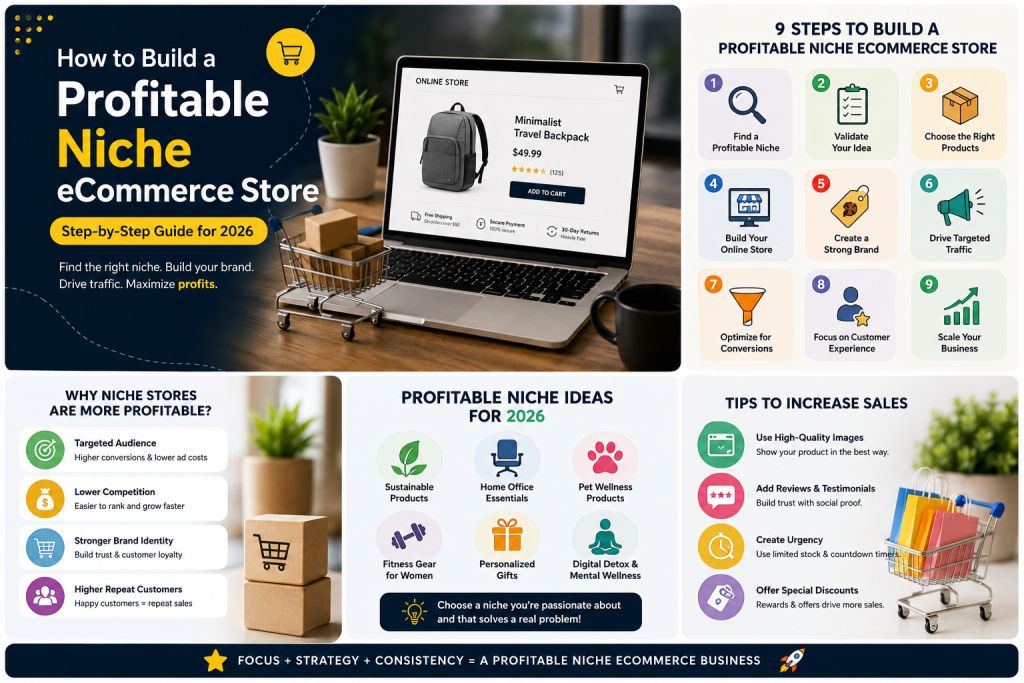
Why Niche Stores Are More Profitable
The logic held by many novice businesspeople that a greater number of products will generate higher sales revenue is completely untenable.
Niche stores can outcompete in the marketplace high conversion rates controlled advertising costs strong brand recognition high repeat purchase rates
The small store I previously worked at exclusively sold ergonomic laptop stands and catered to remote workers. Its sales outperformed those of general electronics stores after only four months, and the core reason for this outcome was its clear market positioning.
Step 1: Find a Profitable Niche
This article suggests that entry-level content creators and entrepreneurs should select a niche track that meets three core criteria: passion, demand fulfillment, and demand growth.
How to Find Winning Niches
This paper proposes that when screening niche tracks, three core criteria must be satisfied:
- Passion-driven orientation,
- Problem-solving capacity, and
- Growing demand.
Current mainstream and popular consumer sectors include:
- Sustainable products,
- Work-from-home supplies,
- Pet health products,
- Customized gifts, and
- Mental wellness products.
This study analyzes three categories of optional tools:
- Google Trends,
- Amazon Best Sellers, and
- Reddit communities.
A friend of mine identified demand from mental health forums, leveraged the undersaturated market to produce anti-anxiety rings, and generated six-figure revenue from his online store in less than a year of operation.
Step 2: Validate Your Idea Before Investing
Never skip any specified steps in order to save time and money.
Four verifications must be completed before launching a startup:
- Researching competing products,
- Testing SEO demand,
- Running small-scale advertisements, and
- Conducting pre-sales prior to stocking inventory.
Signs: Consumers who have purchased the product have submitted reviews, and the advertisement remains active online.
Step 3: Choose the Right Products
Not all products are homogeneous.
This study proposes that product selection for cross-regional cross-border retail must meet four core mandatory standards, including:
- Lightweight design,
low price, - Solves any problem, and
- Not easily available
Three Categories which should be avoided:
- Fragile Items,
- Highly Regulated Goods, and
- Low-Margin Goods
Step 4: Build Your eCommerce Store
Your store is a digital exhibition hall.
Platforms to Use:
- Shopify (beginner-friendly),
- WooCommerce (more control)
Shopify is easy to use, while WooCommerce is flexible.
The core optimization directions for e-commerce sites include:
- clean design,
- mobile compatibility,
- clear descriptions,
- high-definition images, and
- trust marks.
Rewriting product descriptions to center on user benefits can double sales revenue and help consumers clarify the product’s core value.
Step 5: Create a Strong Brand
This household cookware is made of food-grade stainless steel, and is safe and reliable.
Brand is the core of e-commerce tiering.
Consumers do not only purchase physical products; more importantly, they purchase stories.
- What was your original goal for opening your store?
- Who do you aim to serve?
- What problems do you want to solve?
I have long observed that a niche skincare brand built emotional connections with users through its founder’s sharing of his personal acne treatment journey, earned their trust, and subsequently achieved rapid growth.
Step 6: Drive Traffic (The Growth Engine)
Foot traffic equals sales revenue.
Top Traffic Sources
1. Organic (Free)
SEO blog,
Pinterest marketing,
Instagram reels
2. Paid Ads
Facebook,
Google,
TikTok
3. Influencer Marketing
Partner with micro-influencers in your niche.
Step 7: Optimise for Conversions
Traffic acquisition are only half job done for all business operations.
E-commerce operators can boost their order conversion rates by:
- Creating scarcity,
- Setting first-time purchase discounts,
- Reusing buyer reviews, and
- Simplifying the checkout process.
Example:
This retail store added two additional types of marketing reminder messages, i.e. “Only 7 items left!” and “4.8⭐ rated by 1,200+ customers” and its overall sales revenue rose by 30%.
Step 8: Focus on Customer Experience
Customer satisfaction equals repeat purchase.
Improve Customer Experience by:
- Fast shipping,
- Easy returns,
- Quick support,
- Follow-up emails
Recommendations for Growth-Stage
Launch user reward schemes, distribute exclusive offers, and gather user feedback.
Brands: Increase Advertising Budgets, Expand Product Lines, Build Email Funnels, and Implement Operational Automation
Step 9: Scale Your Business
Once you start making consistent sales, scale smartly:
- Advertising budgets may be increased incrementally,
- Product lines expanded,
- Email funnels established, and
- Automated operations advanced.
Core profit models of retail e-commerce:
- Upselling,
- Cross-selling,
- Subscription, and
- Private labels.
Common Pitfalls to Avoid for Small and Medium-Sized Vertical Startups:
❌ Choosing overly broad market tracks
❌ Neglecting brand building
❌ Blindly copying competitors
❌ Skipping product testing
❌ Giving up too early
Final Thoughts: The Reality of Success
Many entrepreneurs mistakenly believe that building a profitable niche e-commerce business can bring them overnight wealth.
In fact, this is an operational system that requires continuous refinement. I personally tested three niche tracks, two of which failed due to a total lack of sales and wasted advertising budgets. The core requirement for success is to gain an in-depth understanding of one’s audience, and there are three guiding principles:
- Focus on solving real problems,
- Maintain consistency, and
- Learn from failures.
Conclusion
The core practical guidelines proposed by the author cover clarity, strategy, and execution, which require accurately selecting a niche track to verify feasibility, starting small to conduct lightweight trial and error, and continuously delivering value.
There are two Key takeaways: one must persevere and never give up prematurely.
About the Author