The Surge of Viral Fitness Challenges
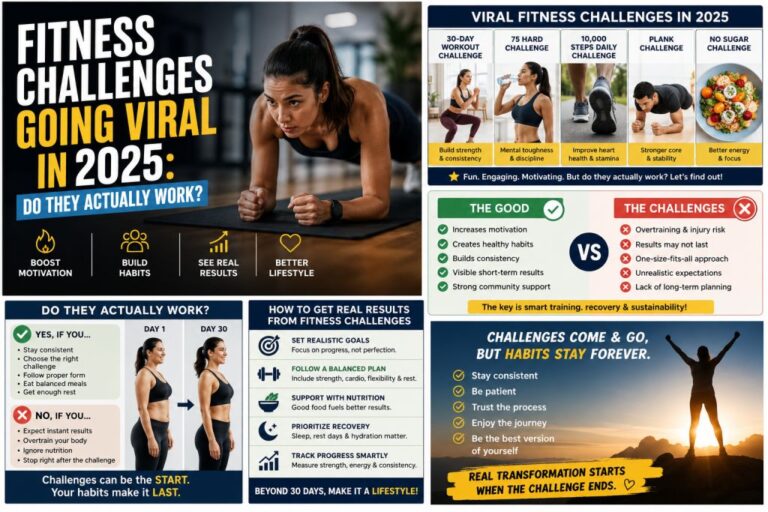
Browsing platforms like Instagram, YouTube, or Threads in 2025 reveals an abundance of fitness challenges. These programs frequently promise significant transformations in just 7, 14, or 30 days. Ranging from the daily “10,000 steps” goal to the intense “75 Hard” program and demanding core routines, these trends currently dominate social media feeds.
However, the central question remains:
Do these viral fitness challenges yield actual results, or are they merely internet hype?
Let us examine this topic using practical experience, real-world insights, and scientific evidence.
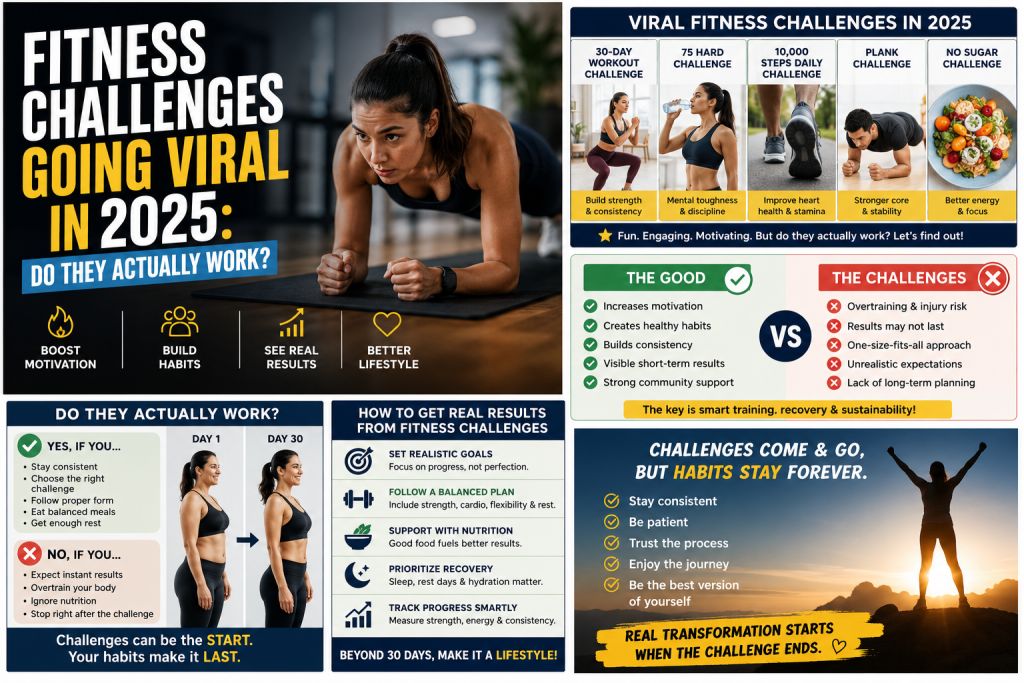
What Are Viral Fitness Challenges?
The viral fitness challenges that emerged in 2025 as standardized training programs to be completed within a specified time limit, and will subsequently analyze the core characteristics of this type of program.
- Brief durations: Usually spanning 7 to 30 days.
- Strong visual elements: Emphasizing before-and-after transformations.
- Social media integration: Driven largely by online platforms.
- Community engagement: Utilizing hashtags and group involvement.
The following are generally recognized as typical case.
- 30 Days Workout Challenge
- 75 Hard Challenge
- Plank Challenge
- 10K Steps Daily Challenge
- No Sugar / Clean Eating Challenges
Why did personal growth challenge, which trended to widespread fame in 2025, become so well-received?
There are four core reasons:
1. Instant Motivation
The general public widely prefers quick results, so various types of communication messaging focused on the “30-day transformation” concept have become extremely common.
2. Social Accountability
Sharing daily progress can build a sense of accountability, and also sustain consistent action throughout the entire course of related work.
3. Community Support
You are not participating alone. Thousands of participants from all locations are joining this exact same challenge alongside you.
4. Low Entry Barriers
These types of challenges are highly accessible, requiring little to no equipment to participate in.
The Scientific Perspective: Are They Effective?
The answer to this question is a combination of “yes” and “no”.
When They Are Successful
The benefits of fitness challenges come with their own prerequisites:
- Newcomers with zero baseline exercise experience who wish to start and sustain an exercise routine must have initial motivation.
- Be able to commit consistently.
- Set practical, achievable goals.
Research from the American College of Sports Medicine shows that short-term structured exercise can boost exercisers’ motivation to participate in workouts, and is particularly effective at improving exercise adherence among novice exercisers.
External nudges during the fitness initiation phase can help users start their fitness activities, and deliver extremely high value.
They provide the necessary push to help you start your fitness journey, which is a highly valuable benefit.
When They Are Ineffective
Issues typically arise when:
- The challenge is excessively demanding.
- Rest and recovery are neglected.
- Unrealistic outcomes are promoted.
- All efforts cease immediately upon completion.
According to a study published in the Journal of Behavioral Medicine, short-term motivation frequently diminishes if long-term habits are not established.
Consequently, this means you risk losing your progress just as rapidly as you achieved it.
Real-Life Observation
One of my friends participated in the 30-day ab challenge hosted on social media platforms, and his progress throughout this challenge will be outlined in the following content.
- Week 1: Highly motivated
- Week 2: Noticeable improvements in strength
- Week 3: Onset of fatigue
- Week 4: Mild back discomfort
Participants in this study who followed this study protocol consistently for a full month achieved improvements; most of these gains faded after they stopped training for two weeks.
The core reason for the rapid decline of this challenge is the failure to incorporate the necessary elements:
- Recovery
- Full-Body Physical Training
- Long-Term Strategy
Hidden Issues in Viral Fitness Challenges
1. The “One-Size-Fits-All” Flaw
Every body is unique. A routine that yields results for one individual might not be effective for someone else.
2. Danger of Overtraining
Engaging in rigorous, daily exercise without proper recovery periods frequently results in physical injuries.
3. Distorted Expectations
A large number of online physical transformations are actually manipulated by:
- Lighting techniques
- Camera angles
- Digital editing
- Unmentioned dietary modifications
4. Absence of Customization
These programs fail to make necessary accommodations for a participant’s age, baseline fitness, or underlying medical conditions.
What Truly Makes a Fitness Challenge Successful?
A comprehensive daily fitness plan must include strength training, aerobic training, flexibility training, and scheduled rest days.
✔️ Progressive Overload
Steadily increasing the workout intensity as time goes on.
✔️ Well-Rounded Routine
Your plan should incorporate:
- Strength training
- Cardiovascular exercise
- Flexibility work
- Scheduled rest days
✔️ Sustainable Timeframe
A 30-day program is a solid start, but you must consider your long-term plan afterward.
✔️ Nutritional Guidance
Optimal fitness results cannot be achieved without an appropriate diet.
✔️ Proper Recovery
Adequate sleep and rest are equally as vital as the exercises themselves.
The Most Effective Types of Fitness Challenges
1. Habit-Forming Challenges
Example: Walking 10,000 steps a day.
Benefit: Establishes long-lasting consistency.
2. Strength-Building Challenges
Example: Adding more push-ups each week.
Benefit: Enhances actual physical fitness.
3. Lifestyle Modification Challenges
Example: Eliminating sugar for 30 days.
Benefit: Positively affects general health.
4. Hybrid Challenges
Method: Integrating exercise, nutrition, and rest.
Benefit: Offers the greatest long-term effectiveness.
Transforming a Viral Challenge into Genuine Results
Rather than simply jumping on the latest trend, consider these strategies:
Step 1: Adapt the Challenge
Tailor the intensity to match your current level.
Step 2: Incorporate Rest Days
Taking time to recover helps prevent injuries and enhances overall performance.
Step 3: Monitor Progress Intelligently
Avoid focusing solely on your weight. Be sure to measure your strength, energy levels, and endurance as well.
Step 4: Continue Past 30 Days
Transition the challenge from a short-term fix into a sustainable lifestyle.
Step 5: Prioritize Proper Form
Using incorrect technique can lead to injuries and hinder your overall results.
Expert Perspectives: Trainer Recommendations
The majority of certified trainers share a common view:
- “While fitness challenges serve as excellent starting points, they are not sustainable long-term solutions.”
The crucial element is the development of habits.
As noted by Harvard Health Publishing, establishing enduring health habits requires setting realistic goals and maintaining consistent repetition.
Quick Comparison: Viral vs Sustainable Fitness
| Factor | Viral Challenges | Sustainable Fitness |
|---|---|---|
| Duration | Short-term | Long-term |
| Motivation | High initially | Steady |
| Risk | Higher | Lower |
| Results | Quick but temporary | Slow but lasting |
| Personalization | Low | High |
The Reality: Are They Worthwhile?
- Yes, provided they are utilized properly.
- No, if you anticipate miraculous results.
It is best to view viral fitness challenges as:
- An initial step, rather than an ultimate solution.
- A motivational aid, rather than a comprehensive workout regimen.
An Improved Strategy for 2025
Avoid chasing new trends; adopt this set of methods.
- Start with small
- Controllable goals
- Build stable routines
- Add variations anchor long-term well-being.
Keep in mind:
- 30-Day Crash Fitness Schemes Constitute Misleading Industry Claims; Long-Term, Sustainable Daily Habits Are the Correct Approach
FAQs
1. Is it possible to lose weight by doing a 30-day fitness challenge?
Yes, though your outcome will vary based on your nutritional habits, level of consistency, and initial fitness level.
2. Are trending fitness challenges safe to try?
Not necessarily. Challenges that are overly strenuous can lead to physical injuries.
3. How frequently should I participate in fitness challenges?
They should be used periodically to increase motivation rather than serving as your primary workout regimen.
4. Which types of challenges are most suitable for beginners?
Straightforward activities such as walking, fundamental strength exercises, or stretching routines are ideal.
Final Thoughts
While fitness challenges in 2025 are enjoyable, motivating, and highly popular, they are not miracle solutions.
The true key to success is simple:
- Consistency outweighs intensity.
- Long-term habits outlast temporary hype.
- Sustainable practices are more effective than quick shortcuts.
When utilized thoughtfully, viral challenges can serve as an excellent catalyst to jumpstart your health routine. Ultimately, however, genuine transformation takes place long after the challenge concludes.
About the Author