Firms may choose either the D2C model or third-party platforms.
Model selection will significantly impact the three core business elements of user growth, profitability, and brand identity.
This paper first unpacks the definitions of D2C and third-party online marketplaces, compares their differences, analyzes their respective strengths and weaknesses, and introduces case examples to assist merchants in selecting the suitable model.
What is a D2C (Direct-to-Consumer) Brand?
Examples:
- A clothing brand selling exclusively via its own website
- A skincare company using Instagram alongside its own Shopify store
Key Characteristics:
- Complete control over branding and customer experience
- Direct communication with customers
- No intermediaries involved
D2C brands sell products directly to customers through their own official websites, mobile applications, and physical stores.
Apparel brands only sell their products through their own official online websites, while skincare brands simultaneously operate their Instagram (Ins) accounts and self-built Shopify sites.
Examples:
Amazon
Flipkart
Etsy
Key Characteristics:
- Large, established customer base
- Built-in trust and logistics support
- Highly competitive environment
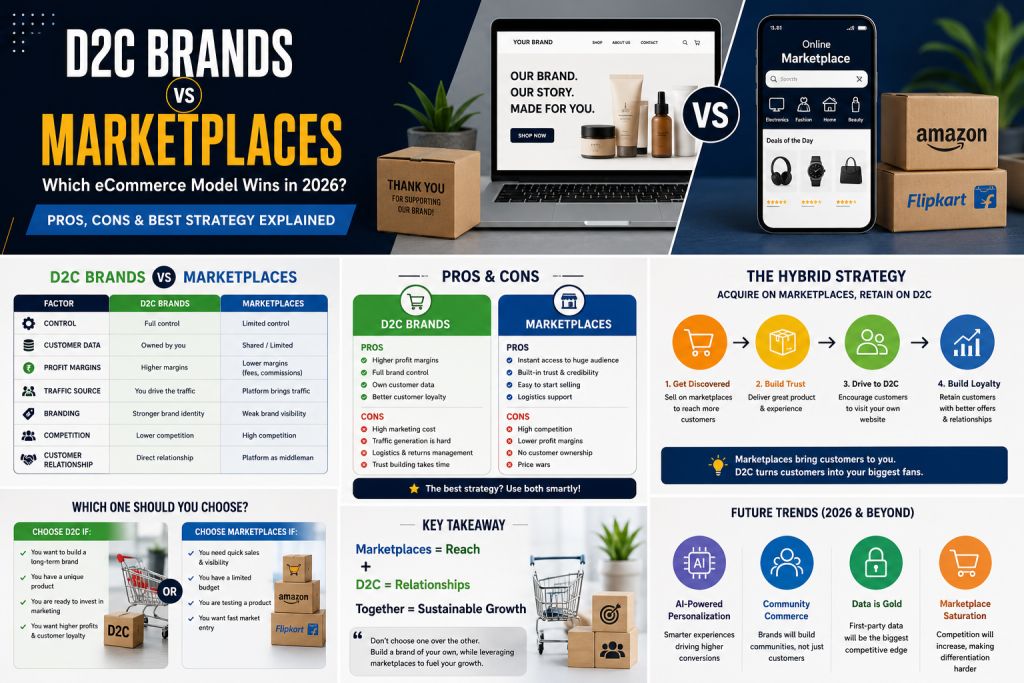
D2C vs Marketplaces: The Core Difference
| Factor | D2C Brands | Marketplaces |
|---|---|---|
| Control | Full control | Limited |
| Customer Data | Owned | Shared/limited |
| Profit Margins | Higher | Lower (fees) |
| Traffic | Self-driven | Platform-driven |
| Branding | Strong | Weak |
| Competition | Lower | High |
The Emergence of D2C Brands: Why It’s Gaining So Much Attention
Direct-to-consumer (D2C) has become the dominant force in the e-commerce sector.
Why is this the case?
Social platforms such as Instagram and TikTok can help brands simplify their connections with their audiences.
By eliminating intermediaries, brands can retain higher profits to improve their overall profit margins.
A small skincare startup stabilized its sales volume by leveraging traffic from third-party e-commerce platforms, but soon encountered operational challenges.
A Real-World Example
Subsequently, the entity in question launched its own official direct-to-consumer (D2C) website.
What were the results?
- Price undercutting
- Weak brand identity
Core growth priorities of this e-commerce project: increase the returning customer rate by 40%, build an email subscription list, and launch bundled add-on sales.
This e-commerce company acquires customers by relying on third-party marketplace platforms, but uses its own direct-to-consumer (D2C) channels to undertake its core user retention operations.
Avoid the maximum 30% commission charged by marketplaces, and earn higher profit margins.
Development of an email subscriber list
Introduction of product bundles and upsell opportunities
It provides brands with comprehensive brand management, covering design, communication, pricing, and end-to-end experience.
Holding ownership of customer data enables businesses to build email lists, conduct retargeting marketing, and customize personalized offers.
Benefits of D2C Brands
At present, online user acquisition is extremely difficult, and three categories of key supporting operational investments must be put in place.
The brand owner bears all logistics-related responsibilities, including transportation, product returns and exchanges, and customer service.
Establishing trust undoubtedly takes time, and new brands face difficulties in building public credibility during the initial stages of their development.
Stronger Customer Relationships
Direct engagement fosters greater loyalty and trust.
Challenges of D2C
Driving Traffic Is Difficult
It requires investment in SEO, advertising, and social media efforts.
Logistics Responsibility
Managing shipping, returns, and customer support falls on the brand.
Building Trust Takes Time
New brands may find it challenging to establish credibility initially.
When to Opt for D2C
To build a successful brand, one must first establish strong brand recognition, launch unique products, secure adequate marketing investment, and pursue long-term sustainable growth.
When to Choose Marketplaces
Merchants’ Core Demands: Fast sales, low budget, new product, and testing market expansion.
Market saturation intensifies competition and sharply raises the difficulty of achieving a business breakthrough.
First-party data is a valuable asset for D2C brands, and changes to privacy regulations will enhance its core importance.
- Your budget is limited
- You are testing a new product
- You want rapid market entry
Future Trends (2026 and Beyond)
AI-Driven Personalization
D2C brands will leverage AI to deliver highly personalized experiences.
Community Commerce
Brands will focus on building communities rather than just acquiring customers.
Marketplace Saturation
Increased competition will make standing out more challenging.
First-Party Data as a Valuable Asset
Changes in privacy regulations will enhance the importance of first-party data for D2C brands.
A Perspective That Transformed My Understanding
I once thought marketplaces were sufficient. Why create a website when platforms already have customers?
But then I realized something crucial:
👉 Businesses that depend solely on marketplaces generate revenue, not a brand.
- On the other hand, businesses that focus on building a brand…
- ultimately gain control over their revenue.
This insight changed my view of e-commerce completely.
So, which approach is better for your business? Let’s break it down.
There’s no one-size-fits-all answer, but your best path is clear.
- D2C = Long-term brand growth + higher profit margins
- Marketplaces = Short-term sales boost + faster expansion
Recommended Strategy?
Begin with marketplaces. Develop your D2C presence. Then, shift your focus firmly toward your brand.
Summary:
The choice between D2C brands and marketplaces isn’t about picking one over the other. It’s about using each model strategically throughout your business journey.
For quick results, marketplaces are effective.
For sustainable success, D2C is essential.
But to truly lead in 2026…
Leverage both models strategically to achieve dominance.
About the Author