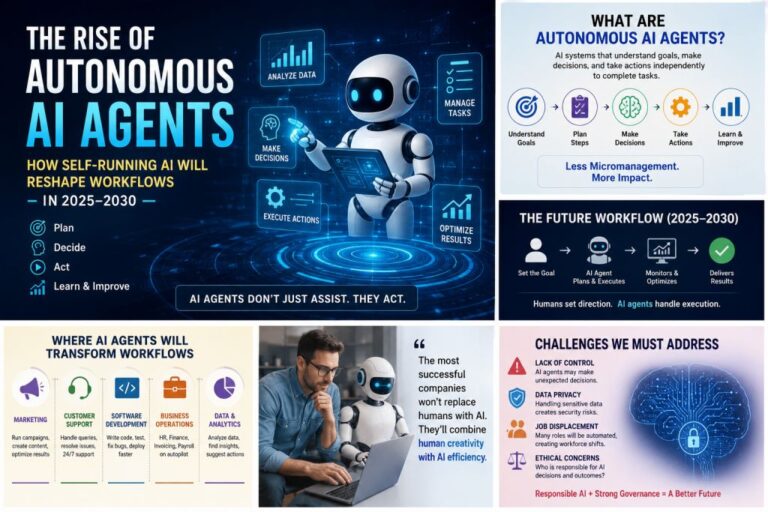
Introduction: The Dawn of a New Professional Landscape
The development of artificial intelligence has long gone beyond the scope of basic automation. While four of its core capabilities have already been put into practical use, breakthroughs for the next generation of autonomous AI agents are still being pursued.
Such systems are by no means passive tools. They can autonomously carry out planning, decisionmaking, and execution tasks, requiring only minimal human intervention.
Between 2025 and 2030, autonomous AI agents will transition from an initial stage limited to only assisting with single tasks to an advanced form that proactively coordinates and manages full work processes.
This paper will sequentially analyze the operating mechanism of the advanced system, explain its significance, and examine its impacts.
Understanding Autonomous AI Agents
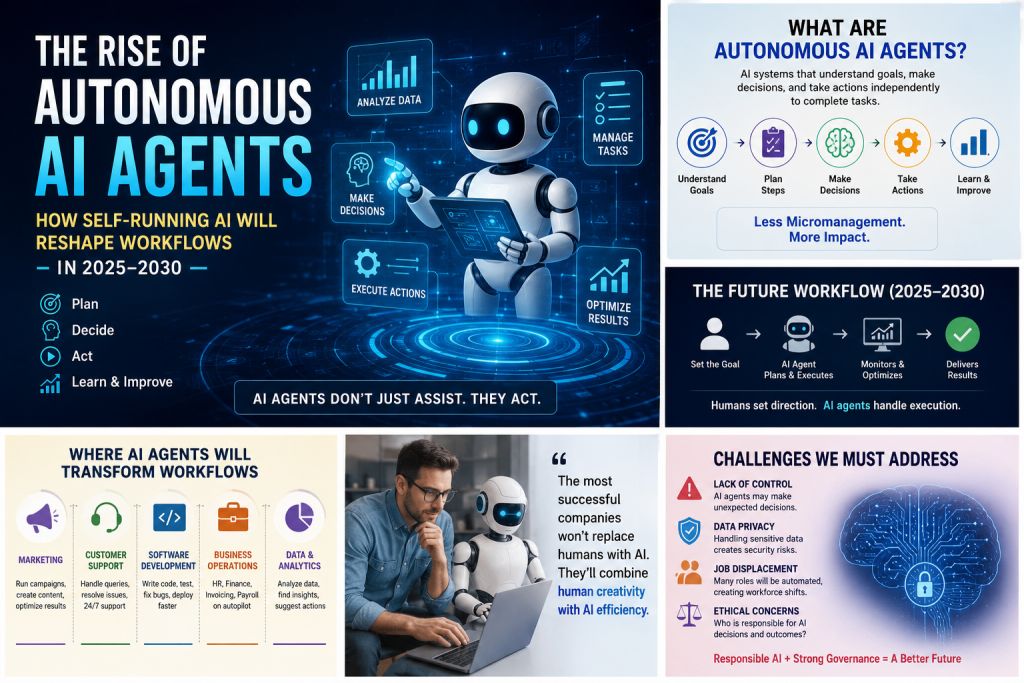
Autonomous AI agents are a class of advanced software systems that can:
- Understand goals
- Decompose tasks
- Formulate decisions
- Execute actions
- Conduct retrospective review and optimization.
Traditional and conventional AI tools have weak autonomy, while new types of AI agents exhibit superior performance.
A Basic Example:
Do not merely task AI with drafting emails in a vague, general manner; you must provide sufficiently specific requirements.
For Example:
Instead of asking AI to “write an email,”.
You can say: “Launch a marketing campaign for my product.”
Autonomous AI agent can do:
- Audience analysis
- Content generation
- Material production
- Scheduled release
- Indicator monitoring and
- Iterative optimization.
The entire set of operation procedures described above can be completed normally without requiring continuous human intervention.
The Reasons Behind the Current Rise of Autonomous AI Agents
1. Sophisticated Language Models
Contemporary AI platforms are highly capable of grasping context, underlying intent, and intricate commands.
2. Seamless API Connections
Artificial intelligence can now easily link with various external platforms, including CRM software, email clients, databases, and cloudbased programs.
3. Enhanced Memory Capabilities
These agents are able to recall data from previous interactions, allowing them to refine and enhance their capabilities over time.
4. Cooperative MultiAgent Frameworks
Distinct AI agents can now work together efficiently, operating much like an organized and unified team.
RealLife Insight: An Observed Turning Point
During a recent project with an eCommerce brand, the team encountered difficulties managing product listings across various platforms.
Prior to AI Implementation:
- Three team members were dedicated to daily updates.
- Errors occurred frequently.
- Product listings lacked consistency.
After Integrating a SemiAutonomous AI Workflow:
- The system automatically managed product uploads.
- It optimized product titles utilizing SEO keywords.
- It adjusted prices dynamically based on competitor data.
The Results:
- A 70% reduction in time spent on manual tasks.
- Improved search engine rankings.
- A significant decrease in human errors.
Although this system was not entirely autonomous, it clearly illustrated the immense potential of future technological advancements.
The Transformation of Workflows by Autonomous AI Agents (2025–2030)
1. Fully Automated Marketing
AI agents will take over the digital marketing tasks of campaign planning, content production, ad A/B testing, and budget optimization.
As a result, marketing practitioners will undergo a role shift, moving from their previous focus on daytoday execution to prioritizing the overall coordination of highlevel strategy and creative direction.
2. Complete Automation of Customer Support
Artificial intelligence agents will be responsible for:
- Managing customer inquiries
- Troubleshooting and resolving problems
- Escalating only the most complicated cases to human staff
Consequently, this transition will result in:
- Quicker response times
- Roundtheclock assistance
- Decreased operational expenses.
3. Accelerated Software Development
AI agents will take over routine tasks by:
- Writing code
- Testing applications
- Resolving bugs
- Deploying updates
Consequently, developers will be able to prioritize system architecture and creative innovation over repetitive coding duties.
4. Business Operations Will Become Fully Automated
The AI agent applications can cover areas ranging from human resources to core financial business domains which will:
- Screen candidates
- Distribute salaries
- Manage invoices
- Forecast budgets.
Therefore, based on the derivation of all causal foundations laid out in the preceding discussion, the operational efficiency of small and micro enterprises will match that of large, scaled enterprises.
5. Data Analysis Will Become Instantaneous
Rather than waiting days for reports to be generated, AI agents will:
- Gather data
- Evaluate trends
- Produce insights
- Recommend actions
As a result, decisionmaking will become a realtime, datadriven process.
The Evolution of Human Roles
Autonomous artificial intelligence will not completely replace human labor, but it will profoundly reshape the global professional landscape.
Declining Roles:
- Data entry
- Routine customer service
- Manual report generation
Expanding Roles:
- AI oversight and management
- Strategic planning
- Creative innovation
- Ethical compliance and governance
Ultimately, the professionals of tomorrow must focus on directing AI technologies rather than attempting to rival them.
Primary Advantages of Autonomous AI Agents
1. Significant Productivity Increases
Assignments that previously required days to complete can now be finished in mere minutes.
2. Decreased Expenses
Minimizing manual labor directly reduces overall operational costs.
3. Enhanced Precision
Artificial intelligence significantly minimizes the risk of human error.
4. Improved Scalability
Organizations can expand their operations efficiently without the need to proportionally grow their staff.
Challenges and Risks
The risk of loss of control arises from unforeseeable decisions made by fully autonomous systems.
1. Lack of Control
Fully autonomous systems have the potential to make unforeseen or unpredictable decisions.
2. Data Privacy Vulnerabilities
The processing of sensitive information by AI agents can introduce significant security risks.
3. Job Displacement
A substantial number of employment roles face the prospect of being replaced by automation.
4. Ethical Dilemmas
Establishing accountability remains a complex issue when an AI agent makes an incorrect choice.
A Valid Concern: A Scenario That Prompts Questions
Consider an AI agent tasked with managing financial investments. It detects a market trend and autonomously transfers substantial amounts of money. However, because the underlying data is slightly flawed, the AI’s decision ultimately results in financial losses.
This situation raises a critical question regarding accountability: Who is responsible? Is it the software developer, the deploying company, or the AI itself?
For this very reason, establishing robust governance and regulatory frameworks will be crucial between the years 2025 and 2030.
How Companies Can Prepare
1. Begin Gradually
Pilot AI agents within restricted operational processes.
2. Prioritize Integration
Link AI systems seamlessly with your current suite of tools.
3. Educate Your Staff
Equip employees with the necessary training to collaborate efficiently with AI.
4. Establish Strict Guidelines
Maintain human supervision over all essential business decisions.
The Future: Human and AI Synergy
The most prosperous organizations will not be those that substitute their human workforce with artificial intelligence. Rather, they will be the ones that merge human ingenuity with the streamlined efficiency of AI.
Consider this framework:
- Humans establish the strategic vision.
- AI manages the practical execution.
This collaborative dynamic will define business achievement over the next ten years.
Conclusion: The Quiet Revolution
Autonomous AI agents are no longer merely a future concept; they are already a reality.
Between 2025 and 2030, they are set to:
- Reshape industries
- Transform job roles
- Drive rapid innovation
The debate over whether AI will alter our workflows has ended.
The true question is:
- Are you prepared to adjust?
Those who embrace working alongside AI today will emerge as the leaders of the future.
FAQs
1. What is an autonomous AI agent?
It is an artificial intelligence system that can complete tasks independently without continuous human intervention.
2. Will it replace human jobs?
It will only substitute some repetitive work tasks, and will not fully replace core human work.
3. Is its security guaranteed?
Currently, relatively mature basic risk control frameworks are in place to constrain its use.
4. Which industries can benefit the most from it?
Fields with high levels of digitalization, including mainstream ecommerce, customer service, and operation and maintenance.
Final Thought
Humanity is entering a brandnew stage of development, where machines are no longer limited to only carrying out auxiliary work, and are able to take independent actions.
Identifying technological shifts in advance enables us to build a future that serves humanity.
About the Author