The science-based, realistic guide to living better with less
Minimalism: More Than Just Aesthetics — Introduction
Today, stress is common. With constant notifications and full closets, it’s way too easy to feel overwhelmed. Minimalist living is not just a trend; it’s a lifestyle that fosters mental and physical health.
But does having less stuff actually reduce stress hormones such as cortisol? Can having fewer possessions really improve your well-being?
In this blog, we will look at how a minimalist lifestyle impacts stress hormones and overall well-being, using the science behind (and new studies), practicality tips and true stories.
What Is Minimalist Living?
A minimalist lifestyle is owning and doing less to focus on what really with intention. It’s not a deprivation; it’s about clarity, purpose and freedom.
Key principles:
- Decluttering physical space
- Reducing digital noise
- Prioritising meaningful relationships
- Spending consciously
- Simplifying daily routines
Stress Hormones Explained: The Role of Cortisol
Now, before discussing how minimalism can help, let’s first go over what stress does to your body.
Cortisol, sometimes known as the stress hormone, is released by your adrenal glands when you are under pressure or threat. While this is useful in short bursts, chronically high cortisol levels can cause:
- Anxiety and depression
- Poor sleep quality
- Weight gain
- High blood pressure
- Weakened immunity
Cortisol levels remain high for extended periods due to modern lifestyles.
How Minimalist Living Lower Levels of Stress Hormones
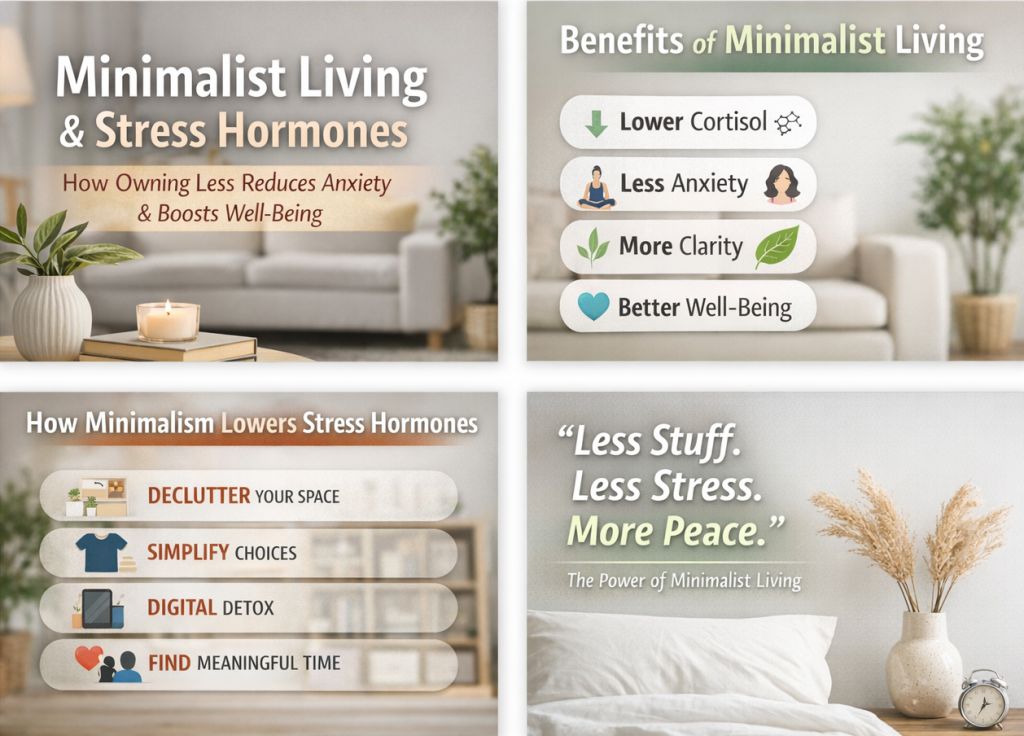
1. Decluttering Lowers Mental Overload
Studies from environmental psychology suggest that clutter vies for your attention, raising cognitive load and stress.
When your surroundings are messy:
- Your brain processes more stimuli
- Focus decreases
- Cortisol levels rise
Minimalist spaces, by contrast:
- Promote calmness
- Improve concentration
- Reduce decision fatigue
Real-life insight:
A friend who works from home previously suffered from anxiety and burnout. Clutter and papers made her desk overcrowded with unused items. After moving to a minimalist workspace — with only her laptop, notebook and one plant — she said she felt “mentally lighter” in a matter of days. She said she was more productive and slept better.
2. The Fewer Choices, The Less Decision Fatigue
We make thousands of decisions every day — from what to wear to what to eat.
Too many choices lead to:
- Mental exhaustion
- Increased cortisol
- Reduced self-control
Minimalism simplifies choices:
- Capsule wardrobes
- Streamlined routines
- Limited distractions
This releases mental pressure and helps maintain stress hormones in balance.
3. Financial Simplicity Reduces Chronic Stress
Money is one of the biggest stress triggers globally.
Minimalist living encourages:
- Conscious spending
- Avoiding unnecessary purchases
- Saving more
That lessens financial worry, helps with sleep and lowers long-term exposure to cortisol.
👉 Personal observation:
When I stopped impulse spending and bought only what I absolutely needed, that changed drastically. My financial issues not only improved, my mindset changed too. I was more in control and less anxious, and surprisingly, happier.
4. Digital Minimalism Improves Mental Health
We drown under notifications, emails and social media.
This digital clutter:
- Triggers dopamine spikes and crashes
- Increases anxiety
- Disrupts sleep cycles
Examples of minimalist digital habits are reducing screen time, unfollowing useless accounts and disabling unnecessary notifications.
These changes help:
- Lower cortisol
- Improve focus
Enhance emotional well-being
5. More Time for Meaningful Activities
With less to own, and to do, you have more time and energy.
Minimalism creates space for:
- Exercise
- Meditation
- Quality time with loved ones
- Creative pursuits
These activities have been scientifically shown to:
- Reduce cortisol
- Increase serotonin and dopamine
- Improve overall happiness
Scientific Proof That Supports Minimalism towards your Stress Levels
There are multiple studies that strengthen the link between environment, lifestyle and stress:
- UCLA’s Centre on Everyday Lives of Families found a link between cluttered homes and high cortisol levels, particularly in women.
- In the Journal of Environmental Psychology, research has shown that organised spaces enhance mental clarity and lower stress levels.
- The studies of mindfulness and simplicity show that reducing distractions leads to greater emotional regulation and well-being.
Though minimalism itself is not always studied directly, its components — decluttering, mindfulness and intentional living — are correlated with reduced levels of cortisol.
Psychological Benefits of Minimalist Living
Aside from hormones, minimalism has psychological benefits:
- Increased Sense of Control
Possessing less contributes to a sense of life control.
- Reduced Anxiety
Less clutter means fewer reminders of unfinished business.
- Improved Focus
Clear spaces create clear minds.
- Greater Life Satisfaction
People say they feel more satisfied with less.
Physical Health Benefits
Lower levels of stress hormones result in actual physical changes:
- Better sleep quality
- Improved digestion
- Stronger immune system
- Reduced risk of chronic diseases
This helps stabilise the body’s responses to stress, indirectly supporting a healthier body.
Top Problems And How Minimalism Fixes Them
Problem 1: “I feel always overwhelmed.”
Solution: Begin with a single small area, such as your desk or wardrobe. Small wins build momentum.
Problem 2: “I don’t have the time to declutter.”
Solution: Try the 10-minute rule. Spend 10 minutes decluttering everyday.
Problem 3: “I’m emotionally attached to my possessions.
Keep genuinely valuable items. Take pictures of sentimental objects before parting with them.
Problem 4: “Minimalism feels like too much of a constraint.”
Solution: Minimalism is personal. It’s not about having less; it’s about having enough.’
A Non-Moving Experience: Less Became More
I have heard of a young professional who lost the majority of his belongings after he had a sudden move for a new job. Initially devastated, however, he found himself surprised to feel something else: freer.
Only armed with a suitcase of the basics:
- He had fewer worries
- He spent more time outdoors
- He reconnected with old hobbies
He called it “losing weight I didn’t know I was carrying.”
That story stayed with me. It revealed a simple truth: Sometimes, what we think we need burdens us.
Everything You Need to Know about Minimalist Living
- Start Small
Tackle one drawer or one shelf.
- Heed the “One In, One Out” Rule
Limit New Additions: For every new item, remove another one.
- Build a Capsule Wardrobe
Focus on versatile, essential clothes.
- Declutter Digitally
Unsubscribe and unfollow to newcomers.
- Create Tech-Free Zones
Keep your bedroom, or dining area, screen-free.
- Practice Mindful Buying
Ask: “Do I really need this?”
Final Thought: Is Minimalism Worth It?
Minimalist living isn’t one-size-fits-all. However, minimizing clutter and simplifying your environment may affect stress and enhanced well-being.
Narrowing your focus on what is truly important can help decrease stress hormones, improve the quality of your thinking and lift your mood.
Minimalism shines in its simplicity. You don’t have to transform your entire lifestyle; just make subtle, mindful changes.
Takeaway
When it comes to minimalism, less is not more.
It’s about opening space for more: more peace, more clarity and more life. Minimalism helps you be intentional about how you live, so that you can make room for the things that really matter to you, making a permanent difference in your stress level and happiness.
About the Author