Data is flowing across borders more than ever and accounts for a significant portion of international trade in the digital economy today. From a small e-commerce seller in India to a multinational firm, there is not one digital transaction which does not depend on cross-border data flow. The key question: How do we regulate data across borders in a way that builds trust, establishes privacy and security, while still complying with different laws on the books?
The cross-border data governance mechanisms, also the International Digital Trade Law is central to the topic Their frameworks are critical to balancing innovation and oversight, and enabling secure, responsible data flows at scale.”
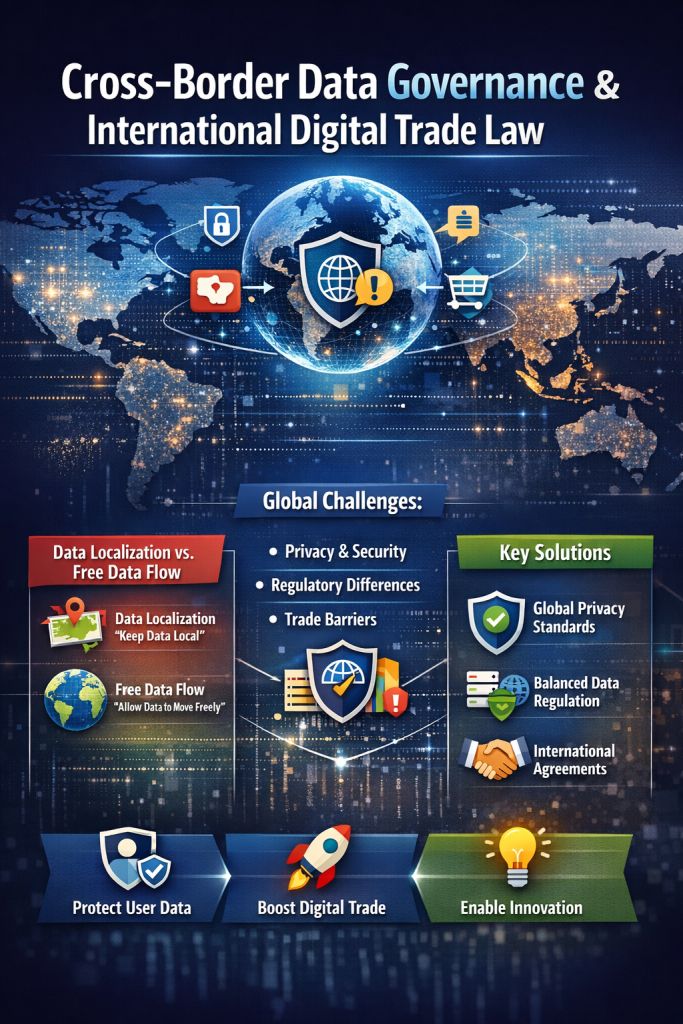
The Situation is Getting Much Worse and the Importance of Cross-Border Data Governance
An online retailer in India selling handmade garments in Germany, the U.S., and Australia must handle personal data such as names, addresses, payment details, etc. Each country has its own separate laws dictating how to store, process, and protect this data.
Without proper governance:
- Legal risks and penalties Businesses are not immune
- Consumers lose trust
- Governments worry about data sovereignty
For example, a mid-sized SaaS business that breached GDPR compliance laws found itself facing legal barriers to entry into Europe, stalling growth for months by this issue alone. This proves that data compliance has become a fundamental component of business success.
Understanding International Digital Trade Law
International digital trade law is the area of jurisprudence that governs the movement of various types of digital goods, services, and data across national borders. It includes:
- Data protection laws
- Trade agreements
- Cybersecurity rules
- Ownership rights in the digital environment
Digital trade chapters in global free trade agreements are becoming more and more powerful drivers of international cooperation everywhere.
These laws aim to:
- Promote seamless data flows
- Prevent unfair data restrictions
- Protect consumer rights
- Enable innovation
But a significant hurdle comes from fragmentation in regulation, as countries retain different rules.
The Great Divide: Data Localisation Vs Free Flow Of Data
Perhaps the largest debate in digital trade these days is between:
✔ Data Localisation
Countries are demanding that data be kept on their soil.
Governance: For national security, for improved law enforcement access, or to safeguard citizen data.
✔ Free Flow of Data
Firms and trade advocates argue for talks on unfettered cross-border data flow.
Why businesses support it:
- Lower costs
- Better efficiency
- Global scalability
Key Challenges in Data Governance
Too much localisation can:
- Increase operational costs
- Limit innovation
- Create trade barriers
Too much freedom can:
- Risk of privacy breaches
- Reduce regulatory control
We would need to establish a balanced global framework leading the path forward towards responsible data sharing, privacy and making sure businesses thrive.
Creating International Norms for Data Governance
Global standards are imperative to promoting digital trade but difficult to establish. Key areas needing attention include:
✔ Data Localisation Standards
Now, instead of strict localisation, countries can adopt the following:
- Conditional localising (only sensitive data stays in local store)
- Sentinel data zones (data given between states whose laws are basically comparable)
This hybrid method minimises operational friction while also maintaining regulatory oversight.
✔ Privacy Protection Frameworks
At the center of data governance lies privacy. Global standards should include:
- Clear user consent rules
- Data minimisation principles
- Transparency requirements
This won’t be easy, but organisations need to move away from a compliance mindset towards one founded on the principles of privacy-by-design.
Early implementation of privacy-by-design principles, for instance, has been beneficial for some startups in securing enterprise clients more quickly than would otherwise be possible as trust has become a significant competitive advantage.
✔ Digital Commerce Regulation
As digital trade expands, so do regulatory demands:
- Taxation of digital services
- Consumer protection in cross-border transactions
- Platform accountability
Rely on mutual aid and preventative social safety nets OVER regulation to stifle innovation while protecting workers.
Reality Check: Cost of Getting It Wrong
One prominent example involved a company that had expanded into multiple markets but failed to align its data practices with local legislation. They employed one global policy, blindly hoping it would be effective everywhere.
It didn’t.
They faced:
- Legal notices
- Customer complaints
- Loss of business partnerships
The realization of which, has not only cost money but also real trust that will definitely affect their business’s long-term growth.
On the flip side, early investment into compliance frameworks enables organisations to expand quickly globally and build credibility with regulators and customers.
Key Problems Businesses Face Today
✔ Regulatory Complexity
Different countries = different rules
Solution: Use modular compliance frameworks.
✔ High Compliance Costs
Legal teams, audits, infrastructure
Solution: Consider scalable compliance tech.
✔ Lack of Awareness
Most of these SMEs are often unaware of the global data regulations as well. Solution: Give tips and expert guidance.
Practical Solutions for Businesses
Organisations may consider the following strategies to address cross-border data governance:
✔ Create a Data Governance Plan
Define:
- What data do you collect
- Where it is stored
- Who can access it
✔ Adopt Privacy-by-Design
Build with privacy by default, not a second thought.
✔ Use Data Mapping Tools
Follow where data travels across systems and countries.
✔ Partner with Legal Experts
Especially when entering new markets.
✔ Stay Updated
Digital trade rules evolve at a brisk pace, where what is permissible today may not be in the near future.”
How Governments and Global Cooperation Can Help
No one country can solve these challenges alone. International collaboration is key.
Governments should:
- Align regulatory frameworks
- Support international agreements on digital trade
- Encourage interoperability of laws
Innovation is hindered by a fragmented regulatory system; streamlined innovation accelerates progress.
‘Governance’ in the context of cross-border data: what is it and how do we achieve it?
We expect several trends to shape the future of cross-border data governance:
✔ Regional Data Alliances Are Growing
Countries forming data-sharing partnerships.
✔ AI and Data Regulation
So do artificial intelligence systems, which rely on cross-border flows of data that require new forms of regulation.
✔ Stronger Cybersecurity Standards
Security will be non-negotiable.
✔ Data as an Economic Asset
Data has become valuable and strategic asset akin to oil.
Special Insight: The New Currency Will Be Trust
A review of a wide range of business experiences across the globe points to one abiding insight:
- The way forward in digital trade will have less to do with data management than with trust.
Companies that:
- Respect user privacy
- Follow transparent practices
- Comply with global standards
…will win in the long run.
Customer dedication that allows for sustainable business development is generally born of trust.
Conclusion
Cross-border data governance and international digital trade law are at the core of global economy. Now, more than ever as digital business expands, stakeholders should be on message to encourage policymakers to empower the development and adoption of clear, consistent and fair regulations.
- Developing global standards around localisation, privacy, and commerce regulation will be critical in establishing a system that protects users and empowers businesses while promoting innovation.
The key implication for businesses is:
- Organisations need to build responsible data practices rather than waiting for regulatory guidance.
In a world driven by data, those who conquer cross-border data governance will win. Establishing trust with accountable and progressive data frameworks is no longer optional; it’s the new imperative.
About the Author