What Are Blue Zones and Their Significance?
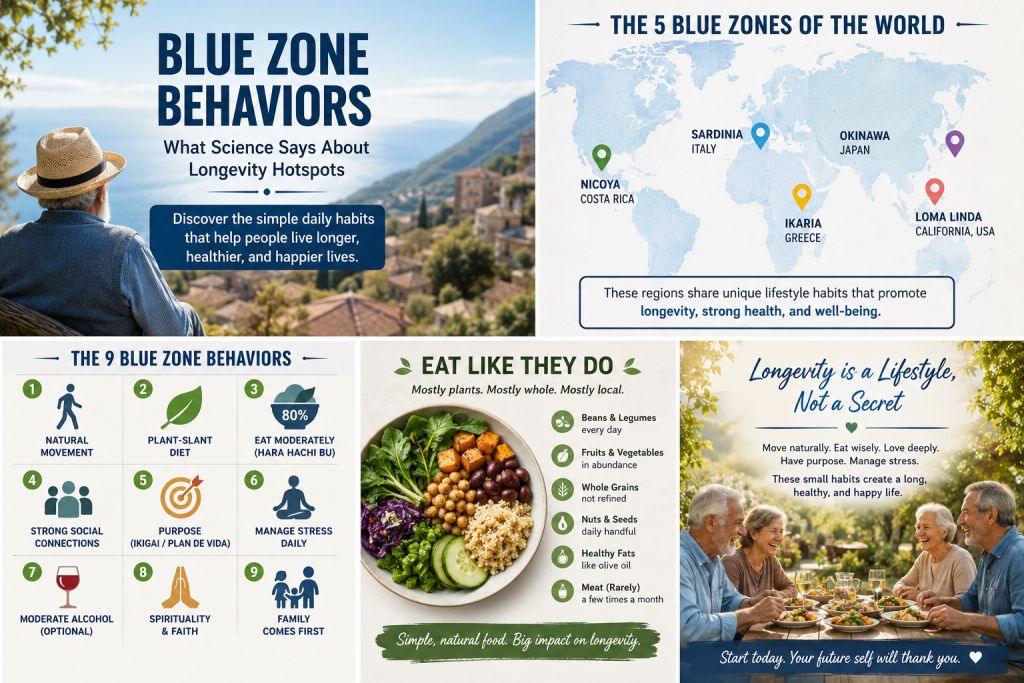
Imagine living to 90 or even 100 as a normal part of life, not an exception. This is the reality in areas known as Blue Zones—regions where people enjoy significantly longer and healthier lifespans. These zones include Sardinia (Italy), Okinawa (Japan), Ikaria (Greece), Nicoya (Costa Rica), and Loma Linda (California).
The term was popularized by researcher Dan Buettner, but further studies show that longevity is influenced more by daily habits than genetics alone.
This article explores scientifically supported Blue Zone behaviours and how they can be adopted, even in busy urban settings like Delhi, Mumbai, or Siliguri.
The Science Behind Longevity Hotspots
Research from the National Institute on Ageing and Harvard School of Public Health indicates that only 20–30% of lifespan is determined by genetics. The majority, 70–80%, depends on lifestyle and environment.
This means daily choices play a bigger role in longevity than inherited genes.
If most people in a given region can live to 90 or even 100 years old, that area qualifies as a Blue Zone: a region where the population’s health and longevity levels are far higher than the global average. Blue Zones are located in Sardinia, Okinawa, Ikaria, Nicoya, and Loma Linda, a concept popularized by Dan Buettner. Research finds that daily habits have a far greater impact on longevity than genetics. This paper will explore approaches to implementing the Blue Zone model in Delhi, Mumbai, and Siliguri, India.
Scientists conducting Blue Zones research have developed the Power9 framework, and these nine core behaviors will be explained in detail in subsequent sections.
1. Natural Movement, Not Gym Workouts
People in Blue Zones do not work out at gyms to stay active; instead, they maintain an active lifestyle through daily activities including commuting on foot, gardening, doing housework, and frequently moving between sitting and standing positions.
Example: A nearly 90-year-old tea garden worker in North Bengal stated that he has never engaged in formal exercise, and only maintains an active lifestyle by walking several kilometers each day. His energy levels far exceed those of many young people, and sustained low-intensity exercise has been proven to protect heart health, reduce inflammation, and extend lifespan.
Research conducted by the U.S. National Institute on Aging and the Harvard School of Public Health shows that genetics only determine 20% to 30% of a person’s lifespan. The remaining 70% to 80% is shaped by lifestyle and environmental conditions, and the impact of daily choices on longevity is far greater than that of innate heredity.
2. Mostly Flexible Approach Diets in Blue Zones are primarily plant-based but not strictly vegetarian.
Common foods include:
- Beans and Lentils
- Vegetables and fruits
- Whole grains
- Nuts and seeds
In this nut-and-seed diet, small amounts of meat are consumed only a few times per month.
Many people think that eating a healthy diet costs a large amount of money. In fact, low-cost staple foods such as dal, rice, and in-season fruits and vegetables meet the Blue Zones standards. Research confirms that this type of high-fiber, antioxidant-rich diet can reduce the risk of developing heart disease, diabetes, and cancer.
3. The core of a healthy diet is eating in moderation, and mindfully controlling portion sizes.
Okinawa’s traditional principle “Hara Hachi Bu” refers to the practice of stopping eating once stomach is 80% full.
The low-threshold dietary approach of eating only until 70% full at every meal can prevent overeating and maintain a healthy metabolism, and professional scientific research has already verified the health value of moderate calorie control.
The flexible plant-based diet practiced in Blue Zones is not a strict vegan diet, and legumes and lentils are listed as the top core recommended foods of this diet pattern.
4. The public health community has reached a consensus
The harms of loneliness are comparable to those of smoking, and strong social connections must be prioritized.
Families in the blue region maintain close bonds, friends gather frequently, and communities provide mutual support.
Elderly residents of small towns gather every night, putting aside all technological devices to share stories with one another, through which they gain genuine human connection and a sense of well-being. Scientific research has confirmed that this type of social bond can reduce stress, benefit mental health, and extend lifespan.
5. The reason that people get up in the morning is critically important
This concept is called Ikigai in Okinawa, Japan, and Plan de Vida in Nicoya, Costa Rica.
The meaning of life is the reason to wake up.
There are four core pursuits in life: family, career, helping others, and mission.
Many people often fall into a state of aimless burnout, and even just a moderate sense of purpose can improve their mental health.
Multiple authoritative scientific studies show that people who have a sense of purpose in life generally have a lower mortality rate.
6. Residents of Blue Zones manage stress through:
- Prayer or meditation
- Taking afternoon naps
- Relaxing socially
- Living simply
Stress is difficult to avoid, and chronic stress is highly dangerous.
Even if one is swamped with various daily trivial tasks and unable to spare extra time for additional activities, setting aside 10 minutes each day to practice silence or mindful breathing can yield measurable physical and mental benefits.
Low Levels of Cortisol (the Stress Hormone) Can Boost Immunity and Extend Lifespan.
7. Moderate Alcohol (Optional, Not Required)
People living in Blue Zones often consume small amounts of alcohol when dining with friends.
The core tenets here are:
- Never going to excess,
- Possessing a social nature, and
- Not serving as a stress-relief mechanism.
People who do not have a regular drinking habit should not start consuming alcohol; longevity does not depend on alcohol.
8. Spiritual or Faith-Based Living
Next, we explore the dimension of spiritual life, and most Blue Zone communities maintain spiritual practices.
Research shows that regular participation in spiritual activities enables people to gain a sense of belonging, emotional stability, and a support system, and is also associated with longevity and good mental health.
9. Family Comes First
Blue Zones communities uphold a family-first principle: they co-reside with elderly family members, prioritize their children’s needs, and maintain strong, stable family ties.
This paper puts forward the core challenge facing contemporary society: the nuclear family structure and high-pressure, fast-paced lifestyles are weakening intergenerational bonds.
It is recommended that you try this simple plan to improve well-being: communicate more with your parents, and set aside dedicated time for your loved ones.
Common Misconceptions About Longevity
Let’s clear some myths:
Three common longevity and wellness misconceptions among the general public:
❌ Believing one needs expensive supplements, extremely restrictive diets, and favorable genetics to achieve longevity.
The core factors that actually matter are
✔️ consuming natural foods, maintaining habits one can consistently stick to, and prioritizing lifestyle.
How to Apply Blue Zone Habits in Daily Life
Many people assume that to lead the ideal slow life, one must relocate to Greece or Japan, but this is completely unnecessary. One can optimize their overall life state simply by completing five small daily tasks properly.
At the start of habit formation, one only needs to initiate two or three habits.
Multiple authoritative studies have revealed the following
Key findings: Harvard University confirmed that a healthy lifestyle can extend lifespan by more than 10 years; National Geographic stated that environmental and social factors are the core of health; the World Health Organization (WHO) noted that birth-related diseases are preventable.
This study draws on the empirical findings outlined in the preceding sections of this paper to reinforce its core conclusion and correct a common misconception: longevity depends on daily habits, rather than inborn genes or any shortcuts.
Final Thoughts: Longevity Is a Lifestyle, Not a Secret
I propose four core action guidelines for minimalist living: align with nature, simplify one’s diet, foster deep connections, and clarify one’s goals.
At present, the whole of society is fixated on immediate outcomes, yet only gradual and sustained lifestyle changes are the most effective.
Many people have fallen into the cognitive misconception that longevity depends on radical life changes. The core of achieving longevity is the long-term, consistent accumulation of small daily efforts.
By starting today and first adopting 1-2 Blue Zone behaviors, one can enjoy a fulfilling, healthy life and a future of vibrant longevity.
About the Author