Introduction: The Rise of Machine Agency
Legal Status and Rights of Autonomous Robots and AI Agents: The Future of Law in an Intelligent World
We note that self-driving cars that face split-second life-or-death decisions, as well as AI agents that execute large-scale financial transactions without any human oversight, have already become tangible real-world applications. The core issues of autonomous intelligent systems—including liability attribution, accountability mechanisms, and independent legal status—are in urgent need of clarification.
As artificial intelligence evolves from a passive tool into an entirely new type of independent decision-maker, the existing legal systems of all countries must directly confront the core, fundamental issue of the legal status of autonomous robots and AI agents.
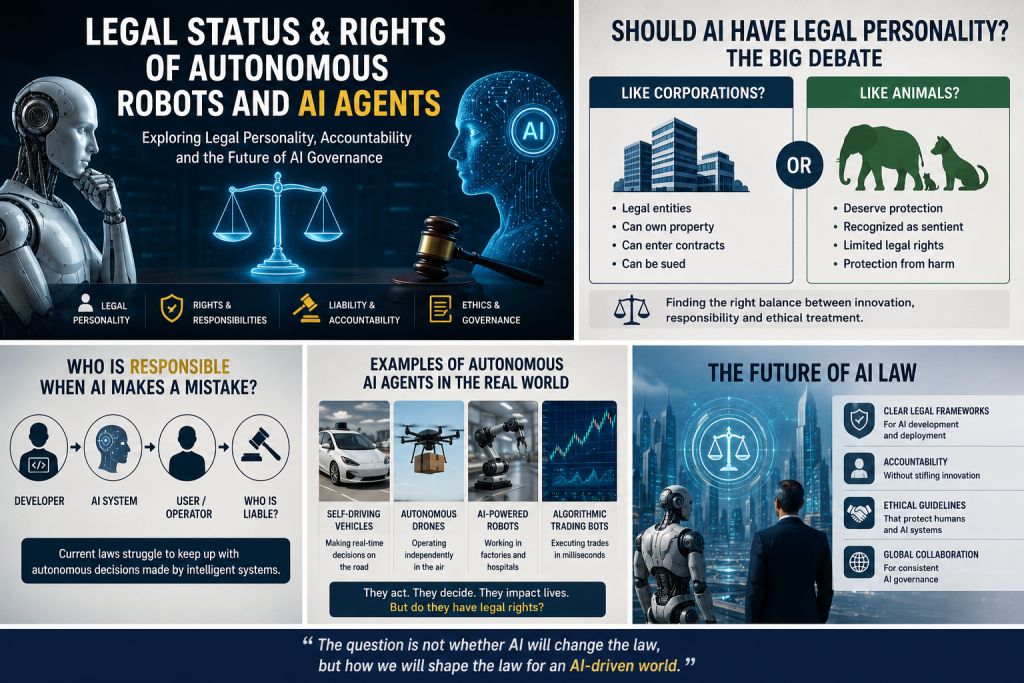
What are autonomous robots and AI agents?
Autonomous robots and artificial intelligence agents can operate without continuous human supervision:
Actors must possess four core capabilities:
- Researching and analyzing data
- Formulating decisions
- Adapting to the environment
- Interacting with surrounding entities.
Examples:
- AI-driven self-driving cars
- Customer service robots
- Autonomous drones, and
- Algorithmic trading platforms
Unlike conventional machines, these systems operate with a degree of independence that poses challenges to current legal frameworks.
The Central Legal Issue: Determining Responsibility
Currently, the law views AI as a tool, not as an independent legal entity. As a result:
When AI causes harm, liability typically lies with:
- The developer
- The owner
- The operator
However, this framework is beginning to show its limitations.
Practical Example
A few years ago, I closely followed a case involving an autonomous vehicle accident. The investigation found that no single human decision led to the crash; instead, it was the outcome of thousands of micro-decisions made by the AI system.
This case highlighted that traditional liability models fall short when decision-making is distributed across AI systems.
Discussing Legal Personality for AI
A highly debated topic today is whether AI systems should be granted limited legal personality.
Understanding Legal Personality
Legal personality refers to an entity’s ability to:
- Own property
- Enter into contracts
- Be held liable
- Initiate or face lawsuits
While humans possess full legal personality, corporations also have it despite not being human.
Should AI Be Treated Like Corporations?
Some cross-disciplinary experts have proposed that autonomous AI agents should be granted company-like legal status.
Potential Advantages
At present enterprises operate as artificial persons capable of independently bearing liability separate from any specific natural person. Reusing this model can simplify the challenges of liability determination across all types of scenarios.
Potential Drawbacks
Enterprises are controlled by humans while AI is capable of independent operation.
Empowering AI would not only complicate liability attribution but also trigger ethical concerns.
Alternatively, Should AI Be Treated Like Animals?
Or rather can we treat AI the same way we treat animals?
Why This Comparison Is Important
Animals:
- Can operate autonomously
- Have the potential to cause harm
- Are afforded limited legal protections
In this framework:
AI would not receive complete rights
However, it might be granted certain protections and obligations
Practical Advantage:
This approach aims to strike a balance between regulation and acknowledgment, without extending full legal personhood to AI systems.
Key Legal Rights Under Consideration
If AI agents are granted limited legal recognition, what rights might they possess?
1. Authorization to Function Within Set Parameters
AI systems may be permitted to operate independently, provided they adhere to established guidelines.
2. Restricted Liability Protection
Liability might be distributed or attributed to the AI entity itself, rather than solely to its developers.
3. Ability to Enter into Contracts
AI agents could autonomously engage in smart contracts.
4. Safeguards Against Improper Use
Advanced AI systems may require protections to prevent unethical exploitation.
Risks of Assigning Rights to AI
Although the concept appears forward-looking, it poses significant risks:
1. Accountability Gaps
Organizations may use AI entities as a shield to evade liability.
2. Ethical Ambiguity
Extending rights to machines could blur the focus on human rights.
3. Legal Challenges
Establishing new legislation, judicial bodies, and regulatory systems would be necessary.
Why Existing Laws Fall Short
The vast majority of existing legal frameworks are centered on human conduct, and operate based on a range of pre-established assumptions.
- Artificial intelligence will upend all the aforementioned presuppositions.
- Control
- Predictability
Autonomous intelligent systems have three types of capabilities that exceed what developers pre-set:
- Unexpected knowledge gain,
- Unplanned decision-making, and
- Operation that outpaces human ability.
This creates a legal gray area where current laws are not entirely applicable.
Emerging International Strategies
Various nations are considering different approaches:
European Union
The EU has contemplated the concept of “electronic personhood” for sophisticated AI systems, although this idea is still debated.
United States
Efforts are primarily concentrated on establishing liability structures and laws for AI accountability.
Asia
Countries such as Japan and South Korea are focusing on AI governance, but they approach the notion of granting legal personhood with caution.
A Personal Reflection: When AI Appears “Alive”
During my participation in this research project, I encountered an advanced AI chatbot developed exclusively to provide emotional support, which exhibited human-like traits including empathy, adaptive learning, and the ability to express humor.
This AI chat response tool, introduced earlier in this paper, once effectively responded to users who shared they were suffering, and successfully helped them avoid crises.
That incident is etched deeply in my heart.
The value of AI lies not in whether it is a form of life, but in the practical impacts it produces.
This led me to consider the following question:
Accordingly, this paper will proceed to discuss the core issues of this research.
A Balanced Approach: Functional Legal Status
A practical solution could be found in a balanced approach known as:
“Functional Legal Personality”
Rather than granting full rights, AI systems might be assigned:
- Legal roles specific to certain tasks
- Restricted accountability
- Defined operational limits
This approach guarantees that:
- Innovation progresses
- Risks are controlled
- Accountability is maintained.
What Businesses and Developers Need to Do
If you create or use AI systems, this discussion is directly relevant to you.
1. Develop Transparent Systems
Make sure that decisions made by AI can be tracked and explained.
2. Clearly Define Responsibility
Establish accountability among developers, users, and other stakeholders.
3. Keep Up with Regulations
AI laws are changing quickly—what is legal now might not be in the future.
4. Prioritize Ethical AI
Following the law is essential, but ethical design is crucial for building lasting trust.
The Future: Laws That Adapt to Intelligence
Autonomous intelligence can make decisions, learn, and produce hard-to-predict behaviors.
The authors of this paper propose that instead of only discussing whether artificial intelligence (AI) should have rights, we need to build a legal system that balances both human rights protection and machine regulation.
- Systems learn independently
- Technology behaves in unforeseen ways
Issues surrounding the legal status and rights of autonomous robots and artificial intelligence are never merely an isolated legal issue. In fact, they reflect the deep-seated core values of society as a whole.
Conclusion: A Pivotal Moment for Humanity
However, setting aside all kinds of vague uncertainties, the choices humanity currently makes will define the trajectory of the relationship between humans and intelligent machines over the timescale of several future generations.
Should we view AI as tools, collaborators, or something else entirely?
There is no straightforward answer.
What is certain, however, is that the choices we make now will define the future of human and intelligent machine relationships for generations to come.
About the Author





Excelente sua didática ! Comecei a acompanhar o site faz pouco tempo
e estou impressionado com o valor que você entrega. Parabéns!