Every human culture, no matter how old or new, has asked the same question at some point:
- How did all this begin?
The mountains, the oceans, the stars above us, and life itself all raise the same question: where did they come from?
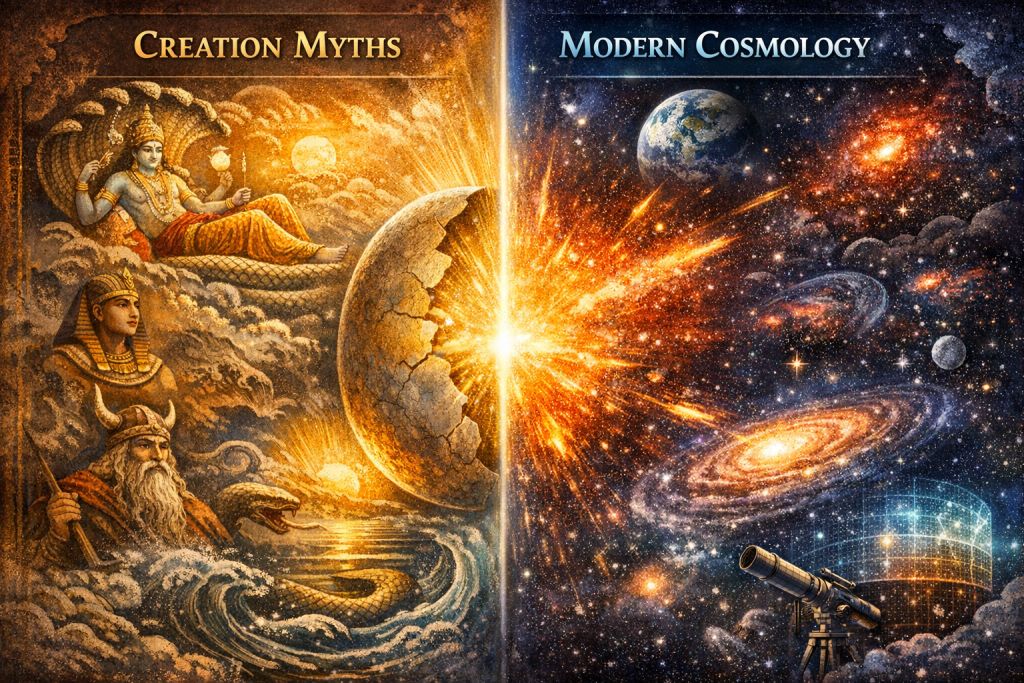
Long before science, people answered this question with creation myths. Today, scientists look for answers through modern cosmology. One approach uses stories, the other uses equations. Both are driven by human curiosity and wonder.
This blog looks at creation myths and modern cosmology side by side, focusing on the similarities between ancient stories and today’s scientific theories. It is written simply and honestly, as a personal reflection rather than a technical paper.
The First Time Humans Looked at the Sky
Imagine early humans sitting around a fire at night. No cities. No lights. Just a sky full of stars. The universe must have felt huge, mysterious, and even frightening.
Without science, they still noticed patterns:
- The sun rose and set
- Seasons changed
- Life appeared and disappeared
- Storms came without warning
They wanted answers. And so, stories were born.
These stories were not foolish. They were thoughtful attempts to explain reality with the knowledge available at the time.
What Creation Myths Really Are
Creation myths are often misunderstood. Many people think they were meant to be taken literally. In truth, most were symbolic rather than scientific.
They used:
- Images instead of numbers
- Metaphors instead of formulas
- Memory and storytelling instead of written data
Across different cultures, creation myths often share similar ideas:
- The universe starts in darkness or emptiness
- There is chaos before order
- Something powerful triggers creation
- Life slowly takes shape
This alone should make us pause. How did people separated by oceans, imagine such similar beginnings?
Examples of Ancient Creation Narratives
- In Indian traditions, the universe begins inside a cosmic golden egg, floating in darkness.
- In Norse mythology, everything begins with a vast, empty gap where fire and ice meet.
- In Egyptian stories, life rises from dark waters.
- In Greek myths, chaos comes before the world takes form.
These are different cultures, but they share the same feeling and the same question.
Enter Modern Cosmology
Fast forward thousands of years.
Now we have telescopes that can see billions of light-years away. We have satellites, computers, and mathematics. This is where modern cosmology begins.
Modern cosmology tries to explain:
- How the universe began
- How it changed over time
- Where it might be heading
The most well-known idea is the Big Bang theory.
What the Big Bang Really Says
The Big Bang theory does not describe an explosion in space. Instead, it explains that space itself expanded.
According to scientists:
- The universe began from an extremely hot, dense state
- Time and space came into existence together
- The universe has been expanding ever since
Even today, scientists admit they do not fully understand what came before this moment, or if the idea of ‘before’ even makes sense.
Honesty is important.
Parallels Between Myths and Cosmology That Are Hard to Ignore
This is where things become truly interesting.
1. Beginning from Nothing
Most creation myths begin with nothingness: darkness, silence, and emptiness.
Modern cosmology also starts with something close to nothing: a singularity where space and time did not exist as we know them.
Different language. Same mystery.
2. One Source of Everything
Ancient myths often speak of a single source, such as a seed, an egg, or a breath.
Modern science also says everything came from one point.
When I first learned this while reading about cosmology, I was quietly surprised. It was not that myths were ‘right,’ but that human intuition was wiser than we often assume.
3. Order from Chaos
Creation stories often describe chaos slowly turning into a structured world.
In science, early matter was uneven and messy. Over time, gravity shaped stars, galaxies, and planets.
Both views accept that order takes time.
4. Cycles of Creation
Some ancient traditions describe the universe as repeating—being created and destroyed again and again.
Modern scientists now explore ideas like:
- Cyclic universes
- Big Bounce theories
- Multiple universes
Science is not copying myths, but it is returning to the questions humans asked long ago.
Are Myths Early Science?
Not exactly. But they are early thinkers.
Myths were how humans tried to explain reality before tools existed. Science is how we explain reality now.
One is emotional and symbolic. The other is logical and measured.
Both are human.
A Moment That Changed How I See This Topic
I once attended a planetarium show where the birth of stars was explained through physics. The visuals were beautiful, with clouds of gas slowly forming light.
Strangely, it reminded me of old stories I heard as a child about the universe being “born.”
That moment stayed with me. It felt like science was continuing a story humanity had begun long ago.
Why This Comparison Is Useful Today
Many people today feel torn between belief and science. This comparison helps bridge that gap.
It shows that:
- Humans have always searched for the truth
- Science did not erase curiosity—it refined it
- Ancient stories still carry meaning
For students, this makes learning easier. For readers, it makes science feel less distant and more human.
What Respected Thinkers Have Said
- Carl Sagan once said that myths were the first attempts at science.
- Joseph Campbell studied how cultures across the world told similar creation stories.
Even modern physicists admit that science cannot answer every question about meaning.
This balance matters.
Final Thoughts: One Sky, Many Stories
Creation myths and modern cosmology are not enemies. They are two chapters of the same human journey.
Our ancestors used stories to understand the universe.
We use science to explore it today.
But the feeling behind both is the same: wonder.
When we accept that, we don’t lose science. We gain perspective.
And maybe, we understand ourselves a little better, too.
About the Author