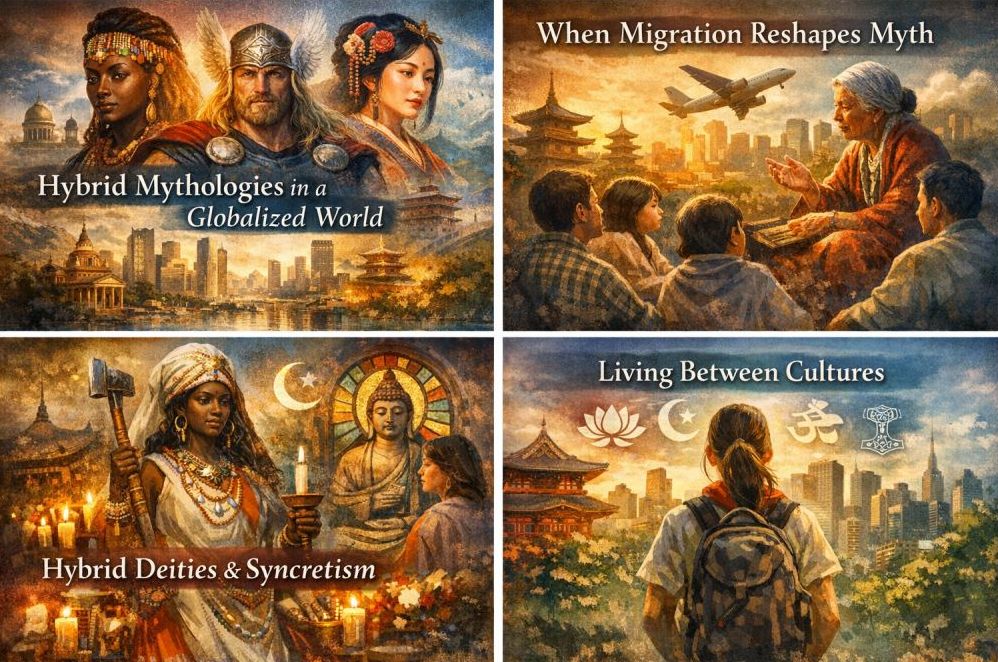
Stories are not fixed; they move with people. Quietly, they cross borders, packed inside memory, ritual, language, and belief. Migrating families bring more than documents and photographs. Gods, legends, superstitions, and sacred habits come, too.
But once those stories arrive in a new place, they begin to change.
This is how hybrid mythologies in globalised cultures are born. They do not appear overnight. They form slowly, shaped by migration, diaspora, and cultural blending. Over time, they create new mythic traditions and hybrid deities, figures who reflect more than one world at once.
I have watched this happen in small ways. At a community celebration organised by migrants, elders recited prayers learned in childhood. The younger generation translated them into another language so everyone could understand. Traditional food was served, but adapted to local ingredients. The ritual felt familiar, yet slightly different. It was not a copy of the past; it was the past adjusted to fit the present.
That small shift said everything about how myth survives.
What Hybrid Mythologies Really Are
Hybrid mythologies form when cultures meet and influence one another. Instead of erasing each other, their stories, symbols, and rituals blend and expand.
Scholars often use the word “syncretism” to describe this process. Outside textbooks, it feels more human than that. It feels like an adaptation.
A clear historical example is Santería. Enslaved Africans in the Caribbean were forced into Catholic practice. Rather than abandon their spiritual systems, they aligned their deities with Catholic saints. On the surface, it appeared as religious conversion. In reality, it was cultural preservation.
The result was not confusion. It was survival through transformation.
Migration as a Force That Reshapes Myth
As migration reshapes daily life, stories change too.
A farming god may lose literal meaning in a city but gain symbolic power. A river spirit might become a metaphor for emotional flow rather than for agriculture. A guardian of forests could become a protector of neighbourhoods.
In diaspora communities, myths often shift settings. Elders describe ancestral villages. Younger generations imagine those same characters navigating apartment buildings, highways, or offices. The core lesson remains intact, but the environment evolves.
At a storytelling evening hosted by second-generation immigrants, I heard a traditional trickster figure reimagined. Once known for causing chaos in village markets, he became an office intern outsmarting corporate executives. The audience laughed, but the message about wit and resilience remained unchanged.
The myth had not been lost. It had simply found a new stage.
How Diaspora Creates Hybrid Deities
When cultures overlap long enough, entirely new spiritual figures can emerge.
In Vodou, West African religious traditions blended with French Catholic influence during colonial rule. African spirits were associated with Catholic saints. This merging allowed enslaved communities to preserve their cosmology while navigating oppression.
In Japan, elements of Shinto and Buddhism have coexisted for centuries. Local kami were sometimes interpreted through Buddhist frameworks. Shrines and temples often share spaces, reflecting a layered spiritual landscape rather than a divided one.
These examples show that hybrid mythologies can grow from conflict or coexistence. Either way, they reveal flexibility rather than fragility.
Globalisation and Modern Myth-Making
In today’s world, myth-making is no longer limited to religious spaces. Popular culture plays a powerful role.
Films like Black Panther combine African symbolism, futuristic imagination, and global storytelling techniques. Meanwhile, Thor reinterprets Norse mythology within a modern cinematic universe.
These stories may not function as sacred texts, but they serve mythic purposes. They create heroes. They explore moral struggles. They offer symbols people recognise across continents.
Streaming platforms, comics, and online communities now serve as laboratories for hybrid storytelling. Cultural elements mix—sometimes respectfully, sometimes carelessly—forming new narratives.
The Emotional Weight of Living Between Worlds
Behind every blended tradition is a personal story.
Many people in diaspora communities describe feeling “in-between.” Not fully rooted in the homeland their parents speak about. Not fully absorbed into the society they live in.
Hybrid mythologies offer a kind of emotional shelter. They allow people to see themselves reflected in stories that hold multiple identities.
I once spoke with someone who said she felt most connected during a festival abroad that combined traditional ritual with contemporary music and bilingual readings. It was not identical to the version celebrated in her ancestral village. It felt honest to her reality.
That moment stayed with me because it revealed something simple: authenticity does not require purity. It requires meaning.
The Internet as a Space for New Myths
Digital culture has accelerated the blending of traditions. Artists mix folklore from different regions. Writers create fictional pantheons inspired by multiple continents. Environmental activists frame climate change through mythic storytelling rooted in Indigenous wisdom and modern science.
This creative exchange inspires artists, but also raises questions about respect and cultural boundaries. Symbols carry history, not just decorative value.
The speed of global communication has made myth-making more collaborative than ever. Stories travel instantly. They adapt quickly. They evolve in real time.
Why Hybrid Mythologies Matter
Hybrid mythologies in globalised cultures matter because they show that tradition is not static.
They help communities preserve identity and encourage dialogue, inspiring art, literature, and film.
They provide comfort during displacement and uncertainty.
From what I have observed, traditions survive not because they resist change but because they respond to it.
Looking Forward
As migration continues and societies grow more interconnected, hybrid mythologies will likely become even more common.
We may see environmental myths uniting scientific awareness and ancestral storytelling. Rituals could form for interfaith families. Spiritual metaphors might emerge, shaped by technology and artificial intelligence.
The world is layered, and our stories reflect that complexity.
Closing Thoughts
When people move, their stories move with them.
They settle into unfamiliar landscapes. They absorb new languages. They adapt to new realities. Sometimes they change so much they seem new, but if you look closely, the roots remain.
Migration, diaspora, and cultural blending do not erase myth. They reshape it.
Hybrid mythologies remind us that identity need not be singular. It can hold more than one origin. More than one influence. More than one truth.
And perhaps that is what makes these new stories powerful: they reflect who we are becoming.
About the Author