Introduction: The Quiet Transformation of Micro-Farming
Smallholder farmers across the globe commonly face a series of pressures: rising labor costs, weather fluctuations, shrinking land access, and the challenge of boosting production with limited resources. Large-scale farms achieved widespread automation long ago, and today small farms are quietly undergoing a transformation supported by autonomous agricultural robots.
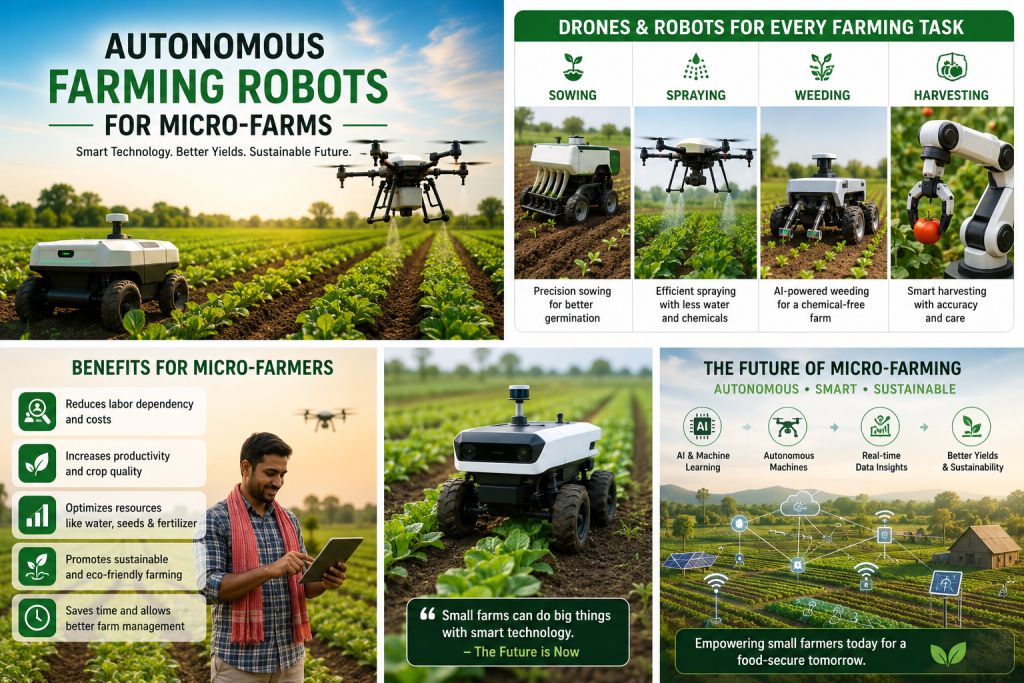
These small smart agricultural devices are far from ordinary farm implements. Instead, they serve as reliable agricultural partners. Comprising ground robots and drones, they cover the full sequence of farming activities from sowing to harvesting, transform the operations of small-scale farms, and improve agricultural efficiency, sustainability, and profitability.
This paper will analyze the role that autonomous agricultural robots for micro-farms play in reshaping the agricultural industry, and will base its full discussion on three core categories of source materials.
What Are Autonomous Farming Robots?
Autonomous agricultural robots are intelligent machines equipped with artificial intelligence, sensors, and GPS technology to execute farming operations with very little human involvement. In contrast to conventional equipment, these advanced robots utilize real-time information—such as weather trends, crop vitality, and soil quality—to make informed decisions.
For small-scale farmers, these technologies provide:
- Decreased reliance on manual workers
- Enhanced accuracy in agricultural practices
- Lower overall expenses in the long run
The Increasing Necessity of Robotics for Micro-Farms
Micro-farms, which typically span fewer than five acres, frequently function with restricted budgets and a shortage of personnel. While visiting a compact vegetable farm on the outskirts of an urban area, I observed a farmer attempting to handle weed control and irrigation entirely on his own. He explained that securing farm labor was both costly and undependable.
This is precisely the gap that autonomous robots can fill.
Primary Challenges Resolved:
- Scarcity of labor
- Unpredictable harvest volumes
- Excessive application of pesticides and fertilizers
- Highly demanding manual labor
Robotic technology resolves these challenges with accuracy and reliability.
Drones and Robotics for Planting, Spraying, Weeding, and Harvesting
1. Intelligent Sowing Robots
The core design goal of modern seeding robots is to place seeds at the ideal planting depth and spacing, and this level of precision can improve germination rates and crop yields.
Advantages:
- Minimizes seed waste
- Promotes consistent crop development
- Conserves time and manual labor
This planting plan can reduce planting-related resource consumption, promote uniform crop growth, and save labor and time.
2. Agricultural Spraying Drones
Unmanned aerial vehicles (UAVs) are widely recognized as an indispensable core operational tool for precision agriculture, capable of efficiently spraying fertilizers, pesticides, and herbicides across entire farm fields.
Advantages:
- Swiftly covers expansive areas
- Minimizes farmers’ exposure to potentially harmful chemicals
- Reduces overall chemical usage by up to 30%
The agricultural precision pesticide application technology developed in this study is capable of large-area operation, reduces farmers’ risk of pesticide poisoning, and cuts pesticide usage by up to 30%.
3. Automated Weeding Robots
Controlling weeds is among the most physically demanding jobs in agriculture. Automated weeding robots employ artificial intelligence and visual sensors to distinguish and eliminate weeds while leaving the surrounding crops unharmed.
Primary Features:
- Herbicide-free weed eradication
- Reduction in labor expenses
- Enhancement of soil quality
This technology is particularly advantageous for organic agricultural operations.
4. Automated Harvesting Systems
The harvesting process is highly time-sensitive and demands accuracy. By utilizing advanced sensors and mechanical arms, robots can accurately detect ripe produce and extract it with care.
Advantages:
- Minimizes damage to crops
- Operates continuously, day and night
- Guarantees harvesting is completed on schedule
For fruits and vegetables, this technology significantly decreases post-harvest waste.
Real-World Impact: A Memorable Experience
During my field visits to small-scale farms, I spoke with a farmer who had introduced a compact weeding robot. The farmer was initially hesitant about this investment, yet he achieved significant positive outcomes after just one growing season.
This agricultural business entity first cut its daily operating costs, then stabilized its core production quality, and most critically, secured the qualification for long-term strategic cooperation.
I still cannot forget those words to this day.
“For the first time, I feel like I am managing my farm, not just working on it.”
Automation helps workers transition into managerial positions.
Obstacles to Implementing Agricultural Robots
Despite the evident advantages, several hurdles remain:
1. Upfront Financial Commitment
Acquiring robotic systems requires a significant initial expense, though these prices are steadily declining.
2. Required Expertise
Agricultural workers must undergo fundamental training to effectively manage and upkeep this equipment.
3. Technological Availability
These advanced systems are not yet readily accessible across all geographic areas.
Nevertheless, through government backing, financial incentives, and increasing familiarity, these obstacles are steadily diminishing.
The Future of Micro-Farming with Robotics
Robotics technology has promising development prospects, and new-generation robots possess a number of core characteristics:
This agricultural planting system is
- Space-saving
- Easy to operate and
- Highly adaptable.
We are entering an era where even small farms of only 1 acre can operate as advanced agricultural facilities. Agricultural technology experts further predict that within the next decade, robot-assisted micro-farms will shift from niche outliers to a common industry standard.
Actionable Advice for Small-Scale Farmers
This introductory guide to the operation and integration of autonomous agricultural robots is specifically developed for agricultural operation entities with practical integration needs, to help you get started smoothly.
- Begin with single application cases such as plant protection drones.
- Adopt scalable technologies.
- Pursue government subsidies and assistance.
- Connect with regional agricultural technology suppliers.
- Coordinate resources to carry out core skills training.
Conclusion: A Promising Future for Small Farms
Automated agricultural robots no longer only serve large commercial farms; they have now become a core resource for micro-farms to maintain their competitiveness.
Integrating unmanned aerial vehicle (UAV) and robotic systems enables small-scale farmers to carry out all core agricultural operations across the entire production process, including key tasks such as planting and harvesting.
This project aims to
- Increase production
- Reduce costs
- Enhance green benefits.
Currently, agricultural transformation is continuing to move forward. For micro-farms, the decision to adopt robotic technology has shifted from whether to adopt the technology to when to adopt it, and the window for this technology to spread widely has arrived.
If these advances in the agricultural sector are fully and effectively implemented, they will empower farmers, improve their living standards, and reshape the pattern of agricultural development.
Final Thought
Technology is meant to empower farmers, not replace them.
Autonomous robots are achieving precisely that.
Have you encountered or utilized agricultural robots on a small-scale farm? Please share your experience—your insights could encourage someone else to adopt smarter farming practices.
About the Author