Introduction
Trust is the core underlying foundation of the internet. It safeguards four categories of users’ sensitive information: personal data, passwords, financial information, and private communications. This security mechanism is supported by cryptography, which relies on complex mathematical methods.
However, quantum computing poses major new threats to established security systems.
Future quantum machines, whose operating principles are completely distinct from those of traditional computers, will eventually crack the vast majority of current encryption standards. In response, experts are developing quantum-resistant (also called post-quantum, corresponding to post-quantum cryptography) cryptographic technologies to address this challenge.
This paper centers on quantum-resistant cryptography, and will examine its fundamental connotations, the necessity of its implementation, the threats it can counter, as well as the preparations required for individuals and institutions to adapt to the post-quantum environment.
What Is Quantum-Resistant Cryptography?
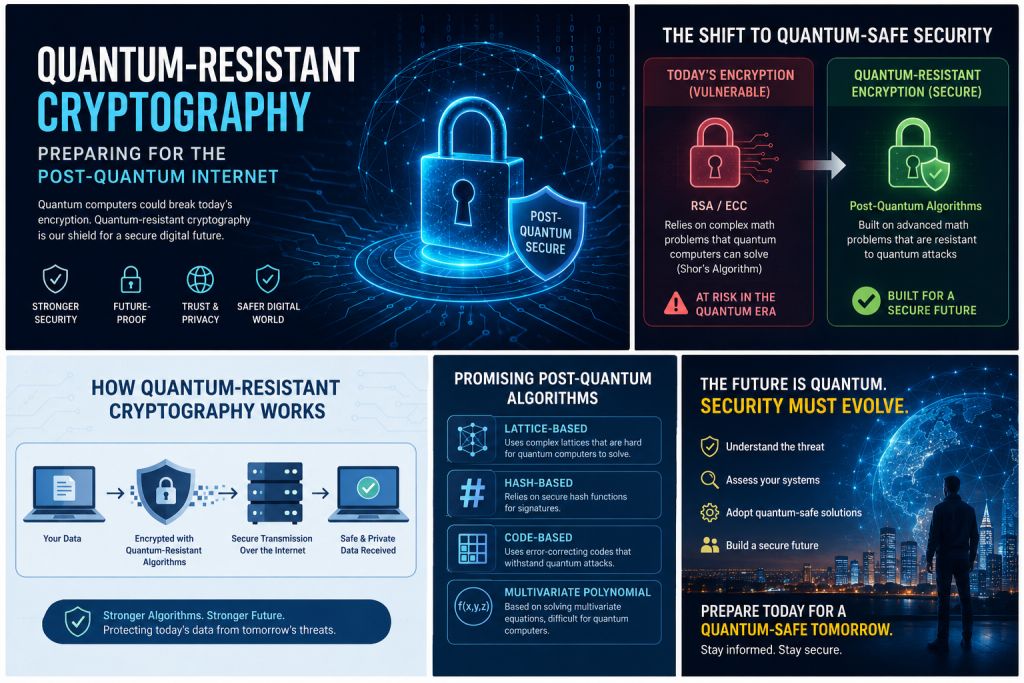
Quantum-resistant cryptography encompasses encryption techniques developed to withstand security breaches from quantum computers.
Current encryption frameworks, including RSA and ECC, depend on complex mathematical puzzles that traditional computers struggle to crack. However, equipped with tools like Shor’s algorithm, quantum computers can resolve these issues at a highly accelerated rate.
To counter this, quantum-resistant algorithms utilize alternative mathematical foundations anticipated to remain secure in a quantum-dominated landscape.
These approaches include:
- Lattice-based cryptography
- Hash-based cryptography
- Code-based cryptography
- Multivariate polynomial cryptography
Ultimately, these advanced systems are designed to safeguard confidential information as quantum technology advances into widespread use.
The Threat of Quantum Computing
To understand the critical nature of this issue, consider that the majority of modern encryption depends on:
- Factoring large numbers (RSA)
- Solving discrete logarithms (ECC)
While traditional computers would require thousands of years to break these codes, advancing quantum computers could potentially solve them in mere hours or minutes.
A Practical Concern
During a recent cybersecurity seminar, an industry specialist highlighted a significant vulnerability:
“Cybercriminals do not require quantum capabilities today; they can simply intercept encrypted information now and decode it in the future.”
This strategy is commonly referred to as a “harvest now, decrypt later” attack.
Highly sensitive information at risk includes:
- Classified government documents
- Healthcare data
- Financial exchanges
- Intellectual property
Adversaries can stockpile this data today with the intention of unlocking it once quantum technology becomes fully viable. Ultimately, this demonstrates that effective cybersecurity must safeguard against both immediate threats and anticipated future advancements.
Recent Advancements in Post-Quantum Cryptography
The international cybersecurity community is actively formulating solutions to mitigate these challenges. The National Institute of Standards and Technology (NIST) is at the forefront of the initiative to standardize quantum-resistant algorithms.
Following comprehensive research and evaluation, several notable algorithms have been chosen, such as:
- CRYSTALS-Kyber (for encryption purposes)
- CRYSTALS-Dilithium (for digital signatures)
These algorithms are anticipated to become the universal benchmark for post-quantum security.
Primary Advantages of Quantum-Resistant Cryptography
1. Future-Proofed Security
Safeguards information against both existing vulnerabilities and emerging technological threats.
2. Extended Data Preservation
Crucial for sectors requiring decades of data confidentiality, such as healthcare, defense, and finance.
3. Regulatory Compliance and Trust
Assists organizations in adhering to continuously updating cybersecurity standards.
4. Strategic Edge
Organizations that implement this technology early establish themselves as pioneers in innovation and data security.
Obstacles in Implementing Quantum-Safe Cryptography
Even though it is highly important, shifting to quantum-resistant frameworks involves several major difficulties.
1. Performance Constraints
Certain quantum-safe algorithms demand increased processing power and storage capacity.
2. Interoperability Issues
Current infrastructures might be incompatible with these emerging cryptographic techniques.
3. Insufficient Awareness
A large number of organizations continue to minimize the potential dangers posed by quantum computing.
4. Complicated Migration Processes
Upgrading worldwide networks demands substantial time, strategic preparation, and financial resources.
Industries Requiring Immediate Action
1. Banking and Finance
Safeguard financial transactions, digital payment systems, and client information.
2. Healthcare
Ensure the protection of patient files and sensitive medical records.
3. Government and Defense
Defend critical national security data.
4. E-commerce and Technology Companies
Guarantee the safety of consumer data and digital communications.
Actionable Steps to Prepare for the Post-Quantum Internet
1. Implement Cryptographic Agility
Cryptographic agility refers to the practice of developing systems capable of rapidly adjusting to new or alternative cryptographic algorithms.
Ensure that specific encryption methods are never hardcoded directly into your systems.
2. Assess Your Current Cryptography
Determine the following:
- Where encryption is currently applied
- Which specific algorithms are in use
- What data requires long-term security
3. Prioritize Sensitive Information
Direct your initial focus toward:
- Long-term confidential data
- Customer details
- Intellectual property
4. Explore Hybrid Cryptography
Utilize a blend of:
- Conventional encryption
- Quantum-resistant algorithms
This strategy ensures continued security throughout the transition phase.
5. Remain Up-to-Date with Standards
Monitor updates from the following:
- NIST
- ISO
- International cybersecurity organizations.
A Personal Observation: The “Invisible Risk”
While working on a digital security project, I encountered a company that considered their encryption to be “unhackable.”
Although they utilized robust RSA encryption, they lacked a strategy to handle quantum computing threats.
The primary problem was evident:
While they were protected in the present, they remained entirely vulnerable to future dangers.
This “invisible risk” highlights the necessity of quantum-resistant cryptography. The objective is to resolve present challenges while actively averting future crises.
The Future of the Post-Quantum Internet
The transition to a quantum-secure internet is a long-term process that will last several years or even decades, and it has already been launched.
Building digital security requires defending against future threats, upgrading encryption protocols, and ensuring all relevant institutions establish long-term strategies.
Although quantum computing will spur remarkable technological progress, it will also pose substantial security vulnerabilities. Consequently, proactive preparation is vital.
Conclusion
As quantum computing continues to advance, traditional encryption technologies face core security risks; proactive protection can safeguard data security, establish trust, and maintain an advantage in responding to new types of threats.
Preparations are launched today to build a secure and resilient future digital landscape.
The primary concern is no longer:
“Will quantum computing impact cybersecurity?”
Rather, the vital question is:
“Are you prepared for it?”
By initiating preparations today, we can establish a more secure, robust, and resilient digital landscape for the future.
About the Author