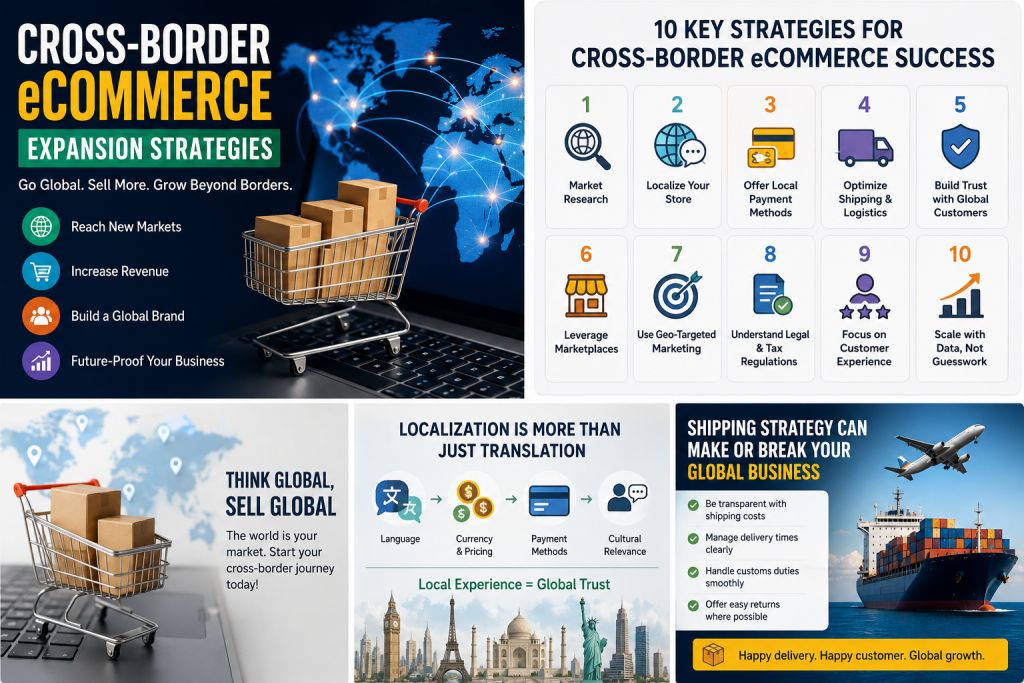
Today, cross-border e-commerce expansion into overseas markets is no longer an optional move for businesses, but a core essential need. The global online retail market will reach a scale of trillions of US dollars. Remaining confined to the domestic market will only lead to missing out on massive opportunities, and enterprises must not mistakenly equate overseas expansion with merely arranging well-functioning international logistics.
This guide will provide three categories of on-site implementation services, covering four core support systems, to meet the full-process needs of overseas market expansion.
Why Cross-Border eCommerce Is Crucial in 2026
Modern consumers think globally. They search worldwide for the best prices, quality, and trends before making a purchase.
Key advantages of expanding internationally include:
Today global consumers search for the best prices and quality trends before making purchases, driving companies to explore the core advantages needed for international expansion.
Enterprises that develop cross-border business operations can expand their customer base, optimize their revenue, hedge risks, and upgrade their brand assets.
1. Begin with Market Research—Not Assumptions
Before expanding, pinpoint where demand for your products already exists.
Focus on analysing:
A small Indian fashion brand leveraged operational experience from the emerging direct-to-consumer (DTC) model optimized its operations to target the U.S. and UAE markets. Six months later its international sales accounted for 35% of its total revenue which verifies the effectiveness of DTC cross-border market expansion.
Before pursuing business expansion, discard all subjective assumptions and first conduct market research to define the demand for your own products.
2. Localise Your Store—More Than Just Translation
Localisation is critical to cross-border success. Many brands fail by simply translating content without adapting the entire shopping experience to local cultural nuances.
Essential localisation areas include:
- Language and tone
- Currency and pricing
- Payment options
- Product descriptions
- Cultural references
Real Insight:
Before entering overseas markets, four core areas of research must be completed: user traffic, market demand, competing products, and local consumer habits.
When expanding markets, scale must not be regarded as the sole criterion: small markets with high participation rates outperform large, saturated markets.
1. Offer Local Payment Methods
Localization for cross-border retail brands is by no means limited to mere text translation; it is the core of successful cross-border operations. Many brands have run into costly pitfalls in this process, and the following text will organize and outline the core domains of localization.
This paper constructs the core framework for the localized operation of cross-border e-commerce firms’ overseas expansion, and reserves slots for original insights.
- India: UPI, Paytm
- Middle East: Cash on Delivery
- US: Credit Cards, PayPal
Strategy Tip:
Integrate payment gateways familiar and trusted by your customers in each region to increase conversions from the start.
After a skincare brand established its local operations in Germany and adopted German-language product descriptions paired with local customer testimonials, its conversion rate doubled.
2. Optimize Shipping & Logistics
If consumers are unable to use their preferred payment method, they often abandon their unpaid shopping carts, and this will be illustrated with examples.
Mainstream payment instruments in Europe, India, the Middle East, the United States (US) show clear regional differences.
Smart Approach:
- Use third-party logistics (3PL) providers
- Establish regional warehouses as order volume grows
- Offer Delivered Duty Paid (DDP) pricing to prevent unexpected charges
Example:
A home decor brand reduced international cart abandonment by 40% after switching to DDP pricing, eliminating surprise customs fees.
E-commerce businesses that operate across multiple regions must integrate payment gateways that are familiar and trusted by users in each local area to boost conversion rates.
3. Build Trust with Global Customers
Logistics and distribution represents the most complex link in the entire process of cross-border e-commerce, and all core influencing factors will be unpacked in subsequent analyses.
Cross-border E-commerce Operators Must Explicitly Disclose Four Core Fulfillment Information Items:
- Shipping Costs,
- Delivery Timelines,
- Taxes and Duties,
- Return Policies.
Insight:
A customer hesitated to buy due to the absence of a local contact number. Adding regional support quickly boosted confidence and sales.
Cross-border e-commerce businesses can introduce 3PL (third-party logistics), build more regional warehouses as their order volumes grow, and use DDP (Delivered Duty Paid) pricing to keep consumers from facing unexpected charges.
4. Leverage Marketplaces for Market Entry
A home decoration brand switched to DDP pricing, and after eliminating unexpected customs fees, the abandonment rate of its international orders dropped by 40%.
We present the five major operational challenges of cross-border business and their corresponding implementation plans in a binary comparison table.
All plans are practically feasible are provided for industry practitioners to reference and reuse.
Benefits:
- Built-in customer trust
- Simplified logistics
- Faster market validation
When I provided consulting services for a niche handmade brand I served, I found that its largest international audience was based in Japan rather than the United States or the United Kingdom. I immediately launched three initiatives: translating the brand’s product pages into Japanese, collaborating with local internet influencers, and adjusting product descriptions to align with local culture.
The business I oversaw developed Japan into its second-largest market in just a few months. Demand for our product had long existed in the local market, and we could seize this opportunity simply by carrying out proper product adaptation.
5. Use Geo-Targeted Marketing
In cross-border online shopping, trust is a core element, and the methods for constructing this trust will be detailed in the subsequent sections of this paper.
Online retail sites may prioritize displaying local customer reviews clear return policies trust badges secure payment icons responsive customer service.
Previously, the lack of a local contact number caused customers to hesitate. After new regional support was added, both customer confidence and sales volume increased.
Running a cross-border e-commerce business requires a global perspective, paired with localized on-the-ground execution. If you:
- Import/export laws
- VAT/GST requirements
- Data privacy regulations (e.g., GDPR)
- Product restrictions
We have sorted out eight actionable implementation steps for practitioners engaged in cross-border overseas expansion: analyze traffic on international platform sites, screen 1-2 target markets, build localized storefronts, test sales volume by leveraging platform support, launch marketing initiatives, and conduct regular operational optimization.
Marketing messages must be customized for each market, and detailed implementation strategies will be elaborated on in subsequent sections.
- Offering multilingual support,
- Providing clear,
- transparent communication,
- Ensuring quick response times,
- Simplifying the returns process,
- Precisely deliver country-specific exclusive advertisements,
- Collaborate with local internet influencers, and
- Optimize regional search rankings.
We recommend that cross-border e-commerce enterprises pursuing overseas expansion develop region-specific landing pages, paired with five sets of SEO keywords tailored to mainstream search needs.
Conversion rates by region
- Customer acquisition cost (CAC)
- Customer lifetime value (LTV)
- Cart abandonment rates
Enterprises planning to expand their global operations must understand relevant compliance requirements, as violations can disrupt corporate growth. These entities must also pay attention to import and export laws, value-added tax (VAT), the General Data Protection Regulation (GDPR), and product restrictions.
Experts Recommend: Collaborate with local legal experts and use global compliance platforms to avoid costly compliance errors.
| Challenge | Solution |
|---|---|
| High shipping costs | Partner with local warehouses |
| Payment failures | Implement region-specific gateways |
| Low trust | Showcase local reviews and policies |
| Cultural mismatch | Invest in localization |
| Legal issues | Seek expert consultation |
Brands that Prioritize
Investment in Customer Experience Enjoy Higher Repeat Purchase Rates and Expand Their Reach to Include International Consumers.
The authors of this paper propose that when entering new markets, firms must abandon the practice of pursuing large-scale expansion based on assumptions.
They should use data to optimize business strategies, and monitor four core indicators:
- region-specific conversion rate,
- customer acquisition cost (CAC),
- customer lifetime value (LTV), and
- shopping cart abandonment rate.
We recommend using existing core data to optimize pricing, marketing, and logistics.
Cross-border e-commerce practitioners must pay attention to emerging trends to maintain their
- Core market competitiveness
- Accelerated global shipping systems
- Growth of local fulfillment centers
- Integration of voice and
- visual search in international shopping
Use of blockchain for transparent logistics
The five core upgrading trends in the cross-border e-commerce sector are, in order:
- AI-powered personalized services tailored for regional adaptation,
- an expedited global freight system,
- expanded local fulfillment centers,
- integrated voice and visual search for international shopping scenarios, and
- blockchain applications that support transparent logistics.
Core Points: Strictly follow the business expansion guidelines outlined earlier to expand global operations, increase revenue, and strengthen the brand’s global influence.
- Understand your markets
- Customize customer experiences
- Build trust Streamline logistics
- Customize customer experiences
- Build trust
- Streamline logistics
The main takeaway:
Follow these guidelines to confidently expand your business worldwide, boost revenue, and strengthen your brand’s global presence.
Quick Action Checklist
✔ Analyze international website traffic
✔ Select 1–2 target markets
✔ Localize your online store
✔ Offer local payment options
✔ Optimize your shipping approach
✔ Test sales through marketplaces
✔ Implement geo-targeted marketing campaigns
✔ Monitor and improve performance regularly
About the Author