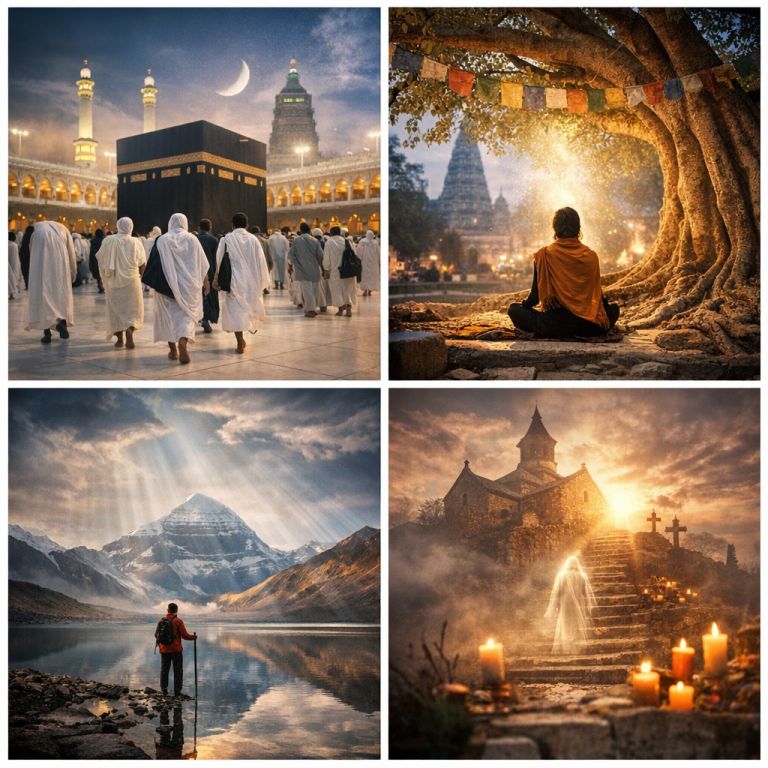
People have been travelling to holy places long before there were maps, hotels, or guidebooks.
They walked.
They carried food in cloth bundles.
They followed stars, rivers, and stories.
Even today, when so much of life happens on screens, millions still pack their bags and travel. They go to temples, churches, mosques, mountains, and rivers. Some are looking for healing. Some bring their grief. Others just feel drawn—even if they don’t know why.
Pilgrimages aren’t limited to any single faith. In fact, they’re woven deeply into the fabric of being human.
Why Certain Places Feel Different
Not every beautiful place feels sacred. And not every sacred place is beautiful.
Some are noisy. Some are crowded. Some sit quietly on forgotten hillsides.
Yet people walk into these spaces and feel something shift.
It might be calm, a sudden rush of emotion, or memories appearing unexpectedly.
Sacred sites absorb emotions left by generations. Entering feels heavy, like stepping into a room filled with old conversations.
Psychologists say that belief can change how we see things. Anthropologists talk about shared meaning.
But when you stand barefoot on cold temple stones at dawn, none of that seems to matter.
You just feel it.
When the Experience Goes Beyond Logic
If you talk to pilgrims for a while, you start to notice patterns.
A man at Lourdes swears his arthritis vanished after washing his hands in the spring.
A woman at Varanasi feels her lifelong fear of death dissolve while watching cremations on the Ganges.
Someone survives a landslide near Kedarnath and calls it divine timing.
Are these miracles?
Some people say yes. Others think it’s just a coincidence mixed with emotion.
The Catholic Church has officially recognised several dozen healings at Lourdes after medical review. In India, temples receive countless letters describing sudden changes, such as recovery from illness, reconciliation in families, or clarity after years of confusion.
Even sceptics admit that sacred journeys can lead to significant personal change.
Whether these changes are supernatural or just psychological often depends on who you ask.
A Quiet Story That Stayed With Me
I have read hundreds of stories about pilgrimages over the years, but one has stayed with me.
A woman travelled alone to Bodh Gaya after struggling with depression for months. She didn’t tell anyone about her trip. She wasn’t religious; she just needed some space.
She sat under the Bodhi Tree for hours.
Later, she wrote:
- “I expected nothing. But when I stood up, something felt lighter inside me.”
Nothing dramatic happened afterwards. There was no sudden happiness.
But when she went home, she left a job that was making her miserable, slowly rebuilt her relationships, and eventually began volunteering with people who were dealing with mental health challenges.
She didn’t call it a miracle.
She called it a turning point.
Why Pilgrimages Actually Work
Modern psychology offers one explanation.
Pilgrimages take us out of our routines. They challenge us physically. They open us up emotionally and give us time to reflect. In these moments, we see life with new eyes.
They help us reset our perspective.
You might walk for hours. You may share meals with strangers. You might listen to your own thoughts, free from distractions. Sometimes, that alone can change how you see things.
Studies on spiritual retreats show lower anxiety levels and stronger feelings of purpose afterwards.
There’s also something powerful about travelling with others. Walking next to people who carry their own burdens reminds you that you are not alone.
The Parts No One Puts on Instagram
Pilgrimages aren’t always peaceful.
Today, sacred places can feel crowded. They can feel commercial. Vendors shout. Phones ring. People push past each other.
Some arrive expecting divine signs and leave disappointed.
Others don’t realise how physically demanding it can be.
And sometimes, emotions come up when you least expect them.
A few lessons most pilgrims learn:
- Go early in the morning.
- Drink water.
- Rest when needed.
- Don’t chase miracles.
Let the experience unfold naturally.
There’s no prize for suffering more.
Sacred Places That Feel Less Touched by Tourism
Not everyone wants famous destinations.
Some quieter places many seekers talk about:
- Mount Kailash
- Lake Manasarovar
- Hemis Monastery
- Mount Abu
- Kamakhya Temple
- Glastonbury Tor
- Mount Shasta
These places attract people who are searching for quiet, not just a good photo.
When Science Steps In
Neuroscientists have shown that prayer and meditation activate brain regions linked to compassion and meaning.
Other research suggests spiritual practices reduce stress hormones and improve immune response.
So even if these experiences don’t feel supernatural, their effects can be measured.
Why Pilgrimages Matter Right Now
- Life today moves quickly.
- People feel tired, burned out, and disconnected.
- Pilgrimages help slow life down.
- They offer silence in a noisy world.
- They give us space to reflect.
- They remind us that life isn’t only about achievement.
Sometimes, it’s about simply being present.
The Real Miracle
Not everyone sees visions.
Not everyone feels divine energy.
But many people come home with something simple yet powerful:
- clarity
- peace
- forgiveness
- courage
Sacred places may not change people.
They help reveal what is already inside us.
That quiet recognition within—the sense of returning to yourself—is the real miracle pilgrimages offer.
About the Author