Cart abandonment continues to be a significant challenge in e-commerce. Even with successful efforts to attract visitors and encourage them to add items to their shopping carts, many leave the site without completing a purchase.
If you manage an online store, you are likely familiar with this problem. For example, one store experienced a 70% loss in sales due to a complicated checkout process. After implementing simple changes, their conversion rates steadily improved over several weeks.
This guide outlines proven strategies to reduce cart abandonment, based on practical experience and measurable outcomes.
What is Cart Abandonment?
Cart abandonment occurs when a customer adds products to their cart but exits the site without finalizing the purchase.
Why It Matters
– Lost revenue opportunities
– Reduced conversion rates
– Increased customer acquisition costs
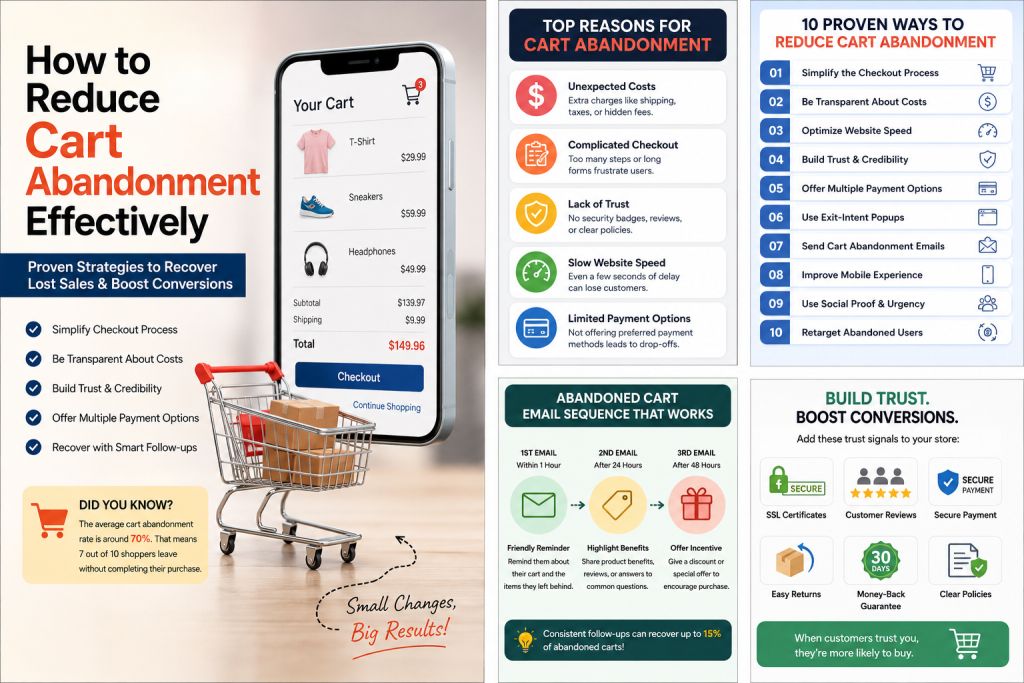
Industry data indicates that around 70% of online shopping carts are abandoned, meaning only about 3 out of 10 shoppers complete their purchase.
Key Causes of Cart Abandonment
To address the problem of shopping cart abandonment, it is first necessary to clarify its core underlying causes.
1. Unexpected Charges
Shipping costs, taxes and duties, and hidden fees often deter consumers during the checkout process.
2. Complex Checkout Process
Lengthy processes, excessive forms, and mandatory registration can easily frustrate shoppers.
3. Lack of Security Confidence
This paper argues that if an e-commerce shopping website is untrustworthy, consumers will hesitate to make purchases.
4. Slow Loading Times
Even brief delays can cause users to abandon their carts.
5. Insufficient Payment Choices
Consumers Prefer Diverse Selection Options, and Frequently Abandon Orders When Suitable Payment Methods Are Unavailable
How to Effectively Reduce Cart Abandonment
The following proven strategies consistently yield positive results.
1. Streamline the Checkout Process
Lengthy checkouts decrease conversion rates.
Recommended Actions:
– Allow guest checkout
– Minimize form fields to only what is necessary
– Implement auto-fill features
Real-World Insight:
An analysis revealed that cutting down form fields from over 15 to just 6 essential ones increased conversions by 30%.
2. Maintain Cost Transparency
Unexpected charges discourage customers from completing their purchases.
Best Practices:
– Display shipping costs upfront
– Provide free shipping thresholds
– Clearly show taxes and additional fees
Helpful Tip:
Prominently feature this message: “Free shipping on orders above ₹999.” This approach encourages higher cart values and lowers abandonment rates.
3. Website speed directly impacts conversion rates
Compress images, select high-speed hosting, and remove unused scripts.
A one-second delay can significantly lower conversions.
4. Establish Trust with Customers
Trust is critical to online shopping.
Core trust elements for overseas e-commerce:
- SSL certificates (HTTPS)
- Customer reviews
- Secure payment icons Transparent return policies.
I feel hesitant when browsing online stores that have no customer reviews; adding social proof can boost confidence to place orders.
Emotional Note:
I often hesitate to purchase from sites lacking reviews. Including social proof quickly increases customer confidence.
5. This paper outlines four types of current mainstream digital payment tools, including digital wallets (Paytm, PhonePe), BNPL, and others.
Rolling Out Retention and Purchase Incentives to Encourage Visitors to Place Orders When They Leave the Station
The e-commerce checkout page has three prompts designed to drive payment conversion: 10% instant discount, free shipping reminder, and limited-time promotion.
These types of promotions can recover lost revenue.
- Cards
- UPI payments
- Digital Wallets (Paytm, PhonePe, etc.)
- Buy Now, Pay Later (BNPL)
Offering multiple payment choices reduces the likelihood of cart abandonment.
6. Implement Exit-Intent Popups
When visitors attempt to leave, present an incentive to encourage them to complete their purchase.
Examples include:
- Discount offer: “Get 10% OFF if you complete your purchase now!”
- Reminder about free shipping Limited-time promotions
- Limited-time promotions
These offers help recover potentially lost sales.
7. Email remarketing can effectively recover abandoned shopping carts in e-commerce
We set up three follow-up emails for potential users who have engaged in the triggering behavior: a reminder is sent 1 hour after the behavior occurs, product advantages are promoted 24 hours after the behavior, and a discount is offered 48 hours after the behavior.
Example: You have unpurchased items in your shopping cart; please complete checkout before they expire.
8. Enhance Mobile Experience
A large number of users shop using mobile phones.
Mobile User Experience Triggers Substantial Customer Churn.
Focus on:
- Fast loading times
- Simple navigation
- One-click checkout
A poor mobile experience can result in lost customers.
9. Consumers generally tend to trust other people’s purchase decisions
Add:
- Only 3 units of this product remain in stock.
- 20 users are currently browsing this item, and
- Its user reviews can be viewed.
These elements accelerate consumers’ purchase decision-making.
10. When implementing retargeting marketing to re-engage users who abandoned their purchases, it is necessary to highlight the exact same products that were added to users’ shopping carts
Not all customers return on their own.
Utilize strategies like:
- Facebook Ads
- Google Remarketing
- Personalized advertisements
Ensure your retargeting campaigns prominently feature the exact product the customer left in their cart.
Advanced Approaches for 2026
All Business Entities Must Consolidate Their Competitive Advantages Through Unconventional Strategies
1. AI-Driven Personalization
The core of the creative practice is clean simplicity.
2. Predictive Discounting
Provide discounts to likely abandoners.
3. Intelligent Checkout Experience
Building Trust and Guaranteeing Speed Can Improve Conversion Rates, While Retargeting Emails Can Recover Lost Orders.
Common Pitfalls to Avoid
- Mandating account creation
- Concealing shipping fees
- Neglecting mobile optimization
- Overloading customers with reminder emails
Key Takeaways
This paper proposes that shopping cart abandonment is generally reversible.
- Clarity and usability are mandatory core criteria.
- Building Trust-Enhancing, Process-Speeding Workflows
- Can Boost Conversion Rates; Retargeting Emails Can Recover Lost Orders
Reducing Shopping Cart Abandonment Rates Requires Eliminating Minor Barriers Throughout the Customer Journey
Final Thoughts
The essence of reducing the shopping cart abandonment rate is resolving minor frictions in the user journey. Even small-scale optimizations can unlock considerable revenue.
Concrete actionable steps include adding trust badges and streamlining the checkout process.
All users who abandon their purchases are prospective customers, so these measures should be rolled out as soon as possible to track measurable improvements in conversion rates.
About the Author