Regardless of their size, all e-commerce businesses must master the core capabilities of data collection, interpretation, and execution to support their own achievement of sustainable growth.
This study will demonstrate that:
- Data analytics can accelerate e-commerce growth,
- Solve pressing industry problems, and
- Support brand expansion.
First, this paper defines data analysis in the e-commerce sector.
E-commerce data analysis is a systematic process that collects, analyzes, and interprets customer and operational data to support informed decision-making.
The core business data analysis module includes:
- User behavior analysis,
- Website performance tracking,
- Revenue trends,
- Marketing effectiveness, and
- Inventory and supply chain insights.
This set of retail analysis tools can answer three core types of questions:
- What are users’ consumption trajectories?
- What causes user churn?
- What is the priority of promotional resources?
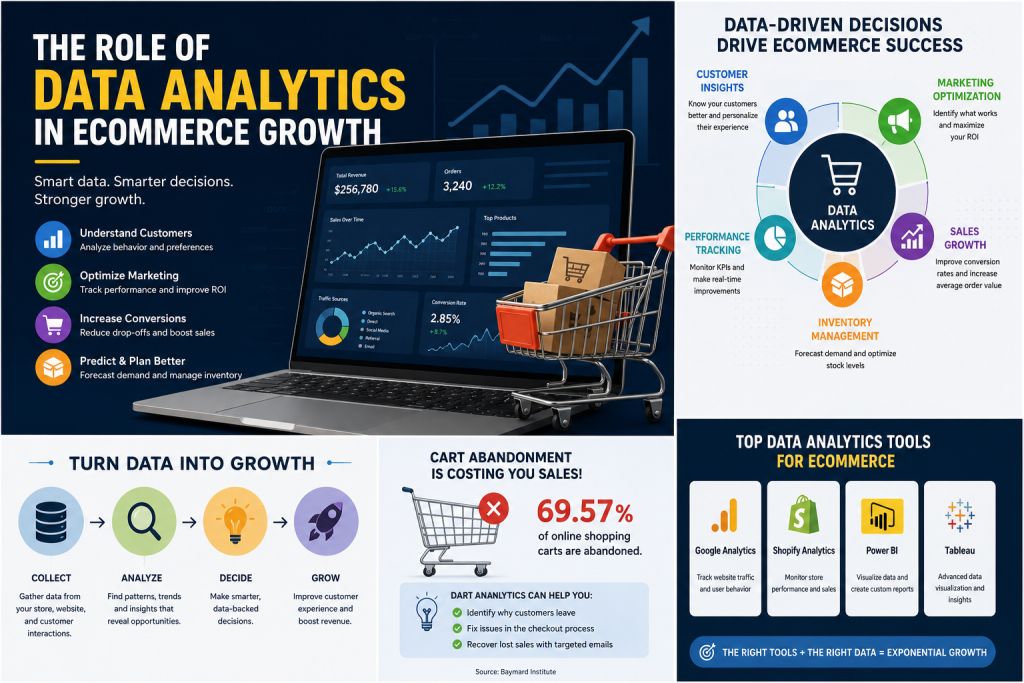
Why Data Analytics is Crucial for eCommerce Growth
1. Understanding Customer Behaviour
Professional data analysis can help users gain in-depth insights into their target customer base.
You can track:
- Pages customers visit,
- Their time spent on products,
- Items added to cart, and
- Purchase patterns
This helps you:
- Personalise user experience,
- Recommend relevant products,
- Increase conversion rates
Real-life insight:
The small clothing brand, which originally had improving customer traffic but sluggish sales, saw its monthly conversion rate rise by 28% after it made an upfront disclosure of its previously hidden shipping fees.
2. Personalised Shopping Experience
Contemporary consumers expect brands to understand their preferences.
Data analytics enables:
- Product recommendations,
- Personalized emails, and
- Dynamic website content
Optimize user experience, recommend appropriately matched products, and increase conversion rates.
Result:
- Higher engagement,
- Increased average order value (AOV),
- Strong customer loyalty
3. Improving Marketing ROI
A small apparel brand that saw favorable traffic trends but previously suffered from shopping cart abandonment due to failure to disclose shipping costs upfront recorded a 28% increase in its conversion rate within one month after implementing the corresponding adjustment.
Analytics helps you:
- Identify high-performing channels,
- Optimize ad spending,
- Track campaign performance in real time
For example:
- Which platform brings more conversions?
- Which email subject gets more clicks?
Expert tip:
Focus on metrics like:
- Customer Acquisition Cost (CAC)
- Return on Ad Spend (ROAS)
- Conversion Rate
4. Inventory and Demand Forecasting
Out of Stock and overstocking determine profitability.
Data analytics helps:
- Predict demand trends,
- Manage inventory efficiently,
- Reduce storage costs
Example scenario: Internet platforms push matching personalized products based on users’ browsing behavior.
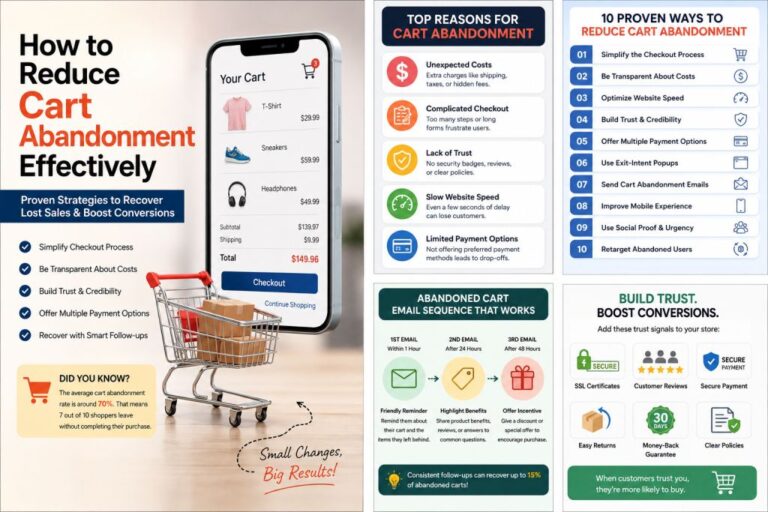
5. Reducing Cart Abandonment
Data has driven marketing to evolve from mere guesswork into a precise, results-oriented discipline.
Analytics can reveal:
- Where users drop off
- Payment issues
- UX problems
Solutions include:
- Simplifying checkout
- Offering multiple payment options
- Sending abandoned cart emails
6. Pricing Optimization
Identify high-performing channels, optimize advertising spending, and track the performance of marketing campaigns in real time.
With data analytics, you can:
- Analyse competitor pricing
- Test different price points
- Identify price sensitivity
Dynamic pricing strategy can increase both sales and profit margins.
Key Types of eCommerce Data Analytics
1. Descriptive Analytics
Sales Reports and Website Traffic Data Can Be Used to Retrace the Full Course of an Incident
2. Diagnostic Analytics
Abnormal business conversion cases pending investigation can be analyzed using churn analysis and journey mapping.
3. Predictive Analytics
What is the core element that needs to be predicted? Revenue and number of new users
4. Prescriptive Analytics
AI-driven recommendations and automated decision-making can be done through this.
Commonly used data tools for e-commerce operations are ordered by business process chain:
- Google Analytics (traffic insights),
- Shopify Analytics (store performance analysis),
- Power BI/Tableau (data visualization),
- CRM tools (customer data management)
Choosing the right tools Used in eCommerce Data Analytics depends on business size and goals.
Challenges in Using Data Analytics
While powerful, data analytics comes with challenges:
1. Data Overload
Excessive data will disrupt the decision-making process.
Solution: Focussing on key metrics (KPIs) cane be the solution
2. Data Accuracy Issues
Wrong data will lead to poor decision making.
Solution: It is necessary to implement regular data audits and a streamlined tracking system.
3. Lack of Expertise
Not all enterprises have data experts.
Solution:
- Use user-friendly tools,
- conduct internal training, and
- outsource services as needed.
A Personal Experience That Changed My Perspective
After this medium-sized handicraft shop increased its advertising budget, its sales failed to grow. The store’s traffic met qualifying standards, product page engagement was high, and the only issue was a serious flaw in its conversion process.
Site data from this analysis team shows that:
- The site’s overall traffic is trending positively,
- Product page engagement is high, and
- Yet its conversion rate is abnormally low.
E-commerce has three types of operational problems:
- Lack of customer reviews,
- Poor descriptions, and
- Unclear return and exchange rules.
The problem?
No customer reviews,
Poor product descriptions,
No return policy clarity
After they:
- Added real customer reviews,
- Improved product storytelling,
- Highlighted trust badges
The brand’s revenue doubled in three months, with no increase in its advertising spending.
This experience showed me:
That data provides not only numbers but also uncovers valuable insights.
Future Trends in eCommerce Data Analytics (2026 & Beyond)
1. AI-Powered Analytics
AI will automate insights and decision-making.
2. Real-Time Data Processing
Enterprises will take immediate action based on real-time data.
3. Voice & Visual Search Analytics
Comprehending how users search via voice and images.
This module explores the behavioral logic of voice-and-image search.
4. Privacy-Focused Analytics
Global data regulations are becoming increasingly strict, and ethical use of data is critically important.
Best practices for data analysis targeted at eCommerce practitioners establish 6 practical full-process operational guidelines:
- Anchoring launch-period goals,
- Tracking KPIs,
- Using concise dashboards,
- Conducting regular testing and optimization,
- Focusing on customer experience, and
- Integrating data with intuition.
Conclusion
Data analysis is the core element that underpins the growth of e-commerce.
This commercial tool can comprehensively assist enterprises in:
- Understanding their customers,
- Optimizing their decision-making,
- Refining their marketing operations, and
- Increasing their profitability.
Isolated data cannot generate value; only strategic application can unlock its utility.
Enterprises that use data effectively will continue to lead their industry peers.
About the Author