How Quantum-Safe Technologies Are Quietly Reshaping Espionage, Diplomacy, and Defence
A few years ago, if someone mentioned encryption in a policy meeting, most political leaders would nod politely and let the technical team handle it. Today, that’s no longer the case.
Quantum computing has changed the conversation.
Not because machines are already breaking every password. They are not. But because we know it is possible. In geopolitics, possibility is often enough to trigger action.
The shift toward quantum encryption and quantum-safe cybersecurity is more than a technical upgrade: it is both political and strategic, redefining how nations view power.
The Quiet Fear Behind Quantum Technology
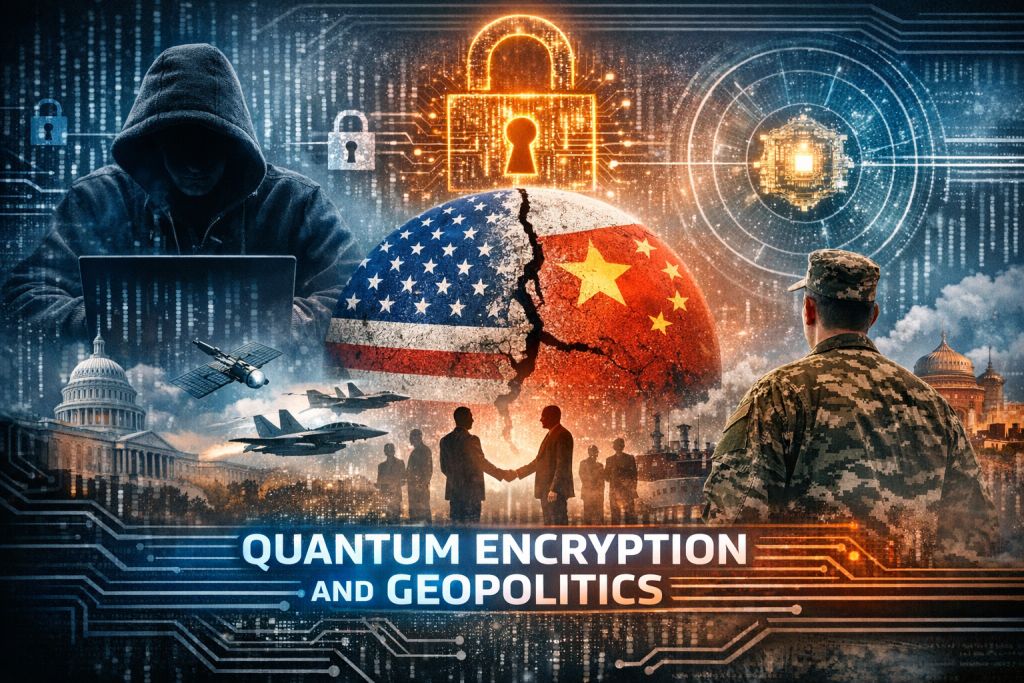
Most current encryption systems rely on mathematical problems that would take traditional computers thousands of years to solve. That protects bank transactions, military secrets, diplomatic cables, and everyday messages.
Quantum computers operate differently. If they mature as researchers expect, they could solve some of those mathematical problems much faster.
That possibility has introduced a quiet but serious fear in government circles: sensitive data collected today might be stored by adversaries and decrypted when quantum systems become strong enough.
This “store now, break later” threat is one of the biggest reasons governments are moving toward post-quantum cryptography and quantum-safe systems.
And when governments move, politics moves with them.
When Cybersecurity Becomes a Sovereignty Issue
I once participated in a discussion with a public-sector cybersecurity advisor who asked a simple question:
- “What if ten years of classified diplomatic conversations suddenly became readable?”
No one had an immediate answer.
The consequences would not be technical—they would be political.
All modern states depend on encrypted communication. Military command systems, energy infrastructure, financial networks, and election systems run on secure digital channels. If encryption collapses, trust collapses. When trust collapses, so does stability.
That is why quantum encryption is no longer treated as an IT matter. It has become a sovereignty issue.
Defence ministries are allocating funds for quantum-resistant systems. National security strategies now include timelines for migrating away from vulnerable cryptography. Intelligence agencies are reassessing which secrets must remain secure for decades, not years.
Cybersecurity is no longer a support infrastructure. It is national defence.
Espionage Is Entering a New Phase
Espionage has always adapted to technology. Codes replaced messengers. Satellites replaced physical observation. Digital interception replaced many traditional intelligence methods.
Quantum-safe encryption disrupts that pattern.
If encryption becomes resistant to decryption, even by powerful adversaries, traditional signal intelligence becomes far less effective. Agencies may find themselves locked out of communication channels they once monitored.
That forces a shift.
We may see:
- More reliance on human sources
- Greater focus on exploiting implementation mistakes
- Increased investment in offensive quantum capabilities
- A rise in supply chain infiltration
Here lies the tension: while countries work to defend themselves with quantum-safe systems, they also explore whether quantum computers can be used offensively before others transition.
This dual path creates a new kind of arms race: not nuclear, not conventional, but cryptographic.
And, as with every arms race, it carries political consequences.
Diplomacy in a Post-Quantum World
Diplomacy used to revolve around territory, military alliances, and trade agreements. Today, technology standards are part of the negotiation table.
Quantum-safe encryption influences:
- International cyber norms
- Export restrictions
- Technology sharing agreements
- Cyber warfare boundaries
If one bloc establishes dominant post-quantum standards, others may have little choice but to follow. Standards become influential. Influence becomes leverage.
At the same time, there is growing recognition that cybersecurity instability benefits no one. Some level of cooperation is necessary. No country wants a global financial meltdown triggered by broken encryption.
So diplomacy now walks a narrow path between competition and cooperation.
Defence Policy Is Being Rewritten
Military planners are not waiting.
Secure satellite links are being redesigned. Procurement policies now require quantum-resistant systems. Defence research budgets include dedicated quantum initiatives.
But beyond infrastructure, something subtler is changing: the logic of deterrence.
In traditional military strategy, strength was visible — ships, aircraft, missile systems. In cyber strategy, strength is invisible. It is the ability to withstand intrusion.
If quantum encryption makes certain systems untouchable, it alters strategic calculations. A nation confident in its cyber defences may feel less vulnerable. That confidence can influence foreign policy behaviour, sometimes stabilising, sometimes emboldening.
Technology does not just defend states. It shapes their posture.
The Emerging Divide
One issue that rarely gets public attention is access.
Developing and deploying quantum-safe infrastructure requires advanced research, skilled labour, and large investments. Not every country can afford that transition.
This risks creating a new digital divide: not based on internet access, but on cryptographic resilience.
Countries without quantum-safe systems may become structurally dependent on those that provide them. That dependency has political implications. Digital sovereignty becomes harder to maintain.
We have seen similar patterns with energy resources and semiconductor manufacturing. Quantum encryption could follow the same trajectory.
A Moment That Stuck With Me
During a strategy exercise, participants were asked to imagine a future headline:
- “Decades of Archived Government Communications Decrypted.”
It was hypothetical. But the room’s reaction was real.
The discussion shifted from abstract computing power to reputational damage, diplomatic fallout, exposed intelligence sources, and economic shockwaves.
It became clear that quantum encryption is not just about future security. It is about protecting the past.
Data longevity matters. Some information must remain confidential for 30, 40, or even 50 years. That long horizon forces policymakers to think differently.
The quantum shift is not sudden; it is gradual. The key takeaway is that its political effects will be widespread and endure for decades, requiring ongoing adaptation from policymakers.
The question remains: how should governments address these profound shifts?
The responsible path forward involves preparation, not panic.
Governments need to:
- Begin structured migration to post-quantum cryptography
- Train cybersecurity professionals in quantum-safe implementation
- Support international dialogue on cyber norms
- Help less-resourced nations adopt secure systems
- Encourage transparency where possible to reduce mistrust
Delay increases risk. But overreaction can create unnecessary geopolitical tension.
The key takeaway: finding a balance between preparation and overreaction is essential for an effective response.
The Larger Political Shift
History shows that major technological changes reshape political power. Nuclear technology transformed deterrence theory. The internet reshaped communication and diplomacy.
Quantum encryption may do both.
- It influences espionage. It affects the defence strategy.
- It alters diplomatic negotiations.
- It shapes economic competition and forces nations to rethink security in a data-driven world.
Above all, the key takeaway is that quantum encryption forces nations to rethink their definitions of security in a data-driven world.
Power is no longer only about territory or weapons. It is about protecting information — and sometimes about accessing it.
The political consequences of quantum encryption and cybersecurity shifts are already unfolding. The technology may still be developing, but the policy decisions are happening now.
Ultimately, the key takeaway is clear: decisions about quantum cybersecurity made today will quietly shape global stability for decades.
About the Author