The Hidden War Inside Decentralized Finance (DeFi)
In the decentralized finance (DeFi) space, cryptocurrencies originally centered their core development on the foundational features of trustless systems, fully transparent transactions, and decentralized architecture. Yet the dark underbelly of the industry is shattering the public’s idealized perception of the sector.
Today’s new generation of cybercriminals are no longer the stereotypical technical hackers; they are financial engineers proficient in utilizing artificial intelligence (AI) and smart contracts. This paper unpacks the logic of crypto money laundering, common blockchain hacking methods, and protective measures for individuals and enterprises.
What Are Crypto Mixers, and Why Are They Used?
The first criminal tool at the core of this paper’s discussion is the crypto mixer, also known as a tumbler: it obscures transaction traceability by pooling funds from multiple users and reallocating them.
Originally developed to protect privacy, the tool is now misused in three primary scenarios: concealing stolen crypto assets, anonymizing ransomware payments, and covering up proceeds from fraud and scams.
Authorities previously disclosed that before a large mixer platform was shut down, it had processed more than 1.3 billion euros worth of illegal Bitcoin transactions.
Additionally, hackers laundered the 1.4 billion US dollars stolen from Bybit using the Tornado Cash mixer. This originally privacy-focused tool has devolved entirely into an accomplice to criminal activity.
What Are Crypto Mixers, and Why Are They Used?
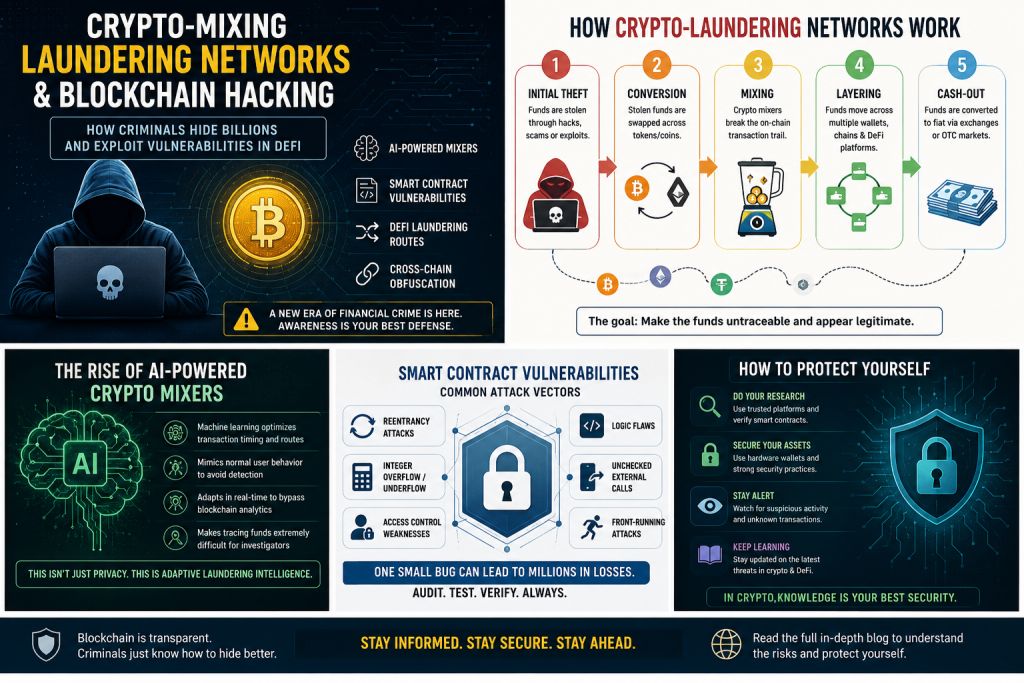
This paper first breaks down the five core stages of modern crypto money laundering, dismantling the general public’s misconception that money laundering is a single, standalone operation:
1. Initial theft, refers to hackers stealing assets by attacking exchanges, crypto wallets, or smart contracts.
2. The conversion stage, involves converting ETH to BTC and then to stablecoins to complete cross-currency money cleaning.
3. The mixing stage, uses tools to sever transaction trails.
4. The layering stage, involves repeatedly transferring assets across multiple wallets, cross-chain bridges, or DeFi protocols;
5. The cashing-out stage, converts assets into fiat currency via exchanges or OTC markets.
The Rise of AI-Powered Crypto Mixers
The paper then introduces a new type of AI-powered crypto mixer.
Compared with traditional tools, this mixer has four core capabilities:
- optimising transaction timing,
- simulating the behavior of regular users,
- evading on-chain analysis and detection, and
- dynamically adjusting wallet routing.
It can evolve in real time to counter forensic tracking efforts, leading to three major harms:
- unpredictable transaction patterns,
- shortened money laundering cycles, and
- increased success rates of criminal activities.
Blockchain Hacking: Beyond Simple Exploits
Finally, the paper corrects the public’s widespread misconception that blockchains are absolutely secure, but smart contracts introduce risk.
It breaks down four common types of smart contract vulnerabilities:
- reentrancy attacks,
- integer overflow/underflow,
- logical flaws, and
- access control loopholes.
Citing industry research data, hundreds of vulnerabilities have been discovered in thousands of smart contracts, causing massive economic losses.
New Threat: Malware Hidden Inside Blockchain
We first put forward an entirely new type of blockchain security threat: attackers can directly embed malware into on-chain smart contracts. This type of attack bypasses most traditional off-chain security screening logics, and it has not been systematically included in mainstream industry security reports before.
Security researchers have found that blockchain attackers store malicious code, launch poisoning attacks, and leverage immutable infrastructure to evade removal.
This paper’s authors propose that the immutability of blockchains has given rise to a permanent attack vector, and the logic of cyberattacks has shifted from intrusion to leveraging blockchains as an attack infrastructure.
Next, we sort out the evolutionary trajectory of crypto money laundering, marking clear transition logic with →: Traditional Mixers → New DeFi-native tools.
The Shift from Mixers to DeFi Laundering
At present, crypto transactions no longer rely on traditional mixers, and have instead adopted:
- Decentralized exchanges (DEXs),
- cross-chain bridges, and
- yield farming platforms.
Industry experts note that cryptocurrency hackers have abandoned traditional cryptocurrency mixers and shifted to using DeFi tools to evade detection.
The difficulty of tracking cross-border transactions continues to rise, stemming from fragmentation, decentralization, and ambiguous jurisdiction.
Real-Life Insight: What I Observed in a Blockchain Audit
Recent public on-chain traceability data shows that more than 70% of large-value crypto money laundering operations have abandoned the centralized Mixers they relied on in the early stage, and instead use the cross-chain liquidity and permissionless interaction attributes of DeFi protocols to conceal fund trails. Finally, we corroborate this shift with first-hand DeFi project security audit cases that our team personally participated in.
In the audit of a leading lending-type DeFi project completed last month, we observed for the first time that criminal groups use machine learning models to optimize intelligent fund splitting path operations, completely moving away from the primitive early model of manually splitting funds.
During a security review of a DeFi project, something unusual appeared:
- An anomaly was discovered during a security review of a certain DeFi project.
- We observed a suspicious wallet on a Web3 blockchain that interacted with the target contract at high frequency with short intervals. Within a few minutes, funds linked to this wallet passed through more than 20 addresses, and every transaction was designed to mimic the behavior of ordinary users.
But deeper analysis revealed:
- All surrounding conditions are normal.
- The core nodes for tracking illicit crypto funds are transaction initiation, coin mixing circulation, and vulnerable wallets.
This empirical evidence also confirms that the technical iteration speed of crypto crime has far outpaced the average upgrade pace of the industry’s security defenses.
Why Crypto Laundering Is So Hard to Stop
This paper outlines four core characteristics of blockchain: the pseudonymity that decouples cryptocurrency wallets from user identities, the globality that operates free from any central authority’s control, the transaction speed that enables second-level fund transfers, and the advanced obfuscation formed by the combination of crypto mixers, decentralized finance (DeFi), and artificial intelligence (AI), which can conceal transaction trails.
Following the shutdown of non-compliant services, new services of the same type emerge rapidly, while some cryptocurrency mixers continue to operate secretly.
- Pseudonymity
Wallets are not directly linked to identities.
- Global Nature
No single authority controls blockchain networks.
- Speed
Funds can move across chains in seconds.
- Advanced Obfuscation
Mixers + DeFi + AI = near-invisible trails
Even when services shut down, others quickly emerge. Some mixers continue operating secretly after closure.
Risks for Businesses, Investors & Developers
- Attention all investors:
Your funds may be linked to illegal activity, and your assets could be frozen by the exchange.
- Web3 Developers:
Smart Contract Vulnerabilities and Substandard Audits Amplify Millions in Losses
Cryptocurrency users must strictly comply with three core security guidelines:
- refrain from interacting with unknown smart
contracts, - use wallets equipped with security alert functions, and
- verify transaction history prior to receiving cryptocurrency.
We have also listed actionable, implementable protective measures targeting three groups: crypto users, developers, and institutions.
How to Protect Yourself (Actionable Tips)
- Smart contract developers must conduct audits, use fuzz testing, and follow secure coding standards.
- Relevant organizations and institutions are required to invest in blockchain forensics tools, monitor suspicious cryptocurrency wallets, and implement anti-money laundering policies.
The Future: Regulation vs Innovation
Governments across the world have joined forces to carry out a strict crackdown on cryptocurrency mixing platforms, seizing the platforms, arresting their operators, and investigating billions of dollars in illicit funds tied to these cases.
Countries worldwide are continuously tightening regulation of the crypto sector, yet three technological development trends have emerged within the industry:
- the iteration of privacy tools,
- AI-enhanced anonymity, and
- increasingly sophisticated hacking techniques.
The clash between regulation and innovation has become sharply pronounced, and balancing privacy and security has become a core issue.
Final Thoughts
The authors of this paper argue that mixers, money laundering networks, and blockchain hacking attacks are by no means mere technical issues, but rather threats to global financial security.
At present, three new combinations of risks have formed:
- AI-powered mixers,
- smart contract vulnerabilities, and
- decentralized money laundering systems.
The first step in addressing these risks is to position awareness as the first line of defense, and to alert investors, developers, and business owners that unknown risks in the crypto space cause the greatest harm.
About the Author