Introduction: The Demand for Speed in Today’s Market
If a person suddenly discovers at 10 p.m. that they have run out of milk at home, in the past they would either grit their teeth and go out in the dark to buy supplies, or wait until the following day to make the purchase. Today, they can place an order via a mobile phone app, and receive the item delivered to their door through instant delivery within just a few minutes.
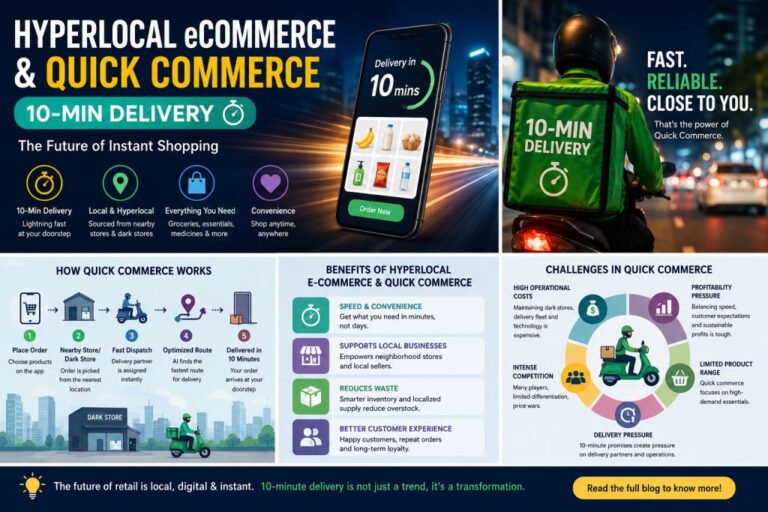
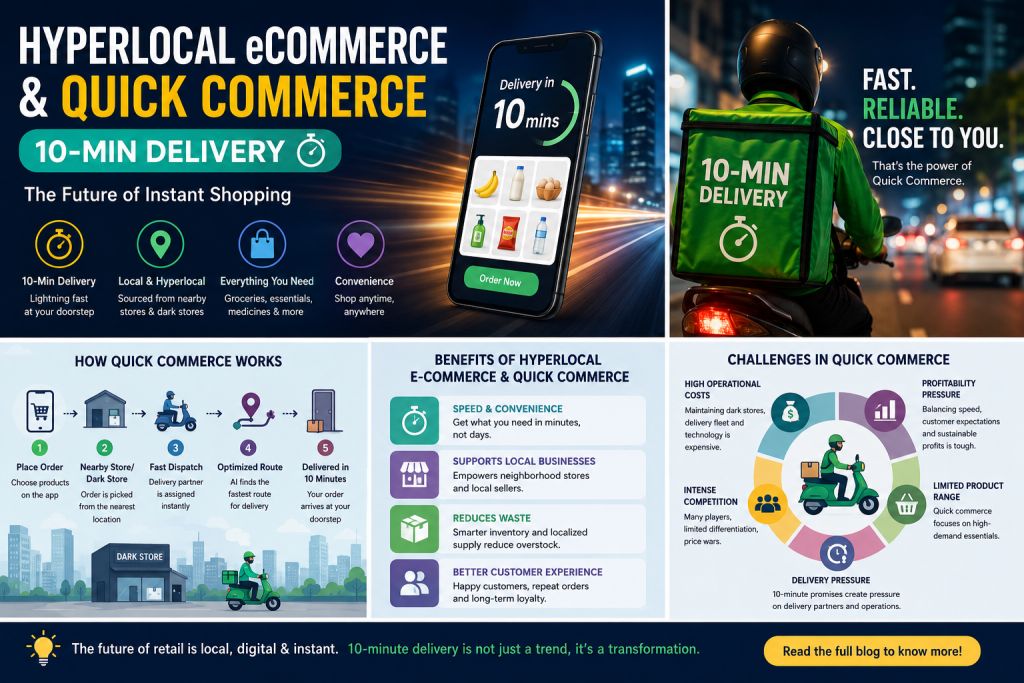
Hyper-local e-commerce and instant retail (q-commerce) are reshaping consumer habits.
As 10-minute delivery platforms continue to expand, core elements such as speed have been added to merchants’ dimensions of competition, beyond the traditional factors of pricing and product selection. This paper focuses on hyperlocal eCommerce, investigating its operating mechanisms, mainstream trends, potential barriers, and future prospects.
What is Hyperlocal eCommerce?
Hyperlocal eCommerce is an online retail model that links consumers directly with neighborhood shops and storage facilities. Rather than dispatching goods from remote distribution centers, purchases are processed and delivered using nearby inventory locations.
Primary Characteristics:
- Emphasis on neighborhood retailers and vendors
- Accelerated shipping times (frequently between 10 and 30 minutes)
- A restricted yet highly targeted assortment of goods
- Live monitoring of stock levels
This framework is particularly successful in metropolitan regions, as dense populations allow for rapid delivery services.
What is Quick Commerce (10-Minute Delivery)?
Quick commerce, or q-commerce, represents the next generation of hyperlocal e-commerce, specializing in exceptionally fast deliveries that usually take between 10 and 20 minutes.
How the Process Works:
- Small-scale fulfillment centers, known as dark stores, are strategically located throughout urban areas.
- Orders are immediately packed using readily available inventory.
- Couriers are dispatched in a matter of seconds.
- Artificial intelligence and advanced algorithms are utilized to determine the fastest delivery routes.
Businesses operating in this industry provide consumers with unparalleled convenience through immediate order fulfillment.
The Growing Trend of Hyperlocal and Quick Commerce
1. Shifts in Consumer Behavior
Modern shoppers now expect:
- Immediate delivery
- Low-effort transactions
- On-demand access
Rather than planning shopping trips days ahead, consumers are increasingly driven by impulse and immediate needs.
2. Urban Lifestyles
Hectic daily routines and congested city traffic have turned quick commerce into a necessity. For urban residents, using delivery applications for minor purchases is frequently more practical and efficient than visiting physical stores.
3. Increased Smartphone Accessibility
The broad availability of budget-friendly smartphones and reliable internet connectivity has allowed millions of people to effortlessly access and utilize delivery platforms.
4. Pandemic-Driven Acceleration
The COVID-19 crisis significantly sped up the adoption of these services. It pushed many individuals who had never previously purchased groceries online to depend heavily on hyperlocal delivery options.
A Real-Life Experience: When 10-Minute Delivery Proved Essential
While working late to meet a strict deadline on an important project, my laptop charger suddenly broke, leaving me highly concerned about my ability to finish the work on time.
I turned to a quick commerce application to purchase a compatible replacement. In just 12 minutes, a delivery driver arrived at my doorstep with the new charger.
This situation demonstrated that rapid delivery services provide much more than simple convenience; they offer crucial reliability during urgent circumstances.
The evolution of quick commerce from a supplementary perk to an indispensable service continues to be a major factor fueling the industry’s growth.
Advantages of Hyperlocal eCommerce and Quick Commerce
1. Exceptionally Fast Delivery
The main benefit is rapid service. Receiving essential items in as little as 10 minutes significantly improves user convenience.
2. Empowers Local Enterprises
These hyperlocal systems frequently collaborate with neighborhood shops, assisting small businesses in growing their online footprint.
3. Minimized Inventory Spoilage
By maintaining supplies of highly sought-after goods, fulfillment centers can effectively decrease excess inventory and unnecessary waste.
4. Enhanced Consumer Experience
The rapid satisfaction of shopper demands results in increased customer loyalty and overall contentment.
Obstacles in the Quick Commerce Model
Although highly appealing, the quick commerce industry confronts several major hurdles.
1. Elevated Operational Expenses
Maintaining dark stores, compensating delivery personnel, and overseeing logistics create substantial financial burdens.
2. Struggles with Profitability
A number of businesses struggle to align ultra-fast delivery services with long-term financial sustainability.
3. Restricted Inventory Selection
In contrast to standard e-commerce, quick commerce caters almost entirely to frequently purchased, high-demand goods.
4. Strain on Delivery Staff
The promise of ten-minute deliveries places intense stress on couriers, prompting various ethical dilemmas.
The Function of Technology
Technology acts as the fundamental backbone of hyperlocal e-commerce.
Core Innovations:
- Artificial intelligence for forecasting demand
- Algorithms designed to optimize delivery routes
- Live inventory management systems
- Geolocation monitoring
Together, these technological advancements facilitate streamlined order fulfillment and rapid delivery.
The Rapid Expansion of Hyperlocal eCommerce in India
India currently stands out as one of the most rapidly expanding markets for quick commerce.
Key Factors Making India an Ideal Market:
- High urban population density
- An expanding middle-class demographic
- Rising smartphone penetration
- A strong consumer preference for convenience
Rapid adoption is highly visible in major metropolitan areas like Bangalore, Delhi, and Mumbai, along with other developing urban hubs. Furthermore, this trend is expanding into smaller cities, where consumers increasingly demand quicker delivery times, illustrating a swift shift in customer expectations.
The Future of Quick Commerce: What to Expect
1. Growing Beyond Groceries
The quick commerce sector is broadening its reach to include:
- Electronics
- Pharmaceuticals
- Apparel
- Everyday necessities
2. Artificial Intelligence Customization
Shopping applications will predict consumer requirements even before a search is initiated.
3. Eco-Friendly Logistics
The use of electric vehicles coupled with green packaging solutions will turn into standard industry norms.
4. Expansion into Smaller Cities
Tier 2 and Tier 3 cities are set to emerge as the next significant markets.
Achieving Success in Hyperlocal eCommerce
All business owners may adopt the subsequent strategies to adjust their operations.
1. Prioritize Location Strategy
Establish warehouses in close proximity to your customer base.
2. Enhance Inventory Management
Keep high-demand items in stock to accelerate inventory turnover.
3. Adopt Advanced Technology
Utilize artificial intelligence and data analytics to enhance demand forecasting.
4. Collaborate with Delivery Networks
Forming robust partnerships with logistics providers is crucial for reliable distribution.
Final Thoughts
Hyper-local e-commerce and ultra-fast retail are by no means a short-lived craze wrongly judged by the general public, but rather the ultimate future of the retail industry.
Currently, the transformation trend in the consumer sector is clearly visible. Consumer mindsets have shifted from delaying purchases to pursuing instant gratification, with an increasing focus on speed and convenience. Enterprises must proactively evolve to retain their competitive advantages.
Quick Commerce has become a permanent, core essential need in the general public’s daily life, covering three core consumption scenarios: last-minute fresh produce, urgently needed daily necessities, and pure convenience-focused purchases. 10-minute delivery is reshaping consumers’ shopping expectations.
In today’s consumer market, the mainstream core standard for evaluating goods is no longer their practical necessity, but delivery speed.
Conclusion
Hyper-local e-commerce and instant e-commerce have reshaped the retail sector through ultra-rapid delivery, innovative solutions, and customer-centric strategies. While they still face ongoing persistent challenges, they hold considerable growth potential.
This enables consumers to obtain daily necessities immediately.
At present, businesses of all types are presented with new opportunities, yet they also face fierce competition.
This study predicts that in future consumption scenarios, waiting to purchase will completely cease to be a necessary option.
If you find this practical piece on e-commerce trends useful, please share it, and continue to follow for the latest developments.
About the Author