AI is rapidly reshaping the personal financial management industry. What began as early-stage basic budgeting applications has now evolved into autonomous intelligent financial ecosystems that can manage every dimension of a user’s financial life without any action required from the user.
When you wake up in the morning, you will find that all tasks—investment adjustments, bill settlements, tax sorting, and savings target resets—have been completed automatically. Do not mistake this for a scenario that only exists in science fiction; such use cases have long been implemented in real life.
What Is an AI Autonomous Financial Ecosystem?
We tie the development of this professional field to the public’s daily financial experience.
These AI-driven autonomous financial ecosystems are supported by:
- machine learning,
- natural language processing,
- predictive analytics,
- blockchain that only applies to select scenarios, and
- real-time financial data integration.
Their core goals are:
- To eliminate process friction,
- reduce human error, and
- automatically optimize financial outcomes.
Unlike traditional financial tools that require users to manually input information, these systems can learn user behavior, adapt to users’ goals, and make decisions in real time.
Can AI Manage All of an Individual’s Personal Finances?
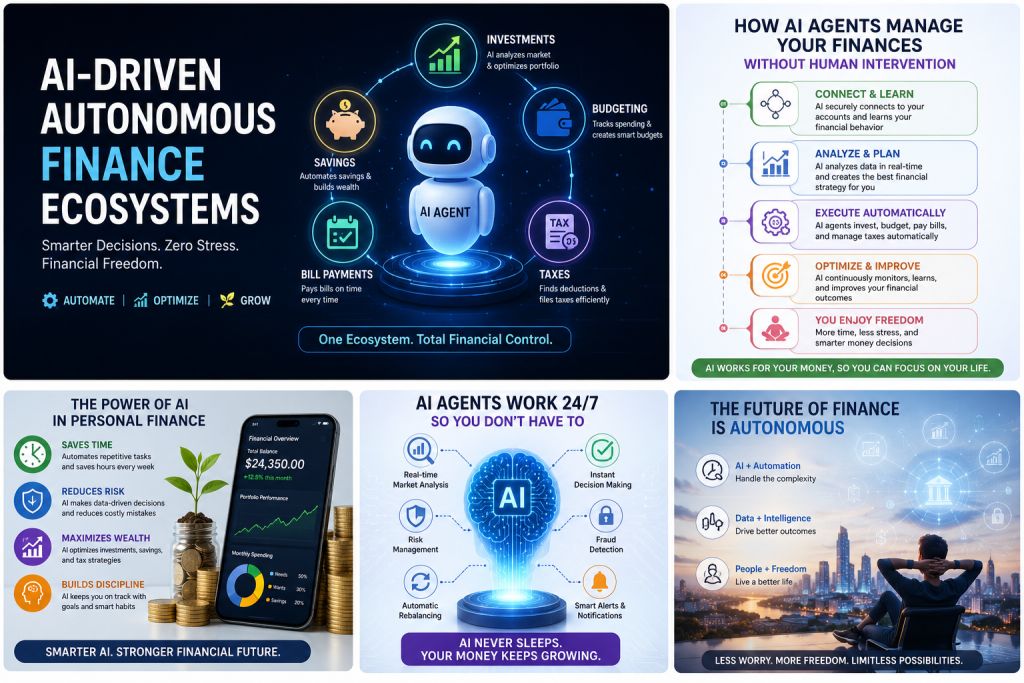
Today, AI agents are now capable of handling the core personal finance tasks of ordinary individuals. We have sorted out five essential high-demand application scenarios to help you clearly understand the tangible value this technology can bring you.
The first scenario is investment management.
Ordinary people often face barriers to the professional expertise required for risk diversification and market-timed trading, and they are easily swayed by emotions that lead to draining internal decision conflict. For example, a friend of mine switched to using an AI-powered robo-advisor, and not only did he escape the emotionally exhausting cycle of chasing asset rallies and selling off during dips, but he also earned stable long-term returns.
The second scenario, smart budgeting, targets the widespread pain point that many people cannot sustain consistent expense tracking.
It automatically syncs all income and expenditures to help you put your income and spending plans into practice. Automatic bill payment.
The third scenario, eliminates late fees incurred from missed payments by taking over all the tedious work of settling bills.
Fourth, tax management organizes all required tax filing materials, solving the problem of complex and time-consuming tax preparation.
The fifth scenario, smart savings and wealth growth, helps you build a long-term plan tailored to your personal circumstances, addressing the gap most ordinary people face of lacking a systematic wealth plan. All of these technical capabilities translate into real, directly perceptible benefits for you, and the entire process uses no obscure technical jargon.
A Personal Reflection: When AI Felt “Too Smart”
Out of curiosity, I tested an AI-powered personal finance application.
I originally only expected it to help me track my daily expenses, but within just a few weeks, it far exceeded my expectations: it flagged wasteful spending on my unused subscriptions, and even proactively put forward cancellation suggestions.
This experience, while not unsettling, was extremely illuminating. It was more than a tool for managing funds; it was a lesson in learning to manage personal finances rationally.
This type of autonomous financial ecosystem has five core values:
- It saves the time spent on manual operations,
eliminates human error, - Improves the reliability of decision-making through data support,
- Enables scalable customization of personalized strategies, and
- Helps users develop the habit of financial self-discipline.
Challenges and Risks You Should Know
Although current AI-driven financial ecosystems boast outstanding capabilities, they still pose four core risks:
- Data privacy concerns,
- Excessive reliance on automation,
- Algorithmic bias, and
- A lack of human judgment.
Trust is the cornerstone of autonomous finance. People need to confirm that these AI systems meet three requirements:
- They act in users’ best interests,
- Protect user data, and
- Support transparent decision-making.
Explainable AI (XAI), which can clearly explain the causes behind financial decisions, is exactly the targeted solution to fill this trust gap.
The Future of AI-Driven Finance
The future fully autonomous AI-driven financial ecosystem has four core functions at its center:
- AI agents negotiating bill subscriptions,
- Smart contracts automating transactions,
- Voice assistants enabling conversational financial management, and
- Real-time financial decision-making.
When this ecosystem is fully realized, managing money will become as invisible and unobtrusive as access to electricity. Who can benefit the most from this new type of ecosystem?
Core matching groups include:
- Busy working professionals,
- Small business owners,
- New investors, and
- People who struggle to maintain financial self-discipline.
Advanced users can further gain benefits from combining AI-driven efficiency with human oversight.
Ordinary people can start small,:
- First testing AI budgeting apps,
- Robo-advisors,
- Automatic bill payment, and
- Tax automation tools.
to gradually build their own integrated financial ecosystem.
Final Thoughts
Many people mistakenly assume that AI-driven autonomous finance is merely a short-term trend, but in fact it constitutes a profound transformation in the relationship between humans and money.
Under the new division of labor in human-computer collaboration,:
- AI handles complex tasks,
- While humans focus on core objectives,
- Which accelerates the intelligent,
- Upgrading of financial decision-making.
The core principle for its real-world implementation is balance: AI only strengthens, rather than replaces, human financial cognition.
After personally testing these types of tools, I found that they do more than just enable automation; they can also sort out capital flows, forecast financial prospects, and unpack the logic of accumulating long-term wealth through aggregated small financial choices. These tools act as a catalyst rather than a mere utility, empowering people to lead smarter, more confident financial lives.
About the Author