Every displaced person faces a turning point when they realise they can no longer stay in their home.
People often come to this understanding slowly and quietly.
For some, this moment comes after their homes flood again and again. For others, it happens when saltwater ruins the last harvest or when a parent sees that their child no longer has a future there.
Climate change forces people around the world to leave their homes.
This is not a distant or theoretical problem.
It is happening now.
Yet, international law still does not recognise people displaced by environmental collapse as refugees.
Climate Migration Is No Longer a Future Problem
Talks about climate change often focus on numbers like temperature increases, greenhouse gas levels, and rising seas.
But migration is not something people experience through data or charts.
Migration happens in everyday places like homes and schools.
Families pack what they need most. Older relatives may not want to move, and children ask questions that are hard to answer.
Some disasters force people to leave suddenly. In other cases, worsening environments drive people to leave over time.
Regardless of speed, displacement always uproots people.
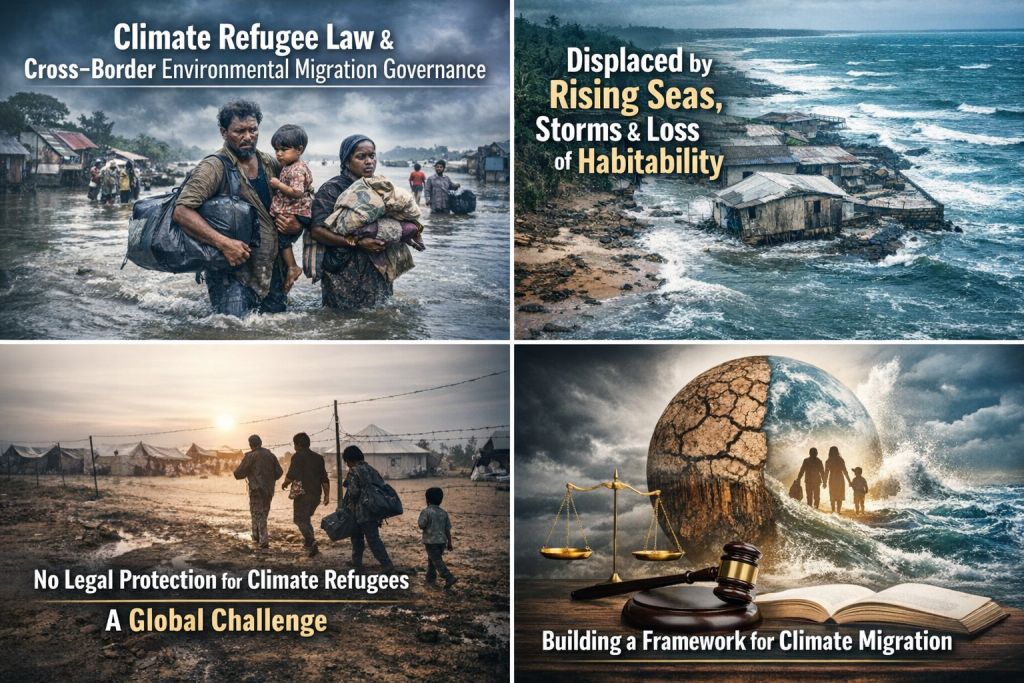
People in places like Pacific islands, South Asian river deltas, and drought-hit African villages are already moving because their homes can no longer be lived in.
Why Climate Refugees Still Don’t Exist in Law
The current global refugee system was made to help people fleeing conflict and persecution, not environmental collapse.
The legal definition of a refugee comes from agreements written more than seventy years ago. Those laws protect people escaping violence or political repression. They do not include rising seas, failing harvests, or disappearing coastlines.
Environmental disasters force people to cross borders, but the law does not recognise them as refugees.
Instead, they are called “irregular migrants.”
This label deprives them of access to legal protections.
Without official recognition, authorities may detain, deport, or leave displaced people in limbo. Many cannot work legally, children miss school, and medical care becomes harder to obtain.
They are forced to live without legal protection.
The Human Cost Behind Policy Gaps
During my research, I met a schoolteacher on a small island who stayed after most people left. She spent her last months recording local songs and stories, fearing their loss when the island disappeared.
That story has stayed with me.
Climate migration is not just about losing homes.
It also means losing language, cultural memories, and a sense of belonging.
I have spoken with families who split up so some members could work abroad while others cared for older relatives. Parents face impossible choices. Teenagers grow up too quickly.
These are not just headlines. These are quiet tragedies happening every day.
Current Global Responses Are Too Weak
There are some international efforts to address these challenges.
The Global Compact for Migration acknowledges climate displacement. Some countries offer temporary protection after disasters. Human rights law prohibits forced returns in extreme cases.
But these steps fail to create a complete or unified system.
Most of these measures remain voluntary, temporary, and politically unstable.
No binding global system exists for people displaced by climate change.
This gap makes protection unpredictable and inconsistent.
What a Real Climate Refugee Framework Should Include
To truly address environmental migration, we need to make several important changes.
Legal Recognition
People forced to move by rising seas, extreme weather, or unlivable conditions must be officially recognised under international law.
Safe Cross-Border Pathways
People should not have to risk their lives to find safety. Tools such as climate visas, relocation programs, and regional agreements can provide them with protection and dignity.
Shared Responsibility
Countries with more resources should help those most affected by climate displacement, since global emissions are the cause.
Guaranteed Rights
People should retain access to healthcare, education, housing, and legal services after crossing a border.
Strong Adaptation Support
Not every community must relocate. Investing in flood barriers, improving water systems, and adopting sustainable farming practices helps many people remain safely in their homes.
Building a New Legal Framework
There are several ways to improve how we manage climate migration.
Some experts want to expand refugee law, while others suggest creating a new international treaty just for climate displacement.
Regional agreements can also help, especially in vulnerable regions such as South Asia, the Pacific, and parts of Africa.
No matter which approach you choose, you must include affected communities in the policymaking process. Policymakers who ignore the voices of displaced people will not succeed.
Why We Can’t Wait
Climate-related migration occurs more frequently.
If we wait, more people will be stuck in legal limbo, face more exploitation, and see their communities break apart.
If we act now, we can provide stability, dignity, and opportunities for planning.
Climate refugees are not asking for special treatment.
They just want to be recognised and acknowledged.
Final Thoughts
Climate change deeply transforms how people move around the world.
Oceans are rising. Ecosystems are breaking down. Heat is becoming extreme.
People leave their homes, not by choice, but because staying is no longer possible.
Current laws fail to keep up with these new realities.
Climate refugee law and cross-border migration rules are no longer just academic ideas. They are urgent needs.
Behind every statistic is a family that had to pack up and leave their home.
Whenever the environment changes, people and policymakers must tackle tough choices.
Will we choose to ignore these challenges, or address them?
Or will we find real solutions to address them?
About the Author