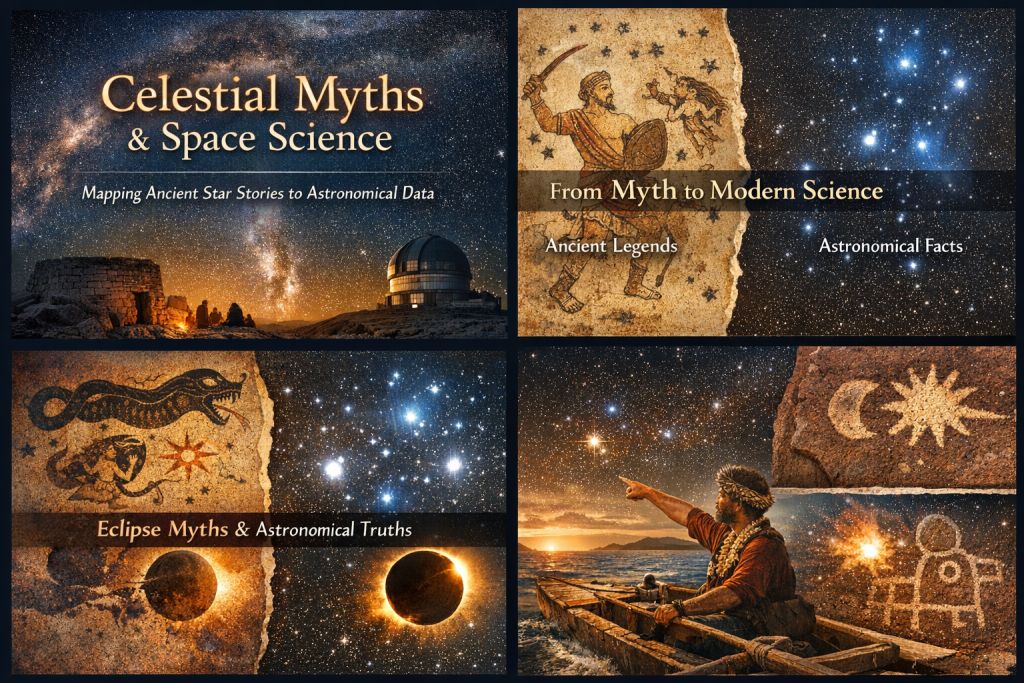
From the earliest days, people have gazed at the sky and wondered about the stars. Before there were equations or observatories, storytellers noticed how the stars returned with the seasons, how some changed in brightness, and how strange lights sometimes moved across the sky. They didn’t have telescopes or computers, but they had time, curiosity, and the patience to watch the sky each night.
Even today, with satellites above us and astronomers exploring far-off galaxies, many old stories remain. I’m often amazed by how closely these myths match real astronomical events. It feels like ancient storytellers were early scientists, using stories to make sense of what they saw.
This blog explores how ancient star myths reflect real events in the sky, and how learning about them can help us see both our history and the universe differently.
Why the Old Sky Stories Still Matter
It’s easy to assume ancient people knew less than we do. We often imagine them surrounded by darkness and superstition. But many cultures were actually very observant. With clear skies above, the night became their calendar, compass, and teacher.
I’ve spent nights in remote places—deserts, mountains, and quiet coastlines—and the sky there is nothing like what we see in cities. It almost feels alive. In those places, myths make perfect sense. They weren’t just for entertainment; they were a way to record and share knowledge.
Modern research in archaeoastronomy now reveals something remarkable:
- Many myths accurately describe real events.
The Pleiades: A Story Shared Across Continents
Few constellations carry as many legends as the Pleiades, often called the Seven Sisters.
Strangely, almost every culture, including Greek, Japanese, Indian, Aboriginal Australian, and Native American, describes them as a group of seven.
Stand outside today and count them. You’ll probably see six.
So why seven?
Modern star measurements, especially from the Gaia spacecraft, show that one of the stars, Pleione, was much brighter thousands of years ago. Many scientists now believe ancient people actually saw seven stars.
When I first heard this, it felt like unlocking a mystery. It suggests those stories could be memories passed down through thousands of generations.
Myths of Sky Explosions and Real Supernovae
Native American stories sometimes speak of:
- “a new sun in the sky,”
- “the night that turned brighter than day,”
- or “a star that burst like fire.”
These descriptions may sound poetic, but astronomers recognized them right away. They match the supernova of 1054 CE, the same event recorded by Chinese and Japanese astronomers. This explosion created what we now call the Crab Nebula.
When I saw a picture in a book of rock art showing a bright star next to a crescent moon, just as recorded during the supernova, I had to stop and think. That drawing wasn’t just art; it was a scientific observation carved into stone.
Rahu and Ketu: Myth as Pure Astronomy
Few myths combine symbolism and science as well as the Indian stories of Rahu and Ketu.
According to legend, an immortal demon’s head (Rahu) swallows the Sun or Moon, causing eclipses, while the tail (Ketu) influences cosmic cycles.
Modern astronomy uses the same names, Rahu and Ketu, for the lunar nodes, which are the points where the Moon’s orbit crosses the Earth’s path around the Sun. Eclipses only happen when the Sun and Moon line up with these nodes.
The myth turned out to be a carefully coded scientific explanation.
The Gemini Twins and Real Star Behavior
In Greek mythology, the twins Castor and Pollux are always together, but one is mortal, and the other is immortal. This isn’t just poetic storytelling.
Pollux is a giant star, slowly expanding and aging, while Castor is actually a complex star system with brightness that changes in unpredictable ways. The myth matches the real traits of both stars surprisingly well.
This made me realize how closely ancient people must have watched the sky, night after night and year after year.
Polynesian Navigation: Stories as Tools
A few years ago, when I visited New Zealand, I joined a short workshop with a Polynesian navigation group. At dusk, one of the master navigators pointed to a rising star and said, “That is our road.”
There were no maps. No instruments. Just the sky.
They described the stars using family-like stories, saying who leads, who follows, who rises angry, and who appears calm. These stories weren’t random; they held information about direction, timing, distance, and ocean patterns.
Later, I learned that astronomers have confirmed many of these star paths using modern mapping tools. The myths were actually navigation guides hidden in stories.
It was one of the most humbling experiences I’ve ever had.
Why Ancient Myths Encoded Science
Stories were easier to memorize than numbers.
A myth could be passed from a grandmother to her grandchildren without losing meaning.
Myths helped people:
- track seasons
- plan agriculture
- predict weather changes
- navigate long distances
- prepare for monsoons or winters
- mark time
- understand the heavens
If something in the sky changed—a star brightening, a comet appearing, or a rare alignment—it often became the beginning of a new story.
These stories traveled farther than any written text.
Modern Astronomy Helps Us Decode Ancient Knowledge
Today, scientists can recreate the night sky from thousands of years ago using tools like:
- The Gaia space telescope
- radio astronomy
- star catalogs
- digital sky simulations
Researchers can now check whether a myth describes a real event.
For example:
- Ancient Chinese dragon myths often align with meteor showers.
- Egyptian stories about Isis searching for Osiris align with the heliacal rising of Sirius.
- Norse tales of a long, brutal winter align with data on ancient volcanic eruptions.
When you look at myths with both cultural and scientific understanding, they start to seem like coded observations rather than just fantasy.
A Personal Moment That Changed My Perspective
During a research trip to the Thar Desert, I sat with a group of elders who talked about Orion. They didn’t call it Orion, but used a local name meaning “The Three Watchers.”
One elder told me, “When the three watchers rise straight up, cold winds are coming. When they lean, rains are close.”
Later, I checked the astronomical positions out of curiosity.
Sure enough, Orion’s belt does seem to tilt or stand upright depending on the season.
A simple observation, told through a story.
Science and myth, side by side, quietly sharing stories around the fire.
How This Helps Today’s Readers, Students, and Explorers
Understanding the link between myth and astronomy isn’t just a historical curiosity. It can actually help us:
- See the sky with new meaning rather than as random dots
- Connect science with culture, making astronomy feel more human
- Appreciate indigenous knowledge systems that deserve much more respect
- Enrich your travel experiences, especially if you love stargazing
- Strengthen educational storytelling, especially for young students
Myths make the night sky feel personal. Science helps us understand it. Together, they make it unforgettable.
The Future of Studying Ancient Star Lore
With AI, big data, and powerful simulations, researchers now use digital tools to:
- Compare myths across cultures
- match stories with celestial events
- reconstruct ancient skies
- Identify forgotten supernovae or comet paths
Some AI studies have already found strong similarities between star stories from cultures that never met, suggesting they were describing the same real events in the sky.
We’re entering a new era of digital cultural astronomy, where myth and science enrich each other rather than compete.
Final Thoughts: Two Languages, One Sky
Whether you use a smartphone to track constellations or listen to a grandparent talk about the stars, you’re doing what people have always done: trying to make sense of a universe much bigger than us.
Ancient myths weren’t wrong. They were simply told in the language of the time.
Space science gives us new tools.
Myth gives us meaning.
Together, they remind us that we haven’t changed much at all.
We’re still looking up, searching the same sky our ancestors watched thousands of years ago.
About the Author