The metaverse, a collective virtual space where users interact through avatars, create economies, and exchange digital assets, is now a tangible economic and social frontier. This rapid development requires robust governance models to address jurisdiction, taxation, property rights, and avatar protections. This blog examines how nations and institutions are responding to these challenges and provides actionable insights for innovators, policymakers, and metaverse participants.
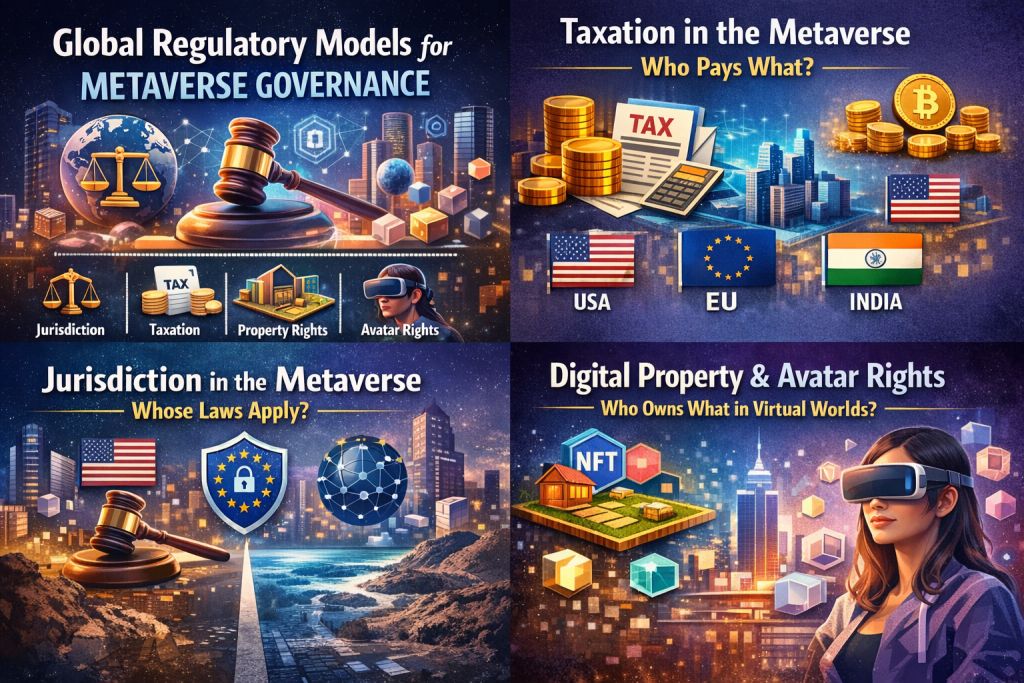
What Is Metaverse Governance — And Why It Matters
Metaverse governance encompasses the laws, regulations, and policy frameworks that govern interactions, economies, identities, rights, and disputes within virtual environments. Unlike the physical world, the metaverse transcends traditional borders, presenting unique challenges and opportunities for regulators globally.
Effective governance is essential. A strong legal framework builds user confidence, protects investments, encourages innovation, and safeguards rights. In contrast, gaps in governance can result in confusion, exploitation, and economic loss.
The Jurisdictional Puzzle: Who Governs the Metaverse?
- Jurisdiction is a fundamental challenge: determining which legal domain governs virtual world activities. Traditional legal frameworks are based on geography, residency, or nationality, while the metaverse transcends these boundaries and complicates territorial jurisdiction.
- Geographic Jurisdiction vs. Virtual Action: For example, a US-based user selling virtual land to a European buyer on a decentralized platform does not fall under a single jurisdiction. This situation creates overlaps and conflicts between laws, including data privacy (such as GDPR in the EU), financial regulations, and property rules.
- New Legal Concepts: Some legal theorists propose electronic jurisdiction, a post-territorial framework based on Web3 architecture, where laws apply to digital identities and activities instead of physical location.
Real-Life Insight: Cross-Border Disputes in Practice
For example, a designer in India selling virtual outfits in Decentraland to global users may face uncertainty regarding GST (Goods and Services Tax) applicability. Under Indian law, digital goods and services provided to residents are subject to an 18% GST, and place-of-service rules determine where indirect tax applies. Without clear jurisdictional rules, such transactions risk being taxed multiple times or not at all, undermining economic fairness.
Taxation in the Metaverse: Who Pays What?
Taxation presents another significant challenge. Governments must determine whether transactions in virtual worlds, such as NFT sales and virtual land leases, are subject to tax.
How Different Regions Tackle Tax
- European Union: Virtual services and goods sold to residents may fall under digital services VAT rules, taxed in the customer’s country.
- United States: The IRS requires reporting of digital asset disposals, making even micro-sales taxable events.
- India: Deposits on gaming and metaverse platforms attract 28% GST and up to 30% income tax on winnings, making it one of the costliest jurisdictions for virtual transactions.
- Singapore: Virtual goods sold by significant vendors are subject to a 9% GST.
- Dubai (UAE): VARA (Virtual Assets Regulatory Authority) licenses metaverse providers and collaborates internationally to harmonize rules for virtual asset activities.
The Taxation Debate: Haven or Harm?
Without appropriate taxation, the metaverse could become a digital tax haven, attracting passive investment while eroding global revenue bases. To address this, the OECD’s Crypto-Asset Reporting Framework (CARF) expands information exchange to crypto intermediaries and wallets, promoting transparency and tax compliance across borders.
Practical Tip for Creators & Investors
If you create NFTs or sell services in virtual worlds, document all transactions, comply with local tax laws, and consult tax professionals experienced in digital assets. Tax authorities are increasingly sophisticated and can trace virtual earnings to real-world identities.
Digital Property Rights: Who Owns What?
Virtual property, including land, avatars, NFTs, and digital goods, is a key aspect of the metaverse. Unlike physical property, virtual assets have distinct legal boundaries.
What Current Models Say
- Defined Ownership via NFTs: NFTs can provide immutable proof of ownership for digital assets across decentralized platforms.
- Terms of Service Limit Ownership: Platforms such as Second Life allow users to purchase virtual land, but terms of service often specify that rights are subject to platform control. As a result, assets may be lost if the platform ceases operations.
- Property Tax Ideas: Some analysts propose digital property taxes on virtual real estate to mirror real-world models, providing governments with a new revenue stream.
Case Example: Second Life’s Legal Challenges
In a notable dispute, a Second Life user sued after losing access to virtual land due to a pricing loophole. Although the case was settled, it demonstrated how unclear virtual property rights can result in economic loss and legal uncertainty.
Avatar Rights: Beyond Digital Representation
Avatars represent identities, reputations, and communities. Governing avatar rights involves:
- Identity Protection: Ensuring users control their digital identities and personal data.
- Avatar Misuse Penalties: Addressing harassment, theft of avatar assets, and unauthorized avatar duplication.
- Personal Rights in Virtual Spaces: Legal protections for avatar-created content, community participation, and expression.
Virtual identity theft, avatar impersonation, and unauthorized reproduction can have emotional and financial consequences, highlighting the need for clear governance.
Emerging Models for Metaverse Governance
Several approaches seek to connect law, technology, and digital rights:
1. National Regulation + International Cooperation
Countries update their laws and cooperate through treaties and frameworks (such as GDPR and CARF) to apply existing legal principles to virtual spaces.
2. Metaverse Constitutions
Some community-led projects propose constitutions that govern rights and duties within their worlds, similar to national charters for digital citizens.
3. Decentralized Autonomous Organizations (DAOs)
DAOs allow participants to democratically govern rules, including dispute resolution, virtual property rights, and community standards.
4. Regulatory Sandboxes
Countries such as Singapore and those in the EU use regulatory sandboxes to test innovations under oversight before wider adoption.
What This Means for You
If You’re a Creator
- Understand tax implications in your home country and internationally.
- Use smart contracts to clearly define property rights.
If You’re a Business
- Ensure compliance with local licensing requirements and international collaboration initiatives.
- Invest in legal expertise related to digital governance.
If You’re a Regulator
- Prioritize international standards to prevent fragmented policies.
- Balance support for innovation with consumer protection.
The Future of Metaverse Governance
The metaverse is evolving more rapidly than legislation. However, uncertainty should not prevail. Through international cooperation, updated legal frameworks, and effective governance models, it is possible to build a virtual world that is equitable, secure, and economically viable.
Addressing these challenges now will help shape the digital frontier responsibly for users, creators, and innovators.
About the Author