In today’s rapidly evolving technological landscape, artificial intelligence (AI) is more than a tool; it has become a cultural symbol. From Hollywood films to academic debates, AI reflects our hopes, fears, and fundamental questions about humanity. Central to these discussions are myths—narratives that influence how we imagine, assess, and develop intelligent machines.
This article examines the role of myth in AI ethics and human–machine narratives, analyzes how mythic themes shape current debates on AI and consciousness, and provides practical insights for developers, ethicists, and readers navigating the AI era.
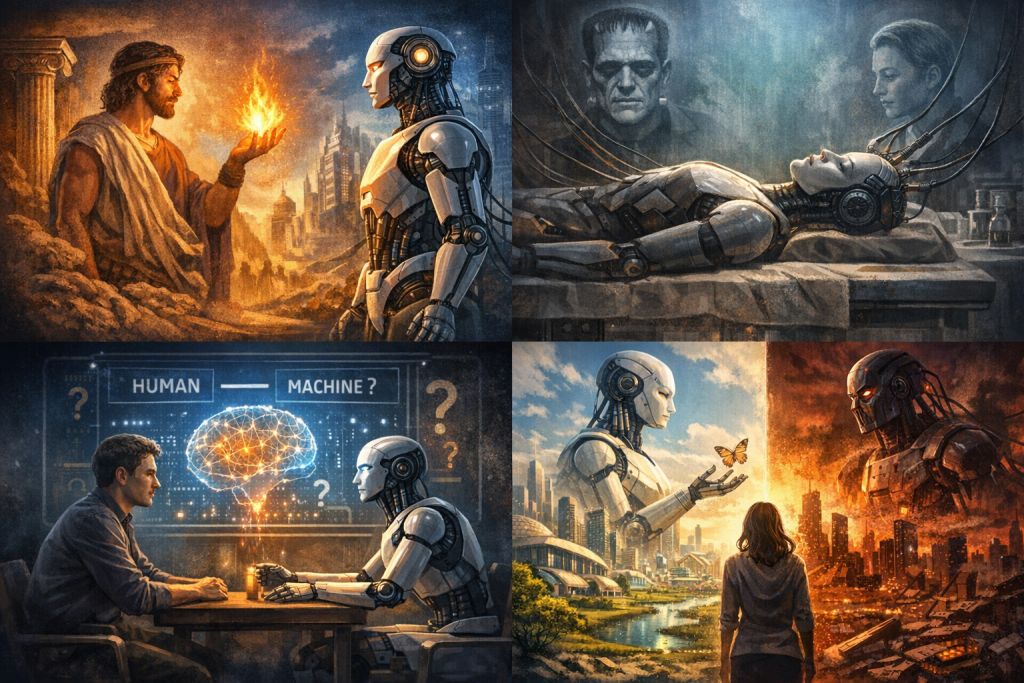
1. What Is Myth and Why Does It Matter in AI?
Myths are foundational narratives that help humans understand the unknown, express values, and address existential questions. Across cultures and eras, myths enable societies to navigate complexity, uncertainty, and moral dilemmas.
In the context of AI:
Myths become mental models that influence research funding, media portrayals, and public expectations.
They shape fear (“the AI apocalypse”) and wonder (“robots as companions”).
They influence ethical frameworks built to govern AI development.
Why does this matter? Because myths impact real-world decisions. They affect policy, guide research priorities, and even influence how users interact with AI systems.
2. Mythic Themes in AI: From Prometheus to the Turing Test
The Prometheus Paradigm
A recurring mythic theme is the Promethean struggle, where humanity creates something powerful that escapes its control.
Prometheus stole fire for humanity, defying the gods.
In AI, this theme reflects fears of runaway intelligence or superintelligence that humans cannot control.
Futurists such as Nick Bostrom have popularized this narrative, warning of existential risks if AI surpasses human wisdom. While his work is rigorous, it draws on mythic fears of forbidden knowledge. This myth encourages caution but can also create unnecessary fear without supporting evidence.
The Frankenstein Complex
Mary Shelley’s Frankenstein serves as a lasting metaphor for creators losing control of their creations. This theme reflects:
- Ethical anxieties about unintended consequences.
- Developer responsibility for harm caused by AI systems.
Rather than viewing AI as a monster, many ethicists suggest it should be seen as a reflection of human bias, a perspective grounded in reality rather than fiction.
The Turing Test and the Quest for Consciousness
Alan Turing’s proposal to measure machine intelligence through behavior sparked a modern myth: if a machine appears intelligent, it must be conscious.
However, intelligence is not necessarily equivalent to consciousness. Many experts, including cognitive scientists such as David Chalmers, argue that behavioral mimicry does not prove inner experience. The myth of the conscious machine drives debate, but is often based on semantics rather than empirical evidence.
3. How Myth Shapes AI Ethics and Policy Debates
Fear vs. Reality in AI Regulation
Myth-driven fears of AI dominance often prompt regulatory responses focused on extreme scenarios, such as banning AI that could surpass human intelligence.
Meanwhile, immediate concerns such as algorithmic bias, job displacement, and privacy erosion often receive insufficient attention.
Insight: Myth can distract from practical ethical issues that need immediate attention.
Narratives That Inform Public Perception
Popular media reinforces myths:
- Films like Ex Machina and Her depict AI with emotions and desires.
- News cycles amplify speculative fears of singularity.
These narratives influence public sentiment and policy discussions. For example, a Pew Research Center survey found that many people believe AI will soon achieve human-like consciousness, despite scientific uncertainty. Fact and fiction combine to create narratives that reshape expectations, both positively and negatively.
4. Myth and Machine Consciousness: A Cultural Mirror
The concept of sentient AI raises fundamental questions about selfhood, soul, and personhood. Ancient myths often explain consciousness in spiritual or divine terms. Modern AI narratives frequently project human qualities onto machines, a phenomenon known as anthropomorphism.
Why do we do this?
- It helps us relate to non-human agents.
- It allows us to project ethical concerns onto artifacts.
- It externalizes our hopes of immortality or transcendence through technology.
From a scientific perspective, consciousness remains a complex issue. AI models such as GPT-4 process language but show no evidence of subjective experience. Myths help frame the conversation but can inflate expectations of machine sentience.
5. Real-Life Impact of AI Myths: Case Studies and Experiences
Here are examples where myth shaped real outcomes:
Case 1 | Bias and the “Neutral Algorithm” Myth
When AI tools were used in hiring and criminal justice, many developers assumed algorithms would be neutral. This belief was based on the myth that mathematics ensures fairness.
In reality, biased data produces biased outcomes. Tools such as COMPAS and hiring AI have demonstrated systemic bias against marginalized groups. This is not science fiction; it is documented in multiple studies, including research published in Science Advances.
Lesson: The Myth of neutrality hindered early ethical scrutiny.
Case 2 | Chatbot Personification
Users interacting with chatbots often attribute emotions and intentions to them. In one user study, participants expressed feelings toward a conversational AI, even when explicitly informed it had no emotions.
This response is not gameplay; it reflects human psychology reacting to perceived agency. The myth of sentient AI affects user trust and behavior, influencing design choices in customer service and therapy chatbots.
Lesson: Storytelling affects user interaction patterns.
6. Solving Ethical AI Challenges Through Myth-Aware Design
Understanding the influence of myth enables a clearer and more humble approach to AI ethics.
1. Separate Science From Story
Distinguish between speculative and evidence-based narratives. For example:
- AI might transform industries → grounded prediction.
- AI will overthrow humanity → mythic extrapolation.
This distinction helps policymakers prioritize realistic risks and benefits.
2. Educate Users and Developers
Incorporate myth-awareness into AI literacy:
- Teach developers how cultural narratives shape assumptions.
- Educate the public about AI capabilities and limitations to counter sensationalism.
This approach reduces fear-driven resistance and encourages informed discourse.
3. Design for Human Values, Not Human Replacement
By recognizing that fears of replacement often stem from myth, we can reframe AI as:
- Tools that augment human ability,
- Systems designed to support dignified human work,
- Partners that align with societal values.
This shift in perspective can address ethical concerns related to job loss, autonomy, and dignity.
4. Ground Ethics in Real Harms
Focus ethical frameworks on tangible harms:
- Discrimination in lending and hiring,
- Privacy violations,
- Misuse of generative media.
These are urgent concerns supported by data and policy research, rather than mythic speculation.
Conclusion: Toward More Human-Centric AI Narratives
Myth is more than fiction; it is a cognitive lens through which we interpret reality. In the context of AI, myth plays a significant role:
- It shapes public perception,
- It influences policy and research,
- It can both illuminate and distort ethical concerns.
By becoming myth-aware, we can move beyond fear-based narratives and focus on building AI systems that reflect humanity’s highest aspirations, rather than its darkest myths.
Final Thought:
The most ethical AI does not arise from fear of a dystopian future or blind faith in machines. It emerges from informed, grounded, human-centric stories that balance imagination with evidence and ethics with practical impact.