How digital spaces are quietly reshaping the way people organize, identify, and participate in public life
Not long ago, most people thought of virtual worlds as places for games, socializing, or experimenting with creative avatars. Politics and citizenship were rarely discussed. Today, though, digital spaces are quietly changing how people come together and make decisions.
This change happened gradually. Over time, it became clear that something significant was taking place.
Now, people are seriously discussing virtual political communities and the idea of “metaverse citizenship.” These are no longer just science fiction topics.
When you spend time in these spaces, the reasons become clear.
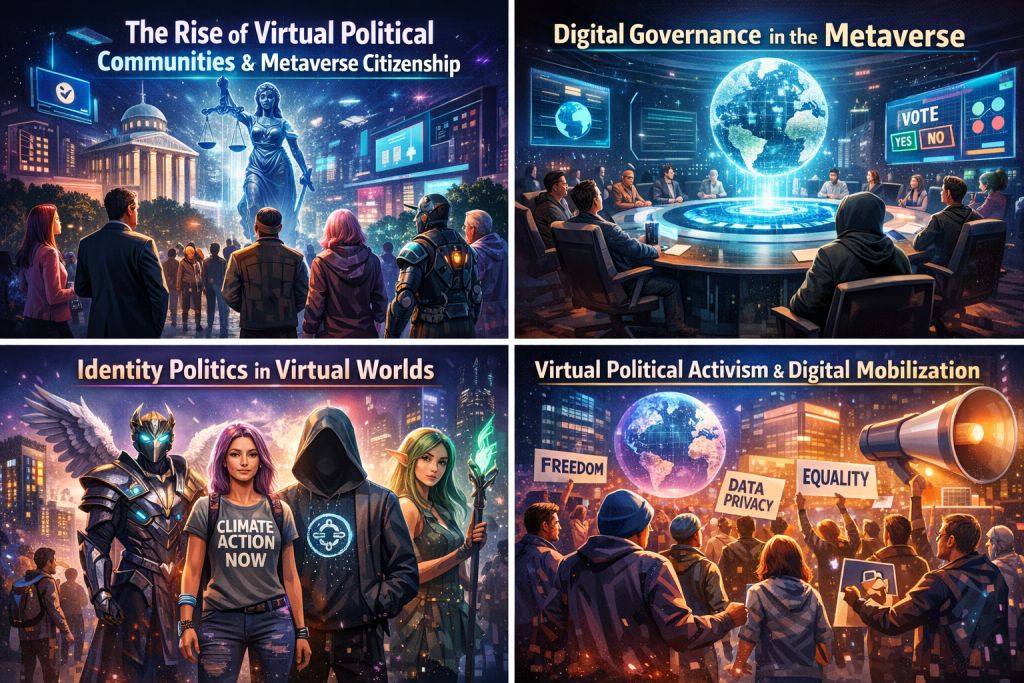
What “Metaverse Citizenship” Actually Feels Like
If you imagine metaverse citizenship as just a digital passport, that misses the point. It’s more complex. It’s about belonging and feeling emotionally connected to a place you visit often.
A digital citizen might:
- Join community discussions
- vote on platform decisions
- own digital land or assets
- build things that others depend on
- help shape social norms
Some people now spend more time in virtual communities than in their own neighborhoods. For them, the boundary between online and real life is thinner than ever.
How Political Communities Form in Virtual Worlds
I’ve followed online activism for over a decade, and what happens in 3D environments feels different.
People do more than just type. They stand together as avatars, nod, wave, and sometimes talk over each other. It feels surprisingly physical.
1. Avatars Make Participation Personal
In VR spaces, even small body movements can change the tone of a conversation. You notice emotion and presence, and you participate in new ways.
I once joined a VRChat forum after a rule change upset many users. I expected chaos, but instead, dozens of strangers with creative avatars held an organized discussion. It felt more like a community center meeting than an online event.
2. Gamified Environments Encourage Engagement
People interact more when the space is playful. You can walk around, explore, sit on virtual chairs, or write notes on floating boards.
Spaces like this make it easier for people to talk without feeling pressured.
3. No Borders Means No Limitations
Conversations that once needed visas, travel money, or careful scheduling can now happen instantly.
Someone in Lagos can stand next to someone in Seoul and talk about digital rights as if they were in the same room.
4. Digital Rights Become Political Issues
When people live, earn, or socialize online, issues like:
- data ownership
- platform governance
- privacy rules
- content rights
These issues start to feel like real political concerns, not just abstract technology topics.
Governance Experiments Inside Virtual Worlds
This is where things get more interesting. Virtual spaces are no longer just for socializing. They have slowly become places to try out new ways of governing.
DAOs as Digital Micro-Governments
Decentralized Autonomous Organizations (DAOs) allow communities to:
- propose changes
- vote transparently
- manage shared funds
- approve or reject new rules
It can be messy, but it is real.
Decentraland’s Voting System
Users decide on:
- platform upgrades
- economic adjustments
- creator policies
- world-building rules
Most real-world institutions struggle to match this level of participation.
Roblox’s Self-Organized Communities
Some Roblox developers run councils to settle disputes, elect moderators, and manage their communities. It might sound playful, but it actually reflects early forms of democracy.
A Moment That Stuck With Me
At a virtual governance workshop in Mozilla Hubs, I watched about twenty people debate policies for a made-up digital city. It felt surprisingly real.
The avatars didn’t matter. What mattered were the voices.
People held their ground, negotiated, and compromised.
In that digital room, it seemed like a new kind of civic life was beginning.
Identity Politics Takes on New Shapes
Virtual spaces allow people to assume identities that don’t exist in the physical world. This changes how communities interact politically.
1. People Carry Multiple Identities
In one world, someone might be a dragon.
In another, an activist.
In a DAO, just a pseudonym is linked to a crypto wallet.
Each identity matters in its own way.
2. Some Real-World Biases Fade
When you can’t see someone’s age, disability, or appearance, conversations often focus more on ideas than on judgments.
Of course, new hierarchies emerge, such as avatars with rare skins, users with expensive digital items, or people with advanced equipment. Still, these dynamics are different from those offline.
3. Representation Looks Unfamiliar
In virtual spaces, leadership often depends on creativity, influence, or digital contributions instead of job titles or credentials.
It is still political, just not in the way we are used to.
Why This Evolution Matters More Than We Think
Virtual political communities are more than a trend. They are becoming a parallel space for civic engagement.
1. Young Generations Already Live Digitally
Many teenagers and young adults now spend more time in hybrid or immersive spaces than on traditional platforms like Facebook or news sites.
That’s where their political identity takes shape.
2. The Metaverse Has Its Own Economy
When a digital world has jobs, property, and income, it naturally needs some kind of governance.
- Rules.
- Rights.
- Responsibilities.
It becomes a society.
3. Digital Rights Are Becoming Human Rights
Questions that once seemed far-fetched now feel urgent:
- Who owns your avatar’s data?
- Who protects you from digital harassment?
- What legal rights do you have over virtual property?
Governments can’t ignore these questions forever.
One Moment That Changed How I See All of This
In 2025, I attended a virtual conference on “Digital Nationhood.” It took place on a metaverse platform with over 1,000 participants. The sessions were interesting, but the moment that changed my perspective happened during a Q&A.
A young woman, speaking through a simple, unremarkable avatar, said,
“This is the only place where I can express my political views safely.”
The room went silent. The avatars stopped moving, but everyone felt the weight of her words.
For people like her, the metaverse is more than entertainment.
It is the only place where they can speak freely.
That moment stayed with me.
The Risks We Need to Face Honestly
- Misinformation will become more convincing inside VR
- platforms may gather extreme amounts of behavioral data
- Virtual economies could magnify inequality
- corporate control might override democratic processes
- Psychological manipulation will be harder to detect
These problems are real and need attention now, not later.
The Opportunities We Shouldn’t Waste
Despite the challenges, virtual political spaces offer opportunities that the real world struggles to provide.
- testing new forms of democracy
- enabling global collaboration
- offering a voice to marginalized groups
- teaching civic behavior through simulations
- lowering barriers to participation
The metaverse could become a place to try out better ways of governing.
How Governments Can Prepare
- study digital citizenship frameworks
- develop laws around avatar identity and digital rights
- collaborate with metaverse platforms
- build digital and civic literacy programs
- support open, interoperable metaverse standards
Ignoring these changes won’t stop them. They are already happening.
A New Kind of Citizenship Is Emerging
We are living through a quiet transformation.
Virtual spaces won’t replace physical nations, but they will add another layer of belonging. For many people, these are places to feel understood, connected, and politically engaged.
In the near future, it’s likely that people will hold:
- a physical citizenship tied to their country
- a digital citizenship tied to the virtual world they choose to inhabit
For some, digital citizenship may even feel more like home.
About the Author