How Algorithms, Personal Expression & Civic Power Converge in 30-Second Videos
Introduction: Why This Matters Now
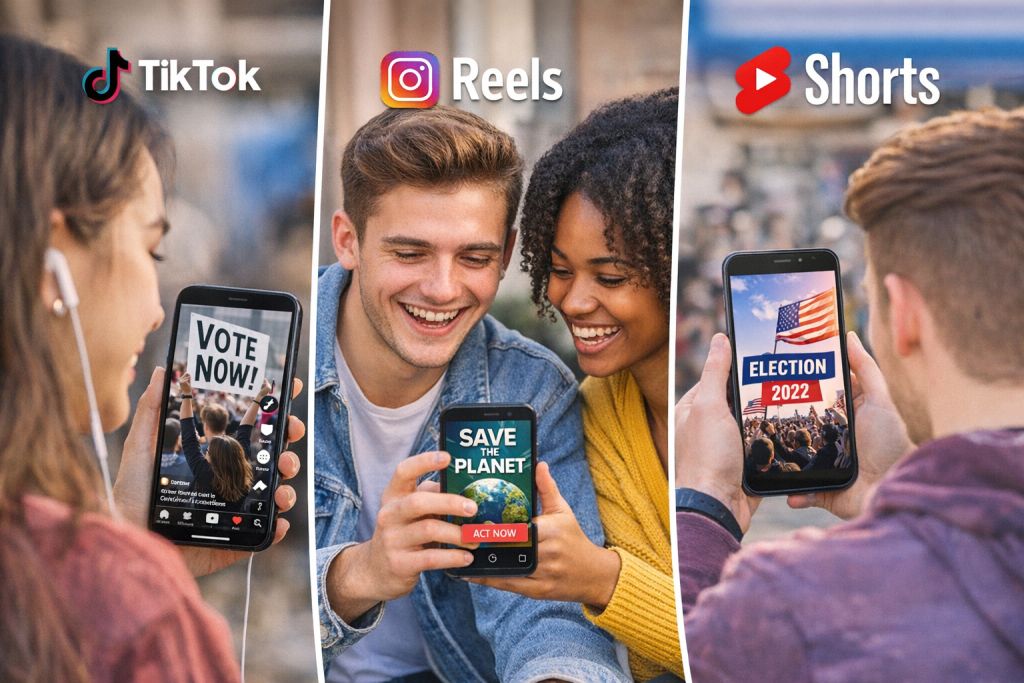
Political activism has moved beyond rallies, essays, and televised debates. Today, short-form videos under 60 seconds have become a primary medium for millions of young people. Platforms such as TikTok, Instagram Reels, and YouTube Shorts now play a central role in political engagement and discourse, particularly among Gen Z and younger millennials.
Trending hashtags and concise policy explainers on these platforms are shaping political narratives and, at times, influencing real-world decisions. This shift raises important questions about its impact on civic participation, misinformation, and democratic engagement.
1. The Rise of Political Microcontent: A New Civic Square
The rapid growth of short-form videos has transformed the media landscape. Young people now receive political information, commentary, and calls to action through concise, visual, and engaging formats rather than lengthy articles or news segments.
Research indicates that exposure to political short videos directly influences teens’ political knowledge and participation, often serving as a primary source of information and discussion.
Recent research shows that teens who view political short videos on platforms like TikTok or Reels are more informed and more likely to engage in civic activities than those who rely solely on traditional media.
This trend reflects a new digital civic space where peer networks and algorithms, rather than institutions, shape political narratives.
2. Studying Political Narratives Built Through Algorithm-Driven Microcontent
Algorithms are central to short-form activism, determining which content appears on users’ feeds. These systems prioritize specific content styles, such as those found in TikTok reels on climate action or Shorts videos about voter turnout.
Key research reveals that:
- Algorithms favor content with high engagement features, such as emotional appeal, humor, and relatable storytelling, over purely informational material.
- Content that elicits strong emotional responses often circulates widely, even when it simplifies complex issues.
- On major microcontent platforms, concise and shareable political messages can become dominant narratives, regardless of their factual depth.
This dynamic presents both opportunities and risks. While these platforms amplify youth voices, they can also spread polarizing or oversimplified political messages, as recent electoral research has shown.
3. Real Voices & Real Movements: From Screens to Streets
Case Study: Gen-Z for Change
Gen-Z for Change exemplifies activism driven by short videos. Founded by young activists using TikTok to promote climate justice, voting rights, and income equality, the organization now reaches hundreds of millions each month and has been recognized in White House briefings for its influence.
Activists such as Aidan Kohn-Murphy and Olivia Julianna show how short-form platforms can mobilize youth for rallies, debates, and civic actions, even before they are eligible to vote.
Grassroots Impact: Beyond the U.S.
Globally, youth movements use microcontent to promote social causes ranging from economic justice to democratic reform:
- Research documents youth TikTok activism that mobilizes peers around unemployment, awareness of governmental policy, and creative protest messaging.
- Campaigns recognized by international awards have emerged solely through TikTok narrative building and youth engagement.
4. The Problem of “Slacktivism” & How to Overcome It
A common criticism of online activism is that it can devolve into “slacktivism,” consisting of symbolic gestures without tangible impact.
However, data suggests a more nuanced reality. When microcontent activism includes calls to action, such as petitions, local meetings, or offline events, it can drive genuine civic participation. For example:
- Youth who interact with political reels are significantly more likely to register to vote or attend rallies.
- Activist communities utilize duets, remixes, and hashtags to coordinate offline actions, not just online sentiment.
Recommendation for activists: Always connect short-form content to a clear, actionable step, such as registering to vote, sharing factual sources, or attending local events. This approach links online expression to meaningful civic engagement.
5. Algorithm Literacy: Empowering Smart Activists
Understanding short-form algorithms is now a key component of civic literacy.
Here’s a breakdown of what youth political users should know:
- What Gains Visibility?
- Emotional resonance and relatability
- Familiar sounds and trending formats
- Rapid engagement (likes/comments/shares)
- What Gets Hidden?
- Complex analysis
- Long policy breakdowns
- Neutral or non-sensational content
Research shows that activist creators adapt their content strategies to align with platform algorithms, using various stylistic approaches to increase reach and encourage algorithmic amplification.
Key takeaway: If your message is important, understand how the algorithm works. Adapt your narrative style while maintaining accuracy.
6. Real-Life Reflection: My Encounter With Short-Form Civic Discourse
Recently, I observed a straightforward Reels campaign addressing local water scarcity. In less than 30 seconds, the creator used animation, trending audio, and a call to action linking to community workshops.
Within 48 hours, dozens of young users reposted, commented, and formed a WhatsApp group to organize a street clean-up and an awareness campaign.
This experience demonstrated two key points:
- Short-form videos can inspire real action beyond online engagement.
- Combining emotion, clear steps, and community involvement is highly effective.
This example aligns with research indicating that youth use remixable content strategies to personalize and disseminate activist messages.
7. Risks & Responsible Practices
Short-form activism also presents challenges:
- Misinformation can spread fast.
- Algorithms may push polarized narratives.
- Youth are vulnerable to deceptive framing.
To address these risks:
- Amplify credible sources (news outlets, research briefs, verified voices)
- Promote platform literacy among young users.
- Encourage cross-platform fact-checking before reposting.
Conclusion: The Future of Youth Political Activism
The growth of political activism on short-form platforms represents a significant shift. Young people worldwide are using microcontent to:
- Build political identity
- Mobilize collective action
- Educate peers in accessible formats
- Drive offline participation
As research progresses and digital media evolves, youth political participation increasingly takes place in short video clips as well as in traditional civic spaces.
About the Author