Drones have shifted from novelties to vital tools in many fields, including photography, agriculture, logistics, infrastructure analysis, policing, surveillance, and emergency rescue. With widespread use, regulation is crucial for privacy, safety, and accountability. Governments update laws to keep pace with technological advances, as users adapt to a changing legal environment.
In 2025, debates about civilian drone usage, governmental surveillance, trespassing, and aerial data collection are at an all-time high. This blog explores these issues in depth—along with a real experience that shaped my understanding of drone law’s importance.
Why Drone Law Matters More Than Ever
As drones have become more autonomous, equipped with AI, obstacle-avoidance sensors, long-range connectivity, and machine learning, their legal implications have grown significantly. Drones that once required manual control can now follow moving subjects, map terrain, and collect data without direct human oversight.
This creates three major challenges:
1. Safety: Preventing mid-air collisions, property damage, and high-risk flights in restricted zones.
2. Privacy: Protecting civilians from unauthorized filming, facial recognition, and mass aerial data collection.
3. Accountability: Clearly defining who is responsible when an autonomous drone violates airspace laws or causes harm.
Without clear, robust regulation, airspace can quickly become a legal grey area—a situation in which laws or regulations are ambiguous or poorly defined, leading to uncertainty about which actions are lawful. This makes it essential to understand both what is allowed and what is prohibited when it comes to civilian drone use.
1. Civilian Drone Usage: What the Law Allows—and Prohibits
Civilian drones now range from lightweight recreational models to large, AI-assisted quadcopters capable of extensive aerial coverage. Although regulations vary by country, several global trends influence modern drone law.
A. Registration and Identification Requirements
Most countries now require:
- Drone registration through a civil aviation authority
- Unique drone ID (remote ID) broadcasting
- Pilot/owner identity verification
- Geo-fencing compliance
Remote ID, in particular, enables authorities to identify drones in real time, which is essential in sensitive or high-security areas.
B. Flight Restrictions and No-Fly Zones
Common restrictions include:
- No flying near airports, military bases, or government buildings
- Max altitude caps (often 120m or 400ft)
- Maintaining visual line of sight (unless certified for BVLOS—Beyond Visual Line of Sight)
- No flights over crowds without special permission
Autonomous drones with object tracking face stricter regulation because their ability to follow moving subjects increases the risk of privacy violations.
C. Privacy and Aerial Trespassing for Civilian Pilots
A growing legal concern is drone trespassing, which occurs when a drone enters private property airspace, even if it does not land.
Key privacy scenarios include:
- Drones capturing footage through windows
- Hovering above private gardens, terraces, or farms
- Using Zoom cameras to record individuals without consent
- Creating 3D models of private homes using photogrammetry
In many jurisdictions, private airspace extends to the height required for the ordinary use and enjoyment of property. This means that property owners generally have exclusive rights to the airspace immediately above their land up to a reasonable height. Therefore, if a drone hovers low over someone’s yard, it may constitute trespassing, which is an unauthorized entry onto someone else’s property, even if the drone does not land.
A Personal Experience That Changed My Perspective
In early 2024, I saw a hobbyist test an autonomous drone in a neighborhood. The drone mistakenly followed a jogger for nearly 200 meters.
The jogger became alarmed, thinking she was under surveillance. The pilot realized the malfunction only after seeing the tracking footage.
Authorities intervened, and while no charges were filed, the incident sparked community debate about drone privacy and responsibility.
This experience made clear that effective drone regulation is about earning public trust, not just managing technology.
2. Governmental Drone Usage: Surveillance vs. Civil Liberties
Government use of drones has expanded into:
- Traffic management
- Border control
- Crowd monitoring
- Crime detection
- Disaster response
- Infrastructure inspection
- Environmental monitoring
While these applications can significantly improve safety and efficiency, they also raise important questions about mass surveillance and individual rights.
A. Legal Boundaries for Governmental Drone Surveillance
Most democratic legal systems impose constraints on government drone usage, such as:
- Obtaining judicial warrants (court-issued permissions) for targeted surveillance
- Placing limitations on facial recognition and biometric collection
- Enforcing storage and deletion policies for aerial footage
- Restricting nighttime surveillance
- Establishing transparency requirements for police drone deployment
In some countries, police drones must broadcast Remote ID, like civilian drones, to ensure traceability and accountability.
B. The Debate Around Mass Aerial Data Collection
The biggest tension in 2025 is between:
- Governmental need for public safety, and
- Citizens’ right to privacy from mass, indiscriminate data collection.
- Modern drones can automatically:
- Map cities
- Capture license plate numbers
- Detect crowd patterns
- Identify individuals using AI
- Track vehicles in real time
Without strict regulation, these practices risk encroaching on civil liberties.
C. A Surprising Incident That Highlighted the Issue
In mid-2023, during a festival in a coastal city, I watched as law-enforcement drones quietly hovered above thousands of attendees. While these drones were intended for crowd safety, many people were unaware they were being recorded.
I was particularly struck by a group of teenagers discussing whether they should hide their faces, as they were uncertain about how long the footage would be stored or who might access it.
That conversation felt like a wake-up call:
- Society should never become so monitored that people change their natural behavior out of fear of surveillance.
3. Autonomous Drone Surveillance: The New Frontier of Regulation
Autonomous drones capable of AI-driven surveillance raise unprecedented legal challenges. These drones can:
- Follow patterns
- Predict movement
- Conduct wide-area sweeps
- Detect anomalies
- Perform automated patrols
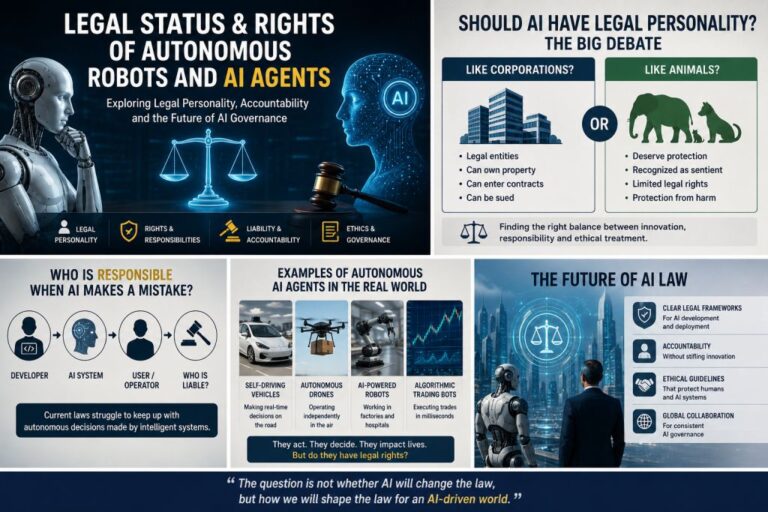
This shift transfers responsibility from human operators to algorithms. Algorithms are sets of programmed instructions that control the drone’s decisions and actions. Legal frameworks for determining accountability in such situations are still developing.
A. Who Is Liable When AI Makes a Mistake?
Example dilemmas include:
- If an autonomous drone trespasses, is it pilot error or algorithmic malfunction?
- If AI misidentifies a person, who is responsible?
- If an autonomous drone crosses restricted airspace, who pays the penalty?
Regulators are now introducing AI liability frameworks to ensure drone manufacturers, software providers, and operators share accountability for autonomous decisions.
B. Ethical Issues in Autonomous Surveillance
Key concerns include:
- Algorithmic bias in identifying individuals
- AI-based profiling of communities
- Over-policing through constant aerial presence
- Lack of informed consent
- Disproportionate monitoring of marginalized areas
- Ambiguous data retention standards
The future of surveillance will require both technological innovation and strong protections for individual rights.
4. Aerial Data Collection: Ownership, Consent & Legal Grey Areas
Drones can collect immense amounts of data, including:
- Videos & photos
- Thermal imagery
- Geospatial maps
- 3D models
- Sensor data
- Wi-Fi or mobile signal mapping (in specialized models)
As data becomes increasingly valuable, laws must clarify:
- Who owns aerial data?
- The drone operator?
- The people filmed?
- The government?
- When is consent required?
- Always for private property
- Usually, for identifiable people
- Not necessarily in public spaces, depending on local law
- How long can aerial data be stored?
Some laws mandate deletion within predefined timelines unless used for legal proceedings.
5. The Future of Drone Law & Autonomous Surveillance Regulation
Looking ahead, several trends will shape drone governance:
A. Global Drone Law Harmonization
Countries will work toward unified standards for:
- Remote ID protocols
- Flight permissions
- Safety certifications
- BVLOS operations
B. Stricter AI Accountability Rules
Expect deeper scrutiny of AI’s decision-making and data use.
C. Stronger Privacy Protections
Future policies may include:
- Mandatory consent notifications
- Real-time public drone tracking apps
- Limits on facial recognition
- “Privacy corridors” over residential zones
D. Smart Urban Airspaces
Cities may develop digital air corridors for drones, similar to dedicated lanes for autonomous vehicles.
Conclusion: Building a Safe, Ethical, and Transparent Airspace
As drones evolve from manual to AI-driven surveillance devices, regulation becomes essential. Balancing innovation and privacy is vital for safety and civil liberties.
No matter your role—hobbyist, operator, policymaker, or privacy advocate—staying informed about evolving drone law is key. Together, we can shape an airspace defined by trust, freedom, and responsible technological progress.
About the Author