India’s landscape features centuries-old forts, abandoned villages, remote beaches, and colonial bungalows, all of which provide ideal settings for ghost stories. However, many classic “haunting” experiences have repeatable, testable explanations. Below, I will outline five of India’s most discussed haunted locations, provide credible background and eyewitness accounts, and explain the scientific principles and safety checks that clarify many supernatural claims.
1. Bhangarh Fort, Rajasthan — the country’s poster child for hauntings
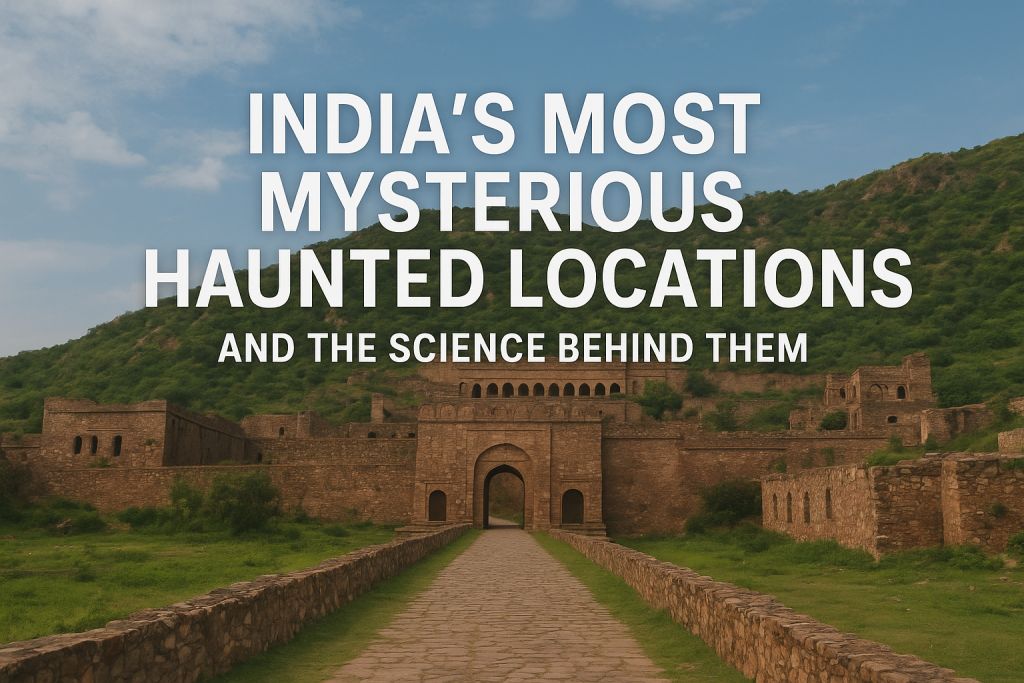
Bhangarh is located in the Aravalli foothills and is legally closed to visitors after sunset. Local legends attribute the town’s destruction to a curse, with variations involving romantic rejection or a wronged sadhu. This story has been repeated in travel articles and official listings for years. The fort’s atmospheric ruins, narrow alleys, and remote setting have established it as India’s most renowned “haunted” site.
Likely explanations include the combination of ruined buildings, unfamiliar noises, and heightened expectations. When visitors anticipate an eerie environment, their senses become hypervigilant; minor sounds may be perceived as footsteps, and shadows may appear as moving figures. The prohibition on nighttime access further enhances the site’s mystique, as restricted entry stimulates the imagination.
2. Kuldhara (Jaisalmer), Rajasthan — the deserted village with a curse
Kuldhara was once a prosperous Paliwal Brahmin village. According to folklore, the villagers abandoned it overnight and placed a curse on anyone who attempted to resettle there. Today, the site is a ruined village promoted as a “haunted” attraction. Both Rajasthan tourism and various media sources highlight the blend of documented history and legend.
The sense of the supernatural in such places often arises from strong emotional cues: isolation, wind moving through empty spaces, and the unsettling sight of intact but uninhabited structures. When combined with local storytelling, these factors create an ideal environment for perceived encounters.
3. Shaniwar Wada, Pune — cries of a prince
Shaniwar Wada, a historic Peshwa fort, is linked to the 18th-century murder of Narayanrao. Locals and visitors have reported hearing a child’s cry on full-moon nights, a classic auditory haunting associated with a genuine historical tragedy. The enduring tale is reinforced by the combination of a widely known violent event and the fort’s unusual acoustics.
Acoustically, old fort walls and courtyards can produce echoes, and under certain conditions, distant human or animal sounds may be focused into a specific area, similar to a whispering gallery. When visitors are familiar with the legend, they are more likely to interpret ambiguous sounds as the reported cry.
4. Dumas Beach, Gujarat — the black sand and vanishings
Dumas Beach, located near Surat, is known for its eerie atmosphere and local stories of spirits, particularly after sunset. Reports of disappearances and unsettling discoveries have contributed to urban legends. Mainstream media have documented both the folklore and the resulting tourism interest.
Possible natural causes include coastal fog, the odor of decomposing organic matter, shifting sands, and changing tides at night, all of which can create unsettling sensory experiences. The beach’s historical association with cremation further intensifies fear and local storytelling.
5. Dow Hill / Kurseong and other hill-station mysteries
Locations such as Dow Hill in Kurseong and various colonial-era houses in the Himalayan foothills are associated with longstanding tales of headless figures, mysterious lights, and missing students. Local reports and compilations of haunted sites often highlight common features: dense forests, old buildings, and tragic histories.
The Science of “Hauntings”: Four natural explanations that repeat worldwide
Investigators frequently identify four recurring themes in reports of hauntings:
- Infrasound — the “fear frequency.”
Very low-frequency sound (below approximately 20 Hz) is often undetectable but can induce sensations of dread, nausea, and visual illusions. Researcher Vic Tandy linked a 19 Hz standing wave to reports of ghostly figures in a laboratory, and subsequent studies have replicated how infrasound can cause anxiety and unusual visual experiences. Sources of infrasound include wind, air-conditioning systems, and natural standing waves in architectural spaces.
- Electromagnetic fields (EMF) and temporal-lobe stimulation
Certain neuroscience experiments, such as Persinger’s “God helmet,” demonstrate that weak, complex magnetic fields or stimulation of specific brain regions can produce sensations of a “presence.” Although this explanation remains controversial and is not universally accepted, increases in EMF from wiring, outdated electrical systems, or nearby transformers have been correlated with some traditional “paranormal” reports.
- Carbon monoxide and environmental toxins
Historical and contemporary investigations indicate that prolonged exposure to carbon monoxide (CO) and certain chemicals can cause hallucinations, confusion, and sensations often described as “haunting.” Common sources include faulty heaters, enclosed spaces, and old chimneys. Medical symptoms such as headache, dizziness, and nausea frequently accompany reported “ghost” sightings in the presence of carbon monoxide.
- Psychological and social factors: suggestion, memory, pareidolia
Human perception naturally seeks patterns. In low light, the brain fills in gaps (pareidolia), memory alters ambiguous events, and social storytelling shapes expectations. When a location is reputed to be haunted, ordinary sounds or movements are often interpreted as evidence, illustrating confirmation bias.
Responsible investigation and safety checklist (practical value for readers)
If you are interested but wish to proceed cautiously, consider the following brief and respectful checklist:
- Respect all rules and local laws. Many sites, such as Bhangarh, are legally closed at night; do not violate these restrictions.
- If conducting an informal investigation, bring a small EMF meter and a carbon monoxide detector. Both are affordable and can help identify environmental factors.
- Record unedited audio and video without commentary for later analysis, as eyewitness memory can be unreliable.
- Assess structural and environmental hazards, such as unstable walls, tides, or wildlife, before exploring any site.
- Consult local historians to distinguish documented history from folklore, which aids in evaluating claims. Local archives and tourism boards are also valuable resources.
Myth, memory, and storytelling: what to take away
Haunted locations serve as cultural touchstones, preserving local histories, highlighting past tragedies, and supporting tourism. These stories are not “false”; they are social artifacts. At the same time, modern science provides testable explanations, such as infrasound, EMF, toxins, and perception, that clarify many encounters while respecting the emotional significance of these sites.