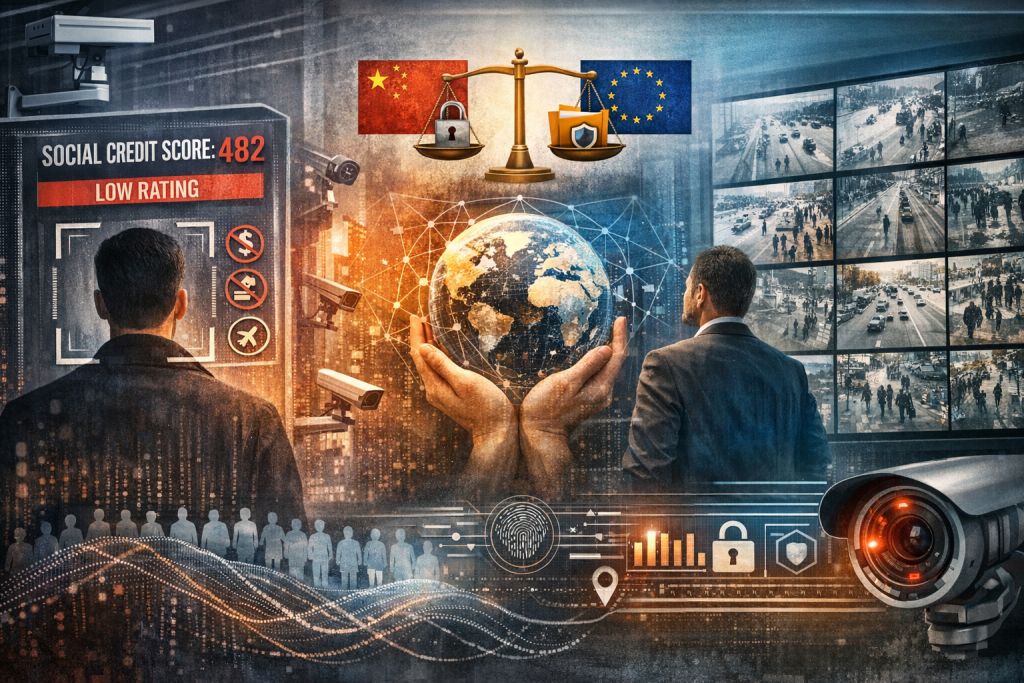
Governments used to rely mainly on laws, courts, police, and public trust. Now, data is quietly changing that balance. Around the world, governments are collecting more data than ever before. Some use it to make services better, while others use it to watch people’s behavior. This change has led to the growth of social credit systems and digital surveillance.
These systems are not just technical tools. They affect how governments see their people, how citizens see the state, and how power works in the digital age. What started as a policy in a few countries is now shaping global ideas about governance.
This blog looks at what social credit systems are, how countries use digital surveillance, and why this matters for the future of freedom, trust, and governance around the world.
Understanding Social Credit Systems in Simple Terms
A social credit system gathers data about people or organizations and uses it to judge their behavior. Based on this, they might get rewards or face penalties.
The data can come from many sources:
- Financial records
- Legal history
- Online behavior
- Public actions
- Government databases
The idea is simple: good behavior is rewarded, and bad behavior is punished. But in practice, it is not always fair or clear who decides what is ‘good’ or ‘bad.’
China’s Social Credit System is the most famous example. It links many databases to rate both citizens and businesses. People with high scores can get benefits, while those with low scores might face limits like travel bans or business penalties.
Supporters say this system helps build trust in society. Critics think it gives the government too much control over people’s private lives.
Why Social Credit Systems Matter for Global Governance
Social credit systems are important not just for where they are used, but for what they mean. They show that the way governments work is changing.
Now, instead of just reacting to crime or rule-breaking, governments can predict, influence, and shape behavior before anything happens. This shifts the state’s role from being a protector to being a constant watcher.
As more countries explore digital monitoring, global ideas about:
- privacy
- freedom
- accountability
- citizen rights
are being tested and changed today.
Comparing Digital Surveillance Governance Models Across Countries
Countries use digital surveillance in different ways. Culture, politics, and laws all play a big role.
- China: Governance Through Digital Control
China’s model is often called the most advanced and strict. There, surveillance cameras, facial recognition, online monitoring, and sharing data between agencies are all common.
The system does not just focus on individuals. Businesses get scores too. If a company breaks the rules, it can lose its licenses or the public’s trust.
China’s model stands out because of its size and how everything is connected. Almost every part of life can be tied to government data. This approach is now being tried or shared with other countries through technology deals.
- India: Identity-Based Governance
India does not have a formal social credit system. But its Aadhaar biometric ID connects people’s identity to welfare, banking, and public services.
In theory, Aadhaar makes things run more smoothly and helps stop fraud.
In reality, it also brings up questions:
- Who controls the data?
- How secure is it?
- What happens when access depends on digital identity?
When identity is needed for basic services, running the government becomes closely tied to who can access data.
- Singapore: Efficiency Over Ideology
Singapore’s digital government focuses on making things efficient, safe, and well-planned. Sensors, data analysis, and digital IDs help improve transport, healthcare, and other city services.
People often trust the government because its services work well. Still, some say that collecting so much data can slowly take away personal privacy, even if there is no clear punishment.
Singapore shows that surveillance can happen without causing fear, but it can still quietly change how the government works.
- Europe: Strong Limits and Ethical Rules
The European Union does things differently. It puts strong limits on how governments and companies can use data.
Under EU law:
- Mass behavioral scoring is discouraged or banned
- Citizens have rights over their data
- AI systems must be transparent and explainable
This shows a way of governing that puts human rights before efficiency. Europe is trying to set global rules for ethical digital government.
- United States: Private Surveillance Instead of State Control
The U.S. does not have a government social credit system. But private companies collect huge amounts of data.
Credit scores, background checks, online profiling, and predictive policing can affect:
- loans
- jobs
- housing
- freedom of movement
Even without a central system, people can still be judged and limited by computer programs. This creates a softer kind of social scoring, run by businesses instead of the government.
How These Systems Change Global Norms
As more countries use surveillance and scoring, the rules for global governance are changing in three big ways.
1. Power Is Becoming Invisible
In the past, power was easy to spot—police, courts, prisons. Now, power is hidden in systems, scores, and computer programs. Decisions are made quietly, often with no explanation.
This makes it harder for people to question authority or even know why something happened.
2. Privacy Is No Longer Assumed
Privacy used to be normal. Now, people have to work to protect it. Countries without strong data laws risk making constant watching a normal part of government.
3. Trust Is Being Replaced by Measurement
Governments once relied on trust and institutions. Now, they depend on data and tracking what people do. This can help control, but it might weaken trust in society over time.
A Personal Observation That Changed My View
A few years ago, I saw new cameras being installed in public places in the city where I lived. There was no public discussion, no notices—just a quiet installation.
Later, a local official mentioned that the footage was shared with departments like transport, police, and city planning. What began as ‘safety’ soon turned into full-scale monitoring.
That moment stuck with me. It showed how easily government can change without people noticing.
Risks We Cannot Ignore
Social credit systems and surveillance bring serious risks:
- Bias: Algorithms can punish certain groups unfairly
- Errors: Wrong data can ruin lives
- No appeal: People may not know how to challenge decisions
- Fear culture: Constant monitoring can change behavior and reduce free thought
Governments should fix mistakes, not make them automatic.
How Governments Can Do Better
Digital governance is not bad by itself. The real issue is how it is used.
Better governance requires:
- Clear laws and limits
- Human oversight over AI
- Public transparency
- Strong data protection
- Citizen education
Technology should help people, not control them.
Conclusion: The Future of Governance Is Being Written Now
Social credit systems are more than just rules. They show what governments care about—control, trust, freedom, or efficiency.
As digital surveillance grows, the rules for global governance are changing. Countries need to make careful choices. Once data systems are in place, they are hard to remove.
- The question is not, if technology will shape government, it already has.
- But the real question is, who controls that power, and who is kept safe from it.