Cities are designed for people although animals like birds, bees and bats inhabit these ecosystems too.
And as urbanization proliferates and biodiversity declines, architects are looking to designs that support a broader range of life forms other than humans.
Including non-human species in the design process leads to cities which are healthier and more sustainable for all their inhabitants.
What Is Architecture of Other Species?
Building spaces for other-than-humans means designing buildings, landscape and infrastructure to facilitate other residues of the living world.
Instead of barring animals and insects with a thin veneer of glass, architects design buildings so that humans can live in harmony with other species.
Examples include:
- Bird-friendly buildings
- Bee-friendly urban gardens
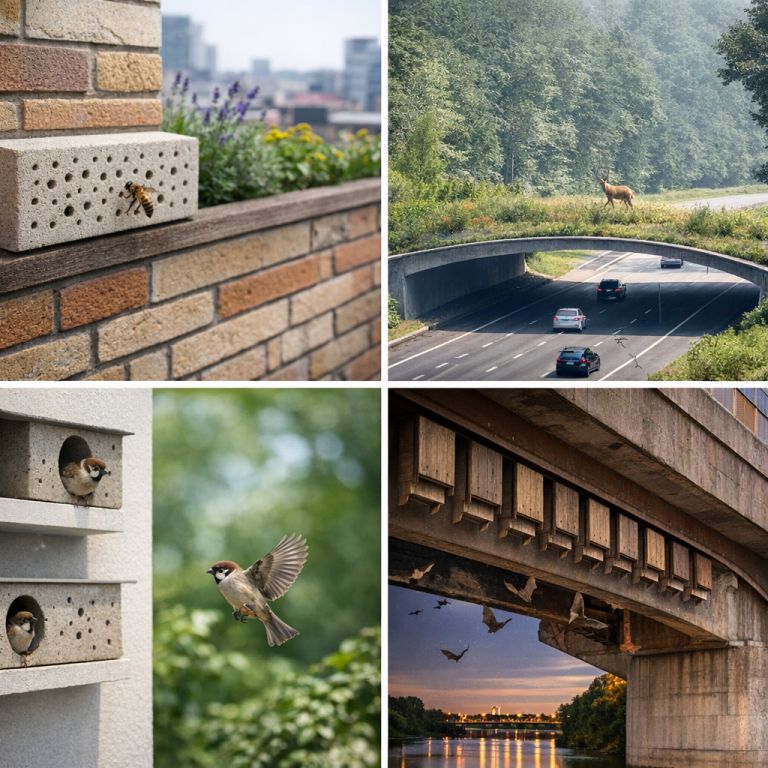
- Bat habitats integrated into bridges
- Wildlife corridors in cities
- Insect- and bird-friendly green roofs
Ly’s approach — which has been dubbed multispecies architecture, or biophilic design for biodiversity — is being re-familiarized with contemporary cities.
Why Cities Need Multispecies Architecture
Urbanization is growing rapidly. According to the United Nation’s latest stats, by 2050 close to 70% of world population will reside in cities. This growth often destroys natural habitats.
When the habitats of species disappear, those animals often can’t survive.
Some consequences include:
- Decline of pollinators, such as bees and butterflies‘
- Fewer predators leads to more pests
- Reduced biodiversity
- Weak urban ecosystems
Architectural design can help remedy these problems, in part by designing for other species.
Benefits include:
- Stronger ecosystems
- Birds, insects and bats all help a system stay in equilibrium.
- Natural pest control
- Bats and birds regulate mosquito and insect populations.
- Better pollination
- Bees and butterflies assist urban plants and agriculture.
- Mental health benefits
- Nature soothes people and increases happiness.
Performing Architecture for Non-Human Species: Examining Real-World Case Studies
Architects everywhere are experimenting with designs meant to accommodate other species.
Bird-Friendly Buildings
In addition, glass buildings threaten birds because they mistake their reflections for open air.
Millions of birds die each year after striking glass.
Architects now use:
- patterned glass
- angled windows
- UV-reflective coatings
These design elements help birds avoid collisions.
In the wake of this, many cities — including Toronto and New York City — have started to enact bird-safe building guidelines.
Bee Bricks in Buildings
Bee bricks are one of the easiest innovations.
These little bricks have small holes in them where solitary bees can lay eggs.
They are embedded in exterior walls by builders while constructing a home.
Bee bricks are now gaining traction throughout the UK, parts of Europe and eco-housing schemes so it’s a small example of these sorts of niche/low hanging fruit style technologies which can straddles contexts.
Solitary bees are also important pollinators and rarely sting humans.
Bat Bridges and Bat Towers
Millions of insects are eaten by bats each night.
Bat-roosting spaces built into the underside of some bridges.
These safer havens not only allow bats to continue living in urban centers, they also offer a much-needed service in natural mosquito control, serving to connect the needs of species and benefit humans at the same time.
Architectural bat towers have sprung up in farm plots to encourage pest management as well.
Wildlife Crossings and Corridors
Roads and stripes divide animal homes.
Most animals that try to cross roads are killed.
The answer, architects and engineers say, is to construct wildlife corridors.
These include:
- green bridges covered with vegetation
- tunnels under highways
- forest corridors between buildings
Wildlife crossing architecture is a queue of global trailblazers (other countries in line include the Netherlands and Canada), so it seems innovation on this planet has not quite up and gone.
That changed the way I think.
As I searched for urban ecology, I came across one story that hit me hard.
An architect designing a modern apartment building noticed that sparrows were trying to nest in tiny crevices in the new construction. The workers would just keep filling in those holes, thinking it was a building defect.
But the architect perceived something different.
He knew the birds were attempting to reoccupy a space in a city that had slowly pushed them out of its path.
Instead of sealing up the gaps, he replaced the exterior wall with one that had cavities for sparrows to nest in.
The result was beautiful.
This not only turned the building into a people habitat but also a birds’ habitat.
Residents said they could hear birds singing each morning, a luxury not always afforded in crowded urban areas.
Architectural choices, remaking the urban fabric, with all its complexity and variety, are small; but as this story also proved, there then has a powerful ripple effect on our cities.
Principles of Architectural Design for Animal Species
There are a few key tenets that guide architects working with multispecies design.
Understand Local Wildlife
Different regions have different species.
Architects must study:
- local birds
- pollinators
- small mammals
- reptiles
With a deep knowledge of local ecosystems, there’s more probability that designs will actually benefit wildlife — emphasizing the need for context-specific research.
Integrate Habitat into Buildings
Habitats can be incorporated into buildings.
Examples include:
- Nesting boxes in walls
- Bats roost under roofs
- Insect hotels in gardens
These features take up little space but provide valuable habitats, showing how small changes can have a big impact.
Reduce Harmful Design Features
Some design choices, without any ill intent, negatively impact animals.
Examples include:
- reflective glass that confuses birds
- bright lights at night that baffle bugs
- scanned all of the structure with sealing without nesting spots
To reverse these features, architects can help mitigate damage for urban wildlife.
Use Native Plants
Decorative plants that add little ecological value are widely used in urban landscaping.
Instead, it is about eco-cities where native plants sustain data and wildlife through the cityscape.
Native plants provide:
- nectar for pollinators
- seeds for birds
- shelter for insects
Create Green Infrastructure
Green infrastructure feeds humans and the random wildlife; it’s the sine qua non of a multispecies city.
Examples include:
- green roofs
- vertical gardens
- rain gardens
- urban forests
Spaces such as these are also thermoregulators, water managers and wildlife habitats, reinforcing the case for green design.
A guide to designing for non-human species
Though multispecies architecture offers benefits, it is not without complications that could prevent widespread practice.
Limited Awareness
But the vast majority of developers focus only on human comfort and cost.
Wildlife design is often ignored.
Lack of Regulations
Few cities require wildlife-friendly architecture.
Without regulations, it is the last thing developers think of.
Maintenance Concerns
Others, building owners say, worry about upkeep or sanitation.
But if they are properly designed, fields are also relatively low-maintenance, according to research — alleviating building owners’ concerns.
The Role of Technology
Technology is helping architects create better homes.
New tools include:
- AI-based ecological modeling
- 3D-printed habitats
- biodiversity simulation software
Architects have employed these technologies to mimic animal behavior around buildings.
3D-printed structures offer custom-built nesting sites for birds and insects, among other things.
The Future of Multispecies Cities
How well humans learn to live alongside other species may be essential to the future of cities.
Now some forward-thinking architects are dreaming up ideas like:
- Buildings designed as urban ecosystems
- Pollinator corridors connecting the green space in our cities
- Animal-friendly skyscrapers
Other researchers have gone so far as to advocate for multispecies neighborhoods in which the habitats of wildlife are planned together with housing.
Only in 2023 would this sound crazy, but the entire Realisation has already come to life and is actually happening on earth with real implementations found all over the world — Refining City.
What Individuals Can Do
You do not need to be an architect to stand up for nonhuman species.
Little things can matter:
- Install birdhouses or bat boxes
- plant native plants
- create pollinator gardens
- Reduce pesticide use
- support wildlife-friendly urban planning
Even tiny spaces, such as balconies, can become micro-habitats for birds and insects — a testament to the fact that we all have a role to play.
Final Thoughts
Architecture addressing the needs of non-human species challenges the notion that human beings are the sole urban inhabitants. The idea is that architects can begin to help restore urban biodiversity — and, in the process, the ecological health of cities — merely by accounting for the needs of their buildings’ inhabitants: birds, bees, bats and other species.
And if we see cities as shared ecosystems, not just human habitats, it changes our ideas about what they can be.
Architects have the power to reinvigorate biodiversity through their buildings, providing birds, bees, bats and other species habitat — along with healthier cities for people.
Perhaps the most inspiring thing about this movement is its simplicity.
Sometimes it doesn’t take much to wring change — just a little birdhouse crammed with stems of native flowers or a roof that purrs with bees.
These little design decisions remind us that cities can be places where many kinds of life live.
The most successful of tomorrow’s cities may not be smart sustainable cities, at least not on autopilot.
They will be cities where we of all species thrive in solidarity, reimagining the metrics of urban success — a place not simply smart nor sustainable per se, but thoroughly inclusive, —in terms of all sentient souls across the living spectrum who call a given place home. Embracing this vision brings us thriving, resilient and living cities — a new hope for nature and humanity.
About the Author