Artificial intelligence has evolved rapidly over the last decade. At first, most people noticed it through small conveniences. Voice assistants, recommendation systems, and automated translations have become part of daily life. Later, more advanced tools emerged. Some could generate images, write articles, or compose music.
Now, as we enter another stage of AI evolution, new concerns are emerging.
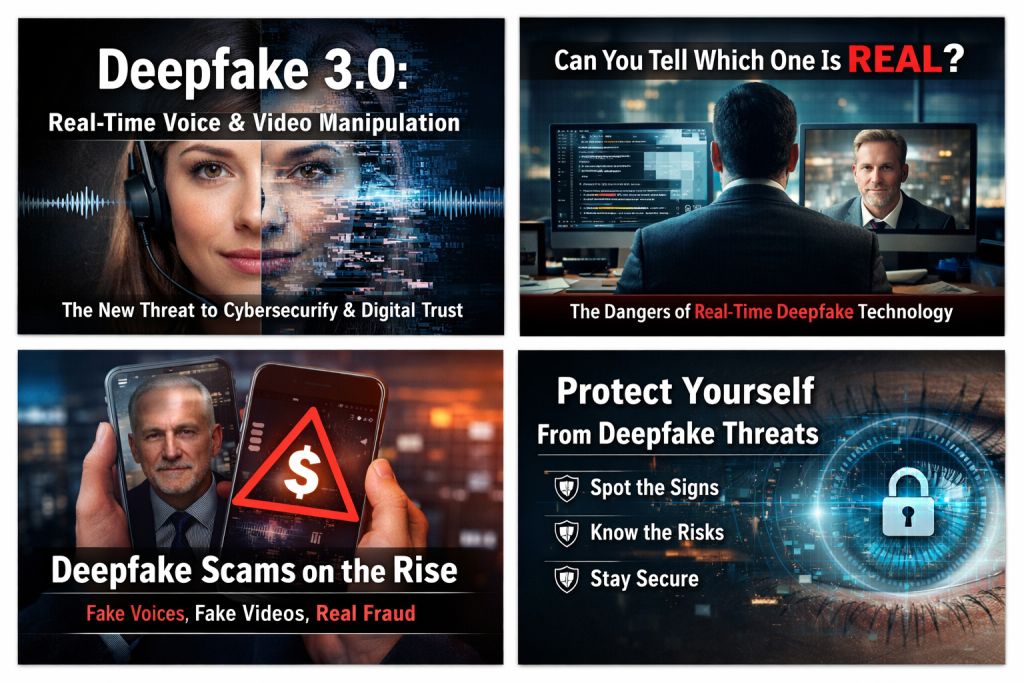
AI systems can now replicate a person’s voice and appearance almost instantly. Sometimes, this imitation happens during a conversation. Instead of editing a video afterwards, the manipulation happens live.
This new phase, often described as Deepfake 3.0, presents challenges for digital security—something cybersecurity experts predict will become increasingly significant in the coming years.
A Simple Explanation of Deepfakes
To understand the impact, it helps to know what a deepfake is.
Artificial intelligence systems learn by analysing large datasets. When the data includes recordings of someone speaking, the system recognises patterns in the voice, such as tone, pacing, and pronunciation.
Video recordings provide another layer of information. By analysing facial expressions frame by frame, AI models learn how a person’s face moves when they speak or react emotionally.
After enough examples, the system can recreate those patterns. The result may be an audio clip or video that appears to feature a specific person, even though the recording never existed.
Early versions of this technology often looked unnatural. Facial movements were off, and voices sounded mechanical. Recent improvements have made these synthetic creations much harder to identify.
Why the Technology Is Improving So Quickly
Deepfake technology did not advance overnight. Several developments have pushed it forward simultaneously.
One major factor is the improvement in AI research itself. Modern generative models are far more sophisticated than those developed just a few years ago.
Another factor is the amount of content available online. Interviews, podcasts, livestreams, and social media videos provide a large supply of training data. AI systems study this material to understand how people look and sound.
Computing power also plays a role. Tasks that once required expensive research equipment can now be handled with cloud services. In some cases, even a home computer is enough.
Because of these advances, creating deepfakes is now easier and faster than ever before.
The Shift Toward Real-Time Manipulation
In the past, creating a deepfake required editing after a video had already been recorded.
The new generation of tools works differently. Some programs can modify voices or faces in real time during communication. This happens in real time.
Imagine a situation where you join a video call with someone who looks and sounds exactly like a colleague or manager. The conversation seems normal, and nothing appears suspicious.
Behind the scenes, software could generate or alter the audio and video while the call continues.
This capability changes the nature of the risk entirely.
Real Situations That Reveal the Risk
Deepfake technology is no longer limited to research labs or demonstrations. There have already been incidents involving real financial losses.
In one widely reported case, a company employee received a phone call from someone who sounded like his supervisor. The caller explained that a payment needed to be transferred quickly as part of a business deal.
Because the voice sounded familiar and urgent, the employee approved the transfer. The scam worked. Familiarity made it easy to trust the caller.
Later, the company discovered that the call had been generated using voice-cloning software trained on recordings of the supervisor.
Another incident involved a video meeting where several participants appeared to be company executives. During the meeting, they instructed an employee to authorise financial transfers.
Investigators later concluded that most of the participants were deepfake recreations.
These examples show how easily people trust what they hear or see. This is especially true when the situation is urgent. In these moments, judgment can be clouded.
A Personal Moment That Made Me Think
I remember noticing something similar in an online technology discussion group.
Someone shared a short audio clip that sounded like a well-known entrepreneur promoting a new investment opportunity. The voice seemed convincing. The accent, pacing, and tone all matched what people had heard in interviews before.
Many members of the group assumed the recording was genuine.
Out of curiosity, I tried to locate the original source. After searching several interviews and podcasts, I realised the clip did not appear elsewhere.
Eventually, it became clear that the audio had been generated with voice cloning software.
What surprised me was how believable it sounded. Without checking the source, it was easy to assume it was real.
The Larger Security Concerns
While individual scams are worrying, the broader implications are even more serious.
Financial fraud is an obvious risk. Criminals can impersonate executives, colleagues, or family members to request urgent money transfers.
There is also concern about political misinformation. A convincing fake video showing a public figure making controversial statements could spread quickly across social media. Even if the content is later proven false, the initial reaction can influence opinion.
Deepfakes could also challenge biometric security systems. Many services rely on facial recognition or voice authentication to verify identity. If those signals can be copied convincingly, traditional security becomes less reliable.
Finally, there is the potential for personal harm. Manipulated videos can be used to damage reputations or harass individuals, sometimes spreading widely before they are disproven.
The Growing Problem of Trust
One of the deeper consequences of deepfake technology is its impact on trust in digital media.
For many years, video footage was considered strong evidence that something had happened. Today, that assumption is becoming less certain.
When people know that realistic fake videos can be created, they begin to question everything they see online.
At the same time, someone caught on camera might claim the footage is fabricated, even when it is genuine.
This makes it harder to distinguish truth from manipulation online.
Possible Ways to Address the Problem
Although the challenges are significant, several strategies may help reduce the risks.
Organisations are beginning to strengthen their verification procedures. Important financial requests may require confirmation via multiple channels rather than a single message or call.
Employee training also plays a role. Many scams succeed because people feel pressured to respond.
Researchers are working on systems that analyse audio and video files for signs of artificial generation.
Another idea is to verify digital content as it is created. Cameras or recording devices could embed secure signatures into files, allowing viewers to verify the content’s authenticity.
Looking Ahead
Artificial intelligence will continue advancing, and deepfake technology will likely improve with it.
However, awareness of the issue is increasing. Governments, technology companies, and research institutions are exploring ways to detect synthetic media and prevent misuse.
The goal is not to stop innovation but to ensure that new tools are used responsibly.
Final Thoughts
Deepfake 3.0 represents a turning point in the digital world.
The ability to imitate voices and faces during live communication changes how we think about identity, information, and trust online.
As the technology becomes more common, the ability to verify information becomes more important.
In an environment where appearances can be easily manipulated, taking a moment to check sources and confirm details may be one of the most valuable habits to develop. Staying vigilant and verifying what we see and hear is essential as we navigate the future of digital communication.
About the Author