B. R. Ambedkar is often called the Architect of the Indian Constitution. His contribution is immense.
But here is a truth many citizens, students, and exam aspirants miss:
- The Constitution was a collective project shaped by many thinkers.
Knowing about these voices shows democracy at work: debate, disagreement, and collaboration.
This blog explores lesser-known minds behind India’s Constitution—and why knowing them matters.
Why We Need to Look Beyond One Name
In classrooms and on social media, history often gets simplified. Heroes become symbols, and complex processes become single-person stories.
A few years ago, I reviewed school-level civics material for an education project. I noticed something striking. Students named Ambedkar instantly. Almost none had heard of the Constitutional Adviser who drafted the first blueprint. Few knew the women who reshaped fundamental rights.
That gap matters.
Democracy was never meant to be the work of a single genius. It was designed as a conversation among diverse voices.
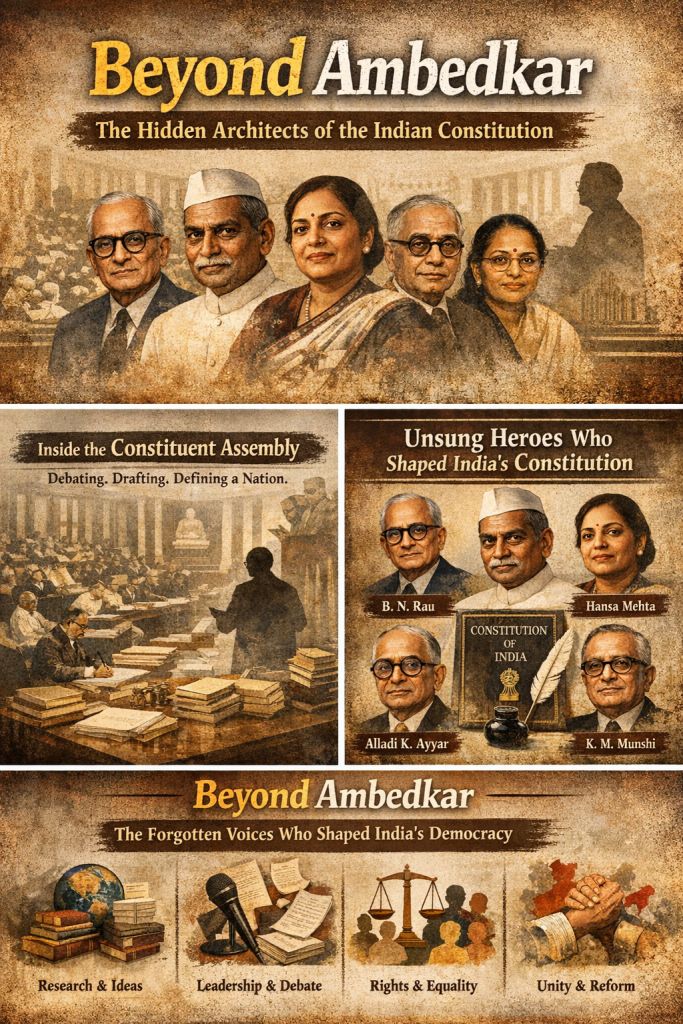
Lawyers, freedom fighters, economists, social reformers, linguists, and activists from all regions and communities joined the Assembly. Each contributed to the constitutional puzzle.
Now, let’s meet some of these vital contributors.
1. B. N. Rau — The Invisible Architect
Before Ambedkar chaired the Drafting Committee, a crucial intellectual foundation had already been laid by Benegal Narsing Rau.
What Rau Did
- Served as Constitutional Adviser to the Assembly.
- Studied constitutions from the USA, UK, Ireland, Canada, and Australia.
- Prepared the initial draft framework of the Constitution.
He travelled internationally, consulting judges and scholars, including U.S. Supreme Court Justice Felix Frankfurter, to understand how constitutional systems functioned.
Constitutional scholars argue that Rau’s comparative research was essential. India avoided common pitfalls faced by young democracies because of it.
Insight:
Ambedkar refined and defended the Constitution politically, but Rau helped design its structural skeleton.
2. Dr Rajendra Prasad — The Consensus Builder
India’s first President, Rajendra Prasad, played a quieter but important role as President of the Assembly.
His Contribution
- Maintained neutrality during heated debates.
- Ensured procedural fairness.
- Helped opposing ideological groups reach an agreement.
The Assembly debated nearly 2,000 amendments. Without strong, balanced leadership, the process could have collapsed. Factional conflict was a real threat.
In modern workplaces or policymaking bodies, this role resembles a skilled moderator who ensures ideas survive disagreement.
3. Alladi Krishnaswami Ayyar — The Legal Brain
One of the most respected jurists in the Assembly was Alladi Krishnaswami Ayyar.
Key Contributions
- Provided detailed legal reasoning behind constitutional provisions.
- Helped reconcile British legal traditions with Indian realities.
- Strongly defended judicial independence.
Many Supreme Court interpretations trace back to debates. Ayyar clarified constitutional intent in those debates.
Why this matters today:
When courts interpret fundamental rights, they often rely on Assembly debates — meaning Ayyar’s arguments still shape Indian law decades later.
4. K. M. Munshi — The Cultural Visionary
K. M. Munshi brought a unique blend of law, literature, and cultural philosophy.
His Influence
- Helped draft Fundamental Rights.
- Advocated freedom of expression and religious liberty.
- Supported preservation of India’s cultural heritage within a modern democratic framework.
Munshi believed India must be modern. Yet it must not lose civilizational continuity. This idea remains central to debates on identity and secularism.
5. Hansa Mehta — The Voice of Gender Equality
Among the most transformative contributors was Hansa Mehta.
What She Changed
- Advocated gender-neutral language in rights provisions.
- Opposed discriminatory personal laws.
- Championed equal citizenship.
Internationally, her influence was significant. She helped change wording in the United Nations’ Universal Declaration of Human Rights. The phrase “All men are born free” was replaced with “All human beings are born free.”
Her work reminds us that equality in India’s Constitution was not automatic. It was fought for.
6. Dakshayani Velayudhan — Representation from the Margins
Dakshayani Velayudhan was the only Dalit woman in the Assembly.
Her Contributions
- Advocated dignity rather than paternalistic reform.
- Emphasised social transformation alongside legal safeguards.
- Supported unity without ignoring caste injustice.
Her speeches feel modern. She urged Indians to change social attitudes. Laws alone were not enough.
7. Jawaharlal Nehru — The Vision Setter
While known primarily as India’s first Prime Minister, Jawaharlal Nehru shaped the Constitution’s philosophical direction.
Key Role
- He introduced the Objectives Resolution, which later became the Preamble’s foundation.
Ideas such as:
- Sovereignty
- Democracy
- Secularism
- Justice and equality
originated here.
Without this vision, the Constitution might have been a legal document rather than a moral one.
8. Sardar Vallabhbhai Patel — The Federal Architect
Vallabhbhai Patel is remembered for his role in political integration, but his constitutional work is equally significant.
Contributions
- Designed India’s federal structure.
- Oversaw the integration of princely states.
- Strengthened administrative services to maintain national unity.
His work ensured that India became a single union rather than a fragile confederation.
The Collective Genius Behind the Constitution
India’s Constitution borrowed ideas from multiple sources, including the Government of India Act 1935, but transformed them into something uniquely Indian.
What made the Constitution extraordinary was adaptation, not copying.
The framers asked practical questions:
- How do you govern massive diversity?
- How do you protect minorities in a democracy?
- How do you balance freedom with stability?
These are still the questions modern societies struggle with.
A Lesson from Real Conversations
I have talked to many young voters preparing for civil service exams. After learning about these contributors, they changed. The Constitution felt less like a distant textbook. It became a living negotiation shaped by people with fears and hopes.
One student said something memorable:
- “If so many people debated it, maybe disagreement is not a weakness of democracy — maybe it is the system working.”
That realisation captures the spirit of constitutionalism.
Why This Matters Today
Understanding the broader group of constitution makers helps solve three modern problems:
1. Oversimplified History
Recognising multiple contributors builds deeper civic understanding.
2. Polarised Politics
The Constitution itself was born of respectful disagreement.
3. Weak Civic Awareness
Knowing the framers’ intentions helps citizens interpret rights and responsibilities.
The Real Legacy: Collaboration Over Hero Worship
Ambedkar himself acknowledged the collective effort behind the Constitution. The drafting committee synthesised ideas, but the Assembly debated each clause in depth.
India’s Constitution survived because:
- Lawyers ensured legal strength.
- Activists ensured social justice.
- Politicians ensured practicality.
- Reformers ensured equality.
It was teamwork on a national scale.
Final Thoughts: Democracy Is a Shared Creation
When we say “Beyond Ambedkar,” we recognise his greatness while emphasising that the Constitution’s true strength lies in the collaborative vision of its many framers. Understanding this collective process is essential to appreciating its enduring relevance and power.
The Constitution is powerful. It reflects many minds, struggles, and visions of India’s future.
Knowing figures like Rau, Mehta, Munshi, Ayyar, Patel, and Velayudhan does something important:
- It reminds us that democracy is not built by heroes alone.
- It is built by participation. That is its strength.
Let us take inspiration from these examples and actively shape our country’s future—engage in discussions, defend rights, and participate in civic life. Become a co-author of the Constitution in your actions every day.
About the Author