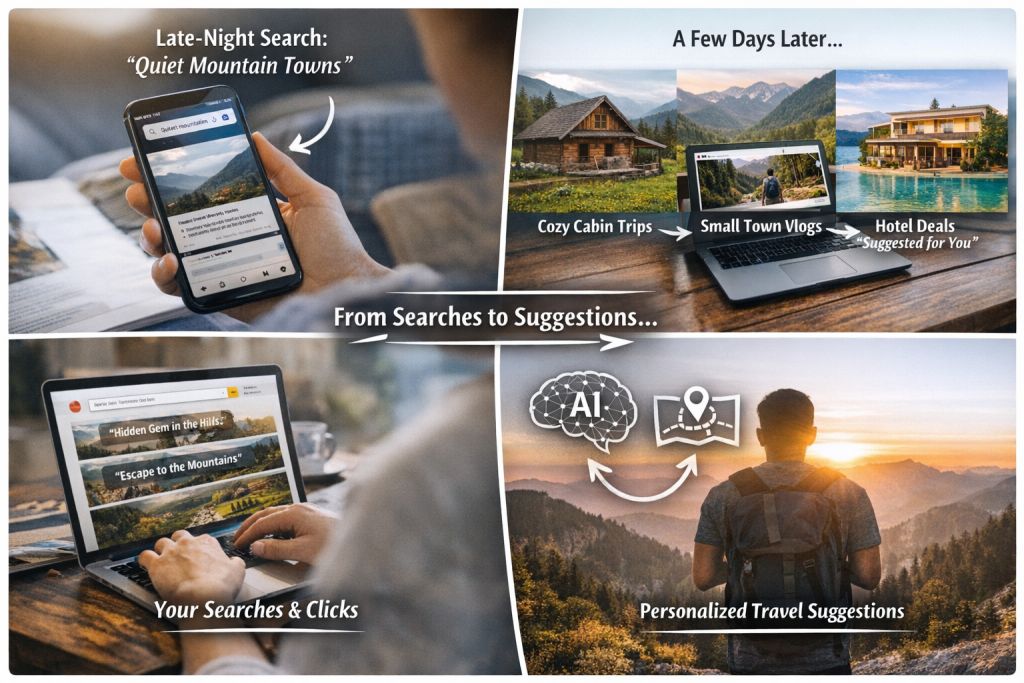
A few years ago, I searched for “quiet hill towns for a short break.” I didn’t book anything or save the page. But over the next week, something strange happened.
My Instagram feed is filled with cafés in Mussoorie. YouTube suggested walking tours of small Himalayan towns. Google showed hotel deals in places I hadn’t searched. It felt unsettling at first, but also oddly helpful.
That was my first real moment of understanding how hyper-personalised travel actually works.
Today, most of us don’t realise we’re not just planning trips. We’re silently training systems through our searches, clicks, scrolls, and pauses.
This blog examines how your search history and browsing patterns shape travel recommendations and argues that understanding this hidden influence is crucial for making informed decisions and retaining agency while using technology.
Travel Planning Has Moved Into the Background
Travel used to be intentional. You decided to go somewhere, then looked for information. Now, the process often runs in reverse.
- You watch a reel.
- You read an article.
- You click on one headline out of curiosity.
And suddenly, a destination starts following you around the internet.
This isn’t magic. It’s data-driven personalisation.
Platforms like Google Travel, Booking.com, Airbnb, Skyscanner, Instagram, and YouTube don’t wait for you to say “I want to go here.” They look for signals, small actions that suggest interest.
The more signals you send, the clearer the picture becomes.
Search History: The First Clue You Give Away
Every travel-related search carries intent, even when you don’t mean it to.
Searching “best budget trips in Asia” tells a different story than “private villas with ocean views.” Over time, these searches stack up. Algorithms don’t see them individually; they see patterns.
I noticed this while researching travel content for work. During one project, I spent weeks searching for sustainable tourism, local stays, and train travel. Without realising it, my digital world shifted. Ads changed. Content recommendations changed. Even Google Discover started showing long-form travel stories instead of quick lists.
I wasn’t planning a trip—but the system assumed I was.
And honestly, it wasn’t wrong.
Browsing Behaviour Matters More Than Keywords
Most people don’t realize how you browse matters more than what you search.
If you open a blog and leave immediately, it’s ignored. If you scroll slowly, read deeply, or return later, that’s logged as a strong interest.
The same applies to videos:
- Watching 10 seconds means nothing
- Watching 80% means something
This explains why one deep dive into a destination can outweigh ten casual searches. Algorithms see time and attention as interest.
From what I’ve seen analysing digital trends, this is where recommendations become eerily accurate. Not because platforms “listen” to you, but because attention is honest.
Social Media Is Quietly Shaping Travel Dreams
Many people believe social media only influences where we want to go. In reality, it shapes how we imagine travel itself.
If you engage with:
- Slow cafés and street food → cities like Istanbul or Hanoi
- Work-from-anywhere content → Portugal, Bali, Chiang Mai
- Luxury walkthroughs → Maldives, Dubai
The algorithm doesn’t just suggest places. It builds your travel identity.
Once that identity forms, platforms reinforce it. You see more of the same, and it feels like your idea.
This feedback loop is powerful and slightly dangerous if left unchecked.
How Travel Platforms Predict Your Next Move
Behind the scenes, travel platforms rely on machine learning models trained on millions of bookings.
They compare:
- Your behavior
- Similar users’ behaviour
- Seasonal trends
- Price sensitivity
If people who behaved like you ended up booking a specific destination, you’re likely to see it too.
I’ve seen cases where users were recommended places they had never searched for, but later booked. Not because the platform forced it, but because it reduced friction.
That’s the strength of hyper-personalised travel: less effort, faster decisions.
The Problem No One Talks About: Travel Filter Bubbles
Here’s where things get tricky.
Personalisation is efficient but also narrowing.
Once a system labels you as a “luxury traveller” or a “budget backpacker,” it becomes harder to break out of that box. You stop seeing alternatives. Hidden gems disappear. Unexpected places remain hidden.
While studying content performance in travel media, I noticed that users exposed to only one travel style tend to repeat the same kinds of trips—even when better options exist.
Discovery suffers. Serendipity fades.
Travel becomes optimized, not exploratory.
Privacy Isn’t the Real Issue—Awareness Is
Most travellers aren’t angry about data collection. They’re simply unaware of it.
Few people know that:
- Incognito mode is limited
- Logged-in devices share data across apps
- Ad preferences influence destination pricing and visibility
According to global privacy frameworks like GDPR, users technically have control. But control without understanding means nothing.
The real concern isn’t being tracked; it’s not knowing how much influence that tracking has.
How Travellers Can Stay in Control (Without Opting Out)
You don’t need to fight algorithms. You just need to guide them.
Simple habits make a big difference:
- Occasionally, explore destinations outside your usual style
- Use private browsing when you want unbiased inspiration
- Follow diverse travel creators, not just one niche
- Clear or pause search history before serious planning
Think of personalisation as a steering wheel. If you don’t touch it, the system keeps going straight.
Why This Matters for Travel Brands and Creators
For travel businesses, hyper-personalisation isn’t a trend; it’s the foundation.
Generic content no longer performs well. Travellers respond to specificity:
- “A quiet 3-day trip from Delhi”
- “Best cities for introverted solo travellers”
- “Food-focused travel for first-time Europe visitors”
From firsthand experience working with digital content, I’ve seen focused guides outperform broad ones every time.
Personalisation rewards clarity, honesty, and usefulness.
What the Future of Travel Personalisation Looks Like
We’re heading toward:
- Voice-based trip planning
- AI travel assistants
- Emotion-aware recommendations
- Real-time itinerary changes
Soon, travel planning won’t feel like research. It will feel like a conversation.
That future can be incredible if designed with respect for human curiosity and choice.
Final Thought: Let Technology Help, Not Decide
Hyper-personalised travel is transforming how we make travel decisions by using our digital behaviour to shape our choices. The main point: this technology holds great power to influence us, for better or worse.
Search history and browsing patterns don’t just reflect who we are; they subtly influence who we become as travellers.
Used wisely, personalisation saves time and improves experiences. Used blindly, it narrows the world.
The best journeys begin with your curiosity—let technology empower, not overshadow, your sense of discovery.
Let the algorithm suggest.
Make the final decision yours—choose adventure on your terms.
About the Author