Before architects used software or machines, people already understood how to build homes that worked.
They paid attention to the sun, the wind, and the changing seasons. Houses fit daily routines and local weather, not trends. Thick walls kept out the summer heat. Steep roofs handled heavy rain. Courtyards made shade. Builders used materials from nearby.
They relied on generations of experience.
Today, many buildings look the same no matter where you go. Concrete towers stand in deserts, coastal cities, and mountain towns. Most need air conditioners or heaters to stay comfortable. When floods or heatwaves come, these buildings often have problems.
This renewed interest in how we build brings Digital Vernacular Homes into focus today.
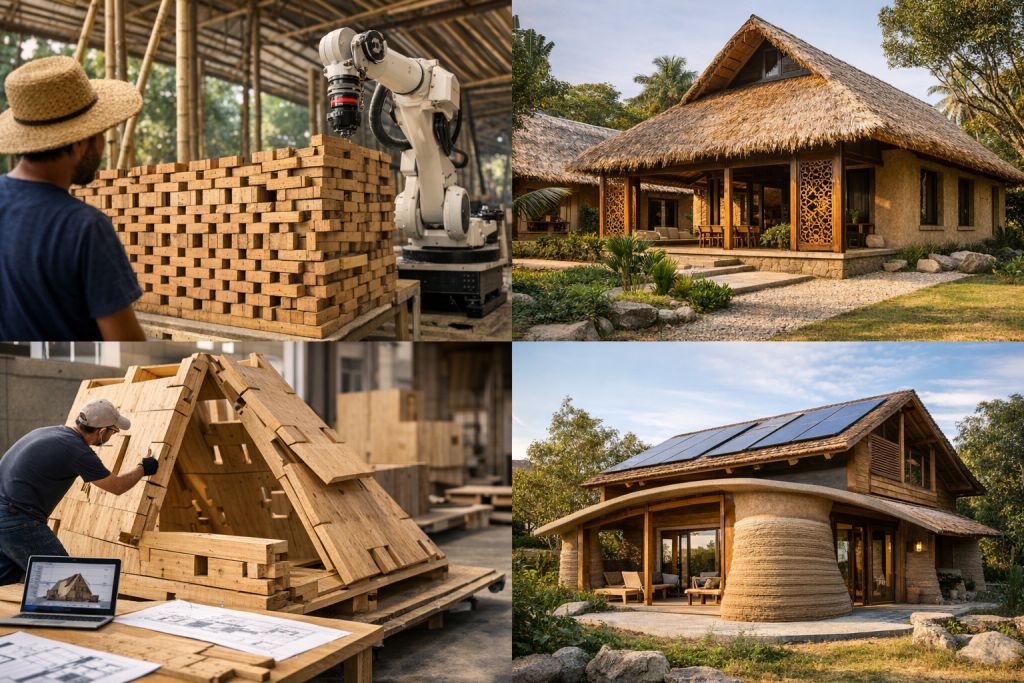
They offer a new approach by combining traditional building knowledge with modern digital tools such as CNC machines, robotics, and computer-guided design.
This approach does not replace tradition.
Instead, it strengthens traditional practices.
But what does “digital vernacular” really mean?
This is actually a straightforward idea.
Digital vernacular homes begin with local knowledge. Architects study how people in a region built houses over generations. They examine layouts, materials, airflow, shade, and how homes respond to the climate.
Then, they use digital tools to build on those ideas.
CNC machines cut building parts precisely. Robots help put structures together. Software checks designs against sun, wind, and rain before construction begins.
It’s traditional knowledge enhanced with digital tools.
That is the main idea.
Traditional homes were already designed for the climate.
I saw this for myself during a trip to rural eastern India.
The village houses were simple, made mostly of earth, bamboo, and wood. Inside, the air stayed cool even during the hottest part of summer. There was no AC or mechanical systems—just smart design.
A short walk away, newer cement homes looked modern but felt uncomfortable, even with fans running.
That contrast left a strong impression on me.
Our grandparents did not have climate models or engineering degrees, but they still built homes that worked with nature.
Modern studies support this. Vernacular homes often do better in extreme heat than newer buildings. Features like thick walls, shaded courtyards, and natural ventilation really help.
Somehow, we lost sight of this.
How technology can help
This is where CNC and robotics become useful—not to replace human skill, but to help.
Digital fabrication lets builders recreate traditional forms more quickly and with less waste. Timber panels are cut precisely. Joints fit well. Parts arrive ready to be put together.
Building becomes cleaner and faster.
Homes no longer have to be generic. Local patterns and materials can be used without increasing costs.
I once talked to a carpenter who had spent decades shaping wood by hand. When he saw CNC-cut joints based on traditional methods, he laughed and said, “At least now my knees can rest.”
That meeting left a memorable impression.
Technology does not have to replace craftsmanship. It can help protect it.
Where culture and technology meet
These homes do not focus on futuristic shapes.
They remain connected to their location.
Architects look at rooflines, courtyard layouts, window placement, and material textures. They turn these into digital models and improve them. The local character stays.
Projects like WikiHouse let communities download designs and cut parts with nearby CNC machines. Homes are assembled using joinery inspired by traditional woodworking.
In Italy, some experimental houses are 3D-printed using clay from the building site. The curved walls help regulate temperature naturally.
These are not just luxury experiments.
They are real solutions to housing shortages and climate challenges.
Designing for climate resilience
Most modern buildings address climate problems by installing machines.
They use more air conditioning, more insulation, and bigger systems.
Digital vernacular homes take a different approach.
They build resilience into the structure itself.
Roof angles are designed for rainfall. Walls are made to handle heat. Windows are placed for cross ventilation. Shading panels are cut to block harsh sunlight while allowing daylight to enter.
This lowers energy bills and makes homes more comfortable inside.
Nature becomes a partner instead of something to fight against.
Practical benefits
This approach helps solve real problems:
- Construction costs fall because the building is faster
- Material waste is reduced
- Homes reflect local culture instead of global sameness
- Energy use drops
- Communities regain control over housing
This means sustainability that people feel through lower bills, comfortable homes, cultural connection, and better community control.
Why this is important now
We are facing both housing shortages and climate instability at once.
Yet we keep using the same building methods that caused these problems.
Digital vernacular homes offer a different path.
They remind us that real progress in architecture means rediscovering what already worked for comfort and resilience, then strengthening those proven ideas with modern digital tools.
To me, this idea feels hopeful.
It shows that architecture can be both practical and poetic.
Final thoughts
Digital Vernacular Homes are about more than just buildings.
They are about memory, place, and responsibility.
By combining traditional design with CNC fabrication and robotics, we can build affordable, climate-resilient homes that are connected to local culture.
Homes that feel alive.
Homes that truly belong.
In a world looking for better ways to live, this seems like the right direction to take.
About the Author