Not long ago, I stood on the edge of a dry farmland patch during peak summer. The soil was cracked. Farmers nearby were waiting for rain that never came. Crops were struggling. That moment stayed with me.
This moment made me realize: agriculture must evolve to survive.
Climate change, shrinking freshwater supplies, rising temperatures, and population growth are pushing agriculture to its limits. In many parts of the world, especially deserts and drought-prone regions, growing food is becoming harder every year.
Against this backdrop of growing pressure, something remarkable is happening quietly in labs, greenhouses, rooftops, and even space research centers.
This approach, known as waterless hydroponics and fogponics, offers a promising solution for cultivating food in harsh environments.
Why Traditional Farming Is No Longer Enough
Conventional farming depends on three things: soil, water, and predictable weather.
All three have become unreliable, putting increasing strain on farmers.
- Water tables are dropping.
- Fertile land is shrinking.
- Heatwaves are damaging crops.
- Floods wipe out harvests overnight.
In many regions, farmers are forced to abandon land simply because irrigation costs are too high or rainfall is too low.
That’s why soilless farming is not just an alternative—it’s becoming a necessity for our changing world.
Understanding Waterless Hydroponics (In Simple Terms)
Hydroponics is a method of growing plants without soil. Instead, plant roots are placed in a solution of water mixed with essential nutrients, or in neutral materials like coco fiber or clay pellets that do not add or remove nutrients.
The plants get exactly what they need, not more or less.
When I first tried a small hydroponic setup at home, I was surprised by how fast everything grew. Lettuce that took weeks in soil was ready in days. And the water use? Shockingly low.
The system recycles water, so almost nothing is wasted.
Key benefits:
- Uses far less water than traditional farming
- Plants grow faster
- No soil diseases
- Precise control over nutrients
- Works indoors or outdoors
Hydroponics already helps grow food in dry cities, on rooftops, in abandoned warehouses, and in desert greenhouses.
As hydroponics becomes more common, fogponics takes efficiency even further.
Fogponics: Farming with Mist Instead of Water
Fogponics is a more advanced form of soilless growing, in which plants receive their nutrients through a fine mist, or fog, that surrounds their roots.
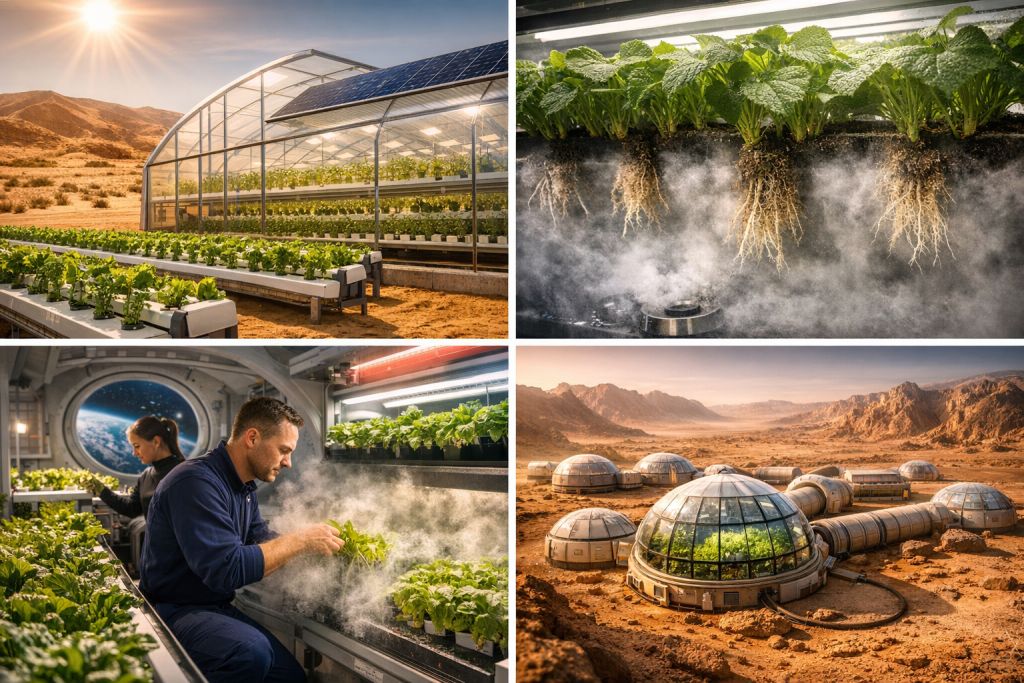
Instead of soaking roots in water, fogponics delivers nutrients as an extremely fine mist made up of tiny liquid droplets. The roots hang freely in the air and directly absorb nutrients from these microscopic particles.
This might sound futuristic, but it’s real.
This is incredibly effective because the fog’s tiny droplets are absorbed quickly by plants, leading to nearly zero water loss and faster, healthier growth.
Because fog droplets are extremely small, plants absorb nutrients more quickly. There’s almost zero water loss. Roots receive more oxygen, which leads to faster growth and stronger plants.
I once saw a fogponic demo where basil plants doubled in size within days. The roots looked like white clouds floating in midair. It was hard to believe they weren’t in soil.
Fogponics systems can use up to 90% less water than traditional agricultural methods, thanks to the very fine droplets and efficient nutrient delivery.
That’s why, for dry regions, these methods are revolutionary.
Solving Agriculture in Deserts
Deserts cover nearly one-third of Earth’s land surface. Most people see them as lifeless.
With hydroponics and fogponics, deserts—often seen as lifeless—become opportunities.
These systems don’t care about sand quality. They don’t rely on rainfall. They can operate inside climate-controlled greenhouses powered by solar energy.
In places like the Middle East, North Africa, and parts of India, hydroponic farms are already producing leafy greens, tomatoes, strawberries, and herbs year-round.
Imagine local food grown in the desert using recycled water and sunlight.
No massive irrigation canals. No soil erosion. No chemical runoff.
Just clean, controlled growth.
Investigating Ultra-Efficient Growing Systems for Space Missions
Pushing further, let’s look beyond Earth.
Space agencies have been testing hydroponics and fogponics to grow food for astronauts.
Why?
- Soil and water are heavy and valuable.
- Water is precious.
- Resupply missions are expensive.
- Astronauts need fresh food for long missions—not just packaged meals.
Fogponics offers something special: it uses very little water and delivers nutrients efficiently in enclosed environments.
On future Moon or Mars bases, these systems could:
- Produce fresh vegetables
- Generate oxygen
- Improve mental health for astronauts
- Reduce dependence on Earth
One engineer once explained that plants in space aren’t just food—they’re emotional support. Watching something grow in a lifeless environment reminds humans why they’re there.
That thought moved me.
Farming becomes symbolic, not just practical.
Real Challenges (And Honest Truth)
These systems aren’t perfect and have real challenges.
Early fogponic setups often fail because:
- Foggers clog
- Roots dry out if the mist timing is off
- Power outages can kill plants quickly
- Setup costs can be high
I lost an entire crop once due to a pump failure overnight. It taught me how fragile tech-based farming can be without backups.
But innovation is solving these issues.
Today’s systems use several advanced technologies:
- smart sensors that monitor plant health,
- automatic nutrient control systems that adjust the solution,
- mobile alerts to notify growers of any issues,
- backup power supplies powered by solar energy,
- and AI monitoring to optimize growth conditions.
As costs drop and knowledge spreads, these farms are becoming easier to manage.
Why This Matters for the Future
Waterless agriculture doesn’t just help deserts or space missions.
It can transform:
- Urban farming
- Disaster relief food systems
- Remote communities
- Vertical farms
- Climate-resilient agriculture
Imagine apartment buildings growing their own food.
Imagine refugee camps producing fresh vegetables.
Imagine cities that don’t depend entirely on long food supply chains.
That future is already beginning.
Environmental Benefits Most People Don’t Talk About
Soilless farming also reduces:
- Land degradation
- Pesticide use
- Water pollution
- Carbon emissions from food transport
Because crops can grow close to consumers, food travels fewer miles.
That means meals are fresher and have smaller carbon footprints.
My Personal Takeaway
What inspires me most isn’t the technology.
It’s what it represents.
Waterless hydroponics and fogponics demonstrate that people can adapt without harming the environment. We don’t have to fight the planet; we can work with it.
From barren deserts to orbiting space stations, these systems demonstrate that with the right blend of science and creativity, it is possible to grow food even in the most extreme environments.
That realization changed how I see agriculture forever.
Final Thoughts
Waterless hydroponics and fogponics aren’t trends.
They’re necessities.
As climate challenges grow, these highly efficient systems aren’t just options—they are becoming vital to food security where nature resists traditional agriculture.
From Earth’s hottest deserts to future Mars colonies, one thing is certain:
- The future of farming won’t be underground.
- It will be in the air.
Join this movement—experiment, share your story, and help redefine the future of food. The next step is ours.
About the Author