Unlock the past, understand the present, and shape the future with immersive VR history.
As digital transformation reshapes how we learn and engage with history, virtual reality (VR) time-travel experiences have become valuable tools for studying public memory. Museums and educational platforms now use VR to bring the past to life, providing insights into how collective and individual memory function in immersive settings.
This article explores the latest developments in VR time-travel, examines its benefits and challenges, highlights research findings, and considers its impact on memory, learning, and cultural preservation.
What Is VR Time-Travel and Why It Matters
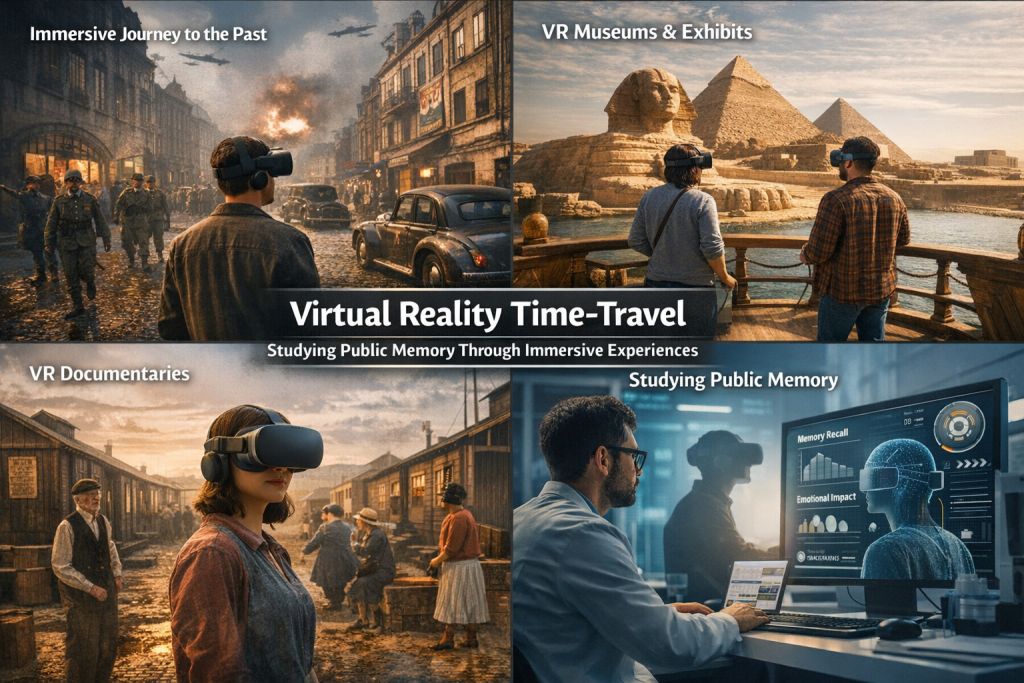
VR time-travel allows users to step into virtual recreations of historical settings, such as 1940s Europe or ancient Olympia, and experience events firsthand. These immersive experiences go beyond traditional media by enabling direct engagement with the past.
These experiences serve as more than entertainment; they provide experimental environments for researchers to study public memory, which is shaped by culture, education, and shared narratives.
How VR Shapes Memory and Learning
Immersion Enhances Memory Formation
Traditional history education relies on textbooks and lectures, which may not sustain engagement. In contrast, VR engages users both emotionally and cognitively:
- Emotional engagement, which drives memory retention, is higher in VR than in passive learning environments. Emotion interacts with the brain’s memory systems to anchor experiences in long-term memory. Research shows that immersive VR environments create emotional markers that enhance knowledge retention compared to traditional methods.
- Interactive exploration keeps users mentally active and motivated, supporting constructivist learning theories that emphasize knowledge construction through meaningful engagement.
- In educational settings, VR has increased engagement, motivation, and learning outcomes in history, fostering deeper contextual understanding than conventional classrooms.
Real-World VR Time-Travel Applications
1. VR History Museums and Exhibits
A notable example of VR time-travel is its use in museum exhibits, where immersive setups allow visitors to walk through history instead of viewing artifacts behind glass.
For example:
- TimeRide offers city-based VR time-travel through the historical epochs of major European cities. Visitors don VR headsets and experience historically accurate environments while physically seated in reconstructed scenes.
- VR experiences like Remembering Pearl Harbor use first-person narration from real historical figures to guide users through critical moments and spaces, blending first-hand testimony with immersive visualization.
These projects are not mere novelties; museums report higher visitor satisfaction and stronger emotional engagement, demonstrating VR’s potential to reshape public memory in cultural spaces.
2. Digital Documentary VR
The Book of Distance, a VR documentary by the National Film Board of Canada, immerses viewers in the internment experiences of the creator’s grandfather during World War II. This experience extends beyond narration by placing users in environments that evoke historical contexts and personal memories.
Immersive documentaries enable participants to inhabit memories, promoting empathy and deeper historical understanding. Scholars refer to this as prosthetic memory, where media extend our internal sense of memory beyond direct personal experience.
Studying Public Memory Through VR
How does VR contribute to the study of public memory?
1. Probing Collective Narratives
By placing users in immersive simulations of historical events, researchers can observe how people interpret, emotionally respond to, and remember key moments, providing insights into the formation of public memory.
Studies show that VR not only imparts facts but also creates narratives that connect emotion, spatial presence, and memory. This combination of cognitive and emotional response is essential to understanding how societies retain and reinterpret their histories.
2. Measuring Memory Recall and Recognition
Emerging research indicates that virtual experiences influence memory performance. Studies comparing VR and non-VR learning environments show that immersive experiences affect information recall and recognition, providing new data on memory quality.
These insights are valuable for educators, cognitive scientists, and policymakers seeking to enhance historical literacy and strengthen shared cultural narratives.
Personal Reflection: A Glimpse into VR History
I recall my first VR time-travel experience during a technology demonstration of a recreated ancient city. Wearing the headset, I walked through digital stone streets, heard distant market sounds, and saw temples rising toward the sky. Although I knew it was a simulation, the emotional impact was significant. The experience felt immersive, as if stepping into another world.
That moment highlighted an important point: immersive VR does not just present history; it enables users to experience it emotionally.
Challenges and Ethical Considerations
While VR holds significant promise, it also presents important questions and challenges:
1. Authenticity vs. Interpretation
Virtual reconstructions always involve interpretation. Decisions about what to include and how to present it inevitably shape users’ understanding of history. This limits the objectivity of VR memory representations and highlights the need for historical accuracy and community consultation.
2. Emotional Impact and Sensitivity
Immersive experiences of traumatic events, such as war or displacement, can elicit strong emotional reactions. While this may deepen empathy, it also raises ethical concerns about psychological safety, particularly with sensitive content. Scholars recommend that VR in memorial spaces be ethically curated and integrated into broader educational frameworks rather than used as stand-alone tools.
3. Accessibility and Inclusivity
Not everyone can access or use VR comfortably. Motion sickness, equipment costs, and learning curves remain practical barriers, especially in under-resourced regions. This highlights the importance of ensuring equitable access to innovation.
Looking Ahead: The Future of VR Time-Travel and Public Memory
The future of VR time-travel is promising. Emerging research explores multi-sensory VR, including synchronized sound and scent cues, to further anchor lived experience and memory. This development could significantly enhance immersion in historical contexts.
Educational institutions, museums, and cultural organizations are increasingly adopting VR to broaden access to heritage and deepen cross-cultural understanding. As technology and educational paradigms evolve, VR could transform school curricula and global heritage tourism.
Key Takeaways
- VR time-travel extends beyond entertainment; it is a powerful method for studying memory, emotion, and learning.
- Immersive experiences enhance engagement and recall, providing new insights into how people internalize history.
- Real-world VR applications, including museum exhibits and documentary reconstructions, present the past in new and impactful ways.
- Ethical and accessibility considerations remain essential as this technology reshapes public memory.
About the Author