As global temperatures rise and sustainability becomes increasingly urgent, the built environment must adapt. Traditional static building envelopes are inadequate for today’s dynamic climates. Unresponsive facades contribute to heat gain, higher energy use, and occupant discomfort, particularly in areas with intense sunlight or significant temperature fluctuations.
Enter the next frontier in architectural design: climate-responsive morphing facades — building skins that adapt, transform, and react to environmental conditions in real time, reducing heat gain, optimizing daylight, and improving resilience. These systems are not just futuristic aesthetics; they are practical solutions to real-world climate challenges.
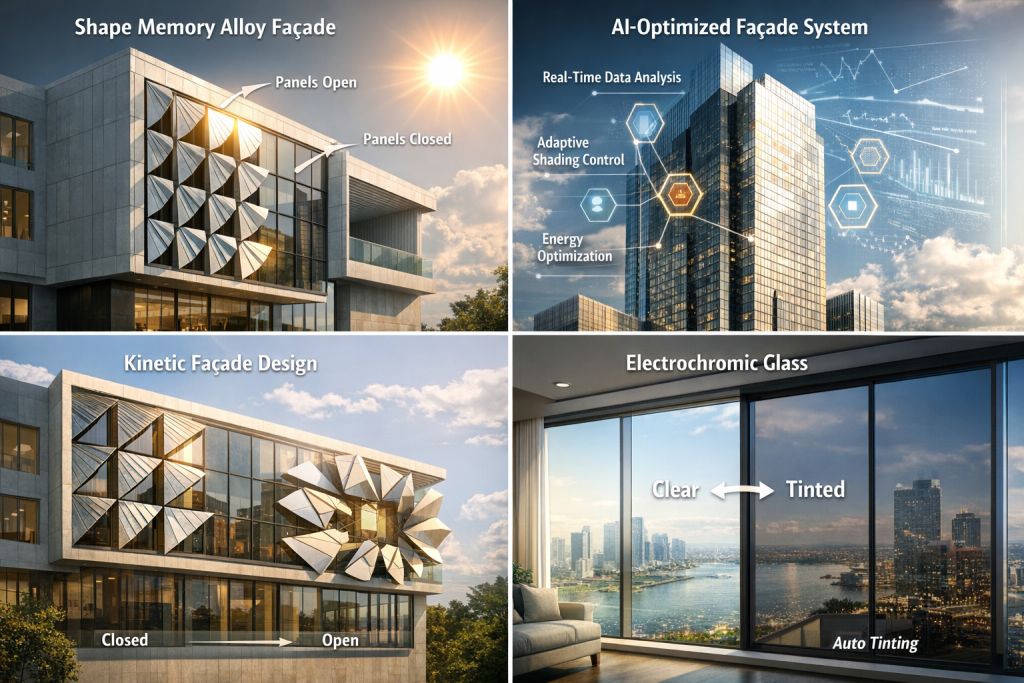
In this blog, we’ll explore:
- What climate-responsive morphing facades are
- Cutting-edge materials like Shape Memory Alloys (SMAs) and electrochromic glazing
- Kinetic facades and biomimetic design
- How AI-based facade optimization is transforming heat mitigation
- Real-world applications and actionable takeaways for architects, engineers, and sustainability leaders
Let’s begin.
What Are Climate-Responsive Morphing facades?
Adaptivity is central to climate-responsive morphing facades. These building envelopes detect changes in weather and adjust their form or properties accordingly. Unlike static facades, morphing facades move or regulate themselves in response to sunlight, temperature, humidity, and occupant behavior.
These facades are part of a climate-adaptive building shell (CABS), where the exterior envelope interacts dynamically with the environment to enhance energy performance and occupant comfort. The facade actively contributes to thermal regulation rather than serving as a passive barrier.
Smart Materials — The Building Blocks of Adaptivity
Shape-Changing Materials: Shape Memory Alloys (SMAs)
Shape Memory Alloys (SMAs) are metals engineered to “remember” a specific shape. When exposed to a trigger, typically heat, they return to their original form. This property can be used in facade elements to open or close shading systems, adjust louvers, or change geometry without large mechanical systems.
Architectural research highlights that SMAs enable facades that respond autonomously to temperature changes and can operate with minimal energy input, as the material itself serves as both sensor and actuator.
This capability is especially valuable for climate-responsive facades in hot and arid regions. SMAs can activate shading devices during peak heat hours, reducing solar heat gain and cooling loads without external power.
For example, in an architectural research lab, SMA strips embedded in a facade prototype curled under direct sunlight, automatically creating shading without motors or power supply. The simplicity and effectiveness of this solution were notable.
Electrochromic Glazing: Adaptive Tint for Sunlight and Heat
Electrochromic glass is another smart material transforming facades. This glass changes tint when an electric current is applied, allowing precise control of light and heat entering a space. It can be adjusted manually or automatically using temperature or daylight sensors, unlike traditional blinds.
Electrochromic facades offer compelling benefits:
- Reduce glare without blocking views.
- Lower heat gain in summer
- Increase passive solar gain in winter.
- Improve occupant comfort while minimizing HVAC loads.
Buildings with dynamic glazing report measurable reductions in cooling loads and improved occupant satisfaction by balancing daylight, views, and thermal comfort.
Kinetic facades — Movement Inspired by Nature
Kinetic facades move beyond material responses by incorporating motion. Exterior panels can slide, rotate, fold, or expand, similar to a flower opening in sunlight. These movements significantly alter the amount of solar radiation entering the building, providing optimized shading throughout the day.
Real Examples:
- Al Bahar Towers (Abu Dhabi): Inspired by traditional mashrabiya screens, a responsive facade of over 1,000 shading units opens and closes in response to the sun’s position, reducing solar gain and cooling demands.
- One Ocean Pavilion (Expo 2012): The facade fins, made from shape-memory materials, mimic natural systems and adapt passively to temperature variations.
- Kolding University: A facade with triangular forms that adjust to light and heat based on embedded sensors.
Kinetic facades combine form and function, delivering visually striking architecture while directly reducing heat gain.
AI-Based Facade Optimization — The Future of Intelligent Skin
Smart materials and kinetic modules allow facades to adapt, while Artificial Intelligence (AI) enables real-time optimization of their behavior.
Why AI Matters
AI transforms responsive facades into learning systems. Rather than relying on fixed rules, AI interprets environmental data such as solar radiation, temperature, weather forecasts, and occupancy patterns to predict the optimal facade configuration for minimizing heat gain or enhancing comfort.
Recent studies show that AI-driven parametric facade systems, which use neural networks and optimization algorithms, can significantly outperform static systems in energy efficiency. These systems reduce HVAC use and stabilize indoor climates under varying conditions.
For example:
- Genetic algorithms and neural networks have been employed to optimize shading positions and configurations in real time, improving thermal comfort while reducing energy use.
- Explainable AI twin models are being developed for double-skin facades with solar chimneys, helping designers identify optimal design parameters for heat mitigation and energy storage.
In practice, a building facade can learn from its environment and occupants. Over time, the system becomes more efficient at predicting heat peaks, adjusting panels earlier, or changing tint levels based on forecasts, reducing the need for occupant intervention.
Real Value: Heat Mitigation and Comfort
Buildings equipped with AI-optimized facades can reduce heat gain by anticipating the thermal impact of incoming solar radiation and responding preemptively. For example:
- AI can adjust kinetic shading elements minutes before peak heat, reducing interior temperatures without excessive HVAC use.
- Combined with electrochromic glazing, AI can finely tune tint levels to balance sunlight and thermal control.
In summary, AI not only responds but also predicts.
Benefits of Climate-Responsive Morphing facades
Thermal Regulation and Energy Savings
By dynamically modulating solar gain, morphing facades can significantly reduce cooling and heating energy use, which is especially important in hot climates and tropical cities.
Enhanced Sustainability
Reducing energy demand supports global decarbonization goals. Adaptive facades help buildings move toward net-zero energy targets by minimizing mechanical cooling and utilizing passive design principles.
Occupant Comfort and Well-Being
Dynamic facades reduce glare, gently control daylight levels, and maintain consistent indoor comfort, which improves occupant productivity and satisfaction.
Architectural Expression Meets Function
Morphing facades are both efficient and visually dynamic, providing architects with a range of movement, patterns, and forms that change throughout the day.
Challenges and Considerations
Despite their advantages, climate-responsive facades present several challenges:
- Maintenance & Durability: Moving parts and smart materials require thoughtful maintenance planning. Research shows motorized kinetic facades can be especially maintenance-intensive.
- Cost & Complexity: The upfront investment is higher than for conventional facades.
- Control Systems Integration: AI optimization requires robust sensor networks and building management integration.
However, technological advances and economies of scale are reducing these barriers.
Practical Tips for Designers & Builders
If you are considering climate-responsive facades for a project:
1. Start with Climate Data: Use environmental simulation tools early in design to identify facade typologies that maximize benefits.
2. Combine Materials & AI: Integrate smart materials with AI control systems to move beyond reactive facades into predictive climate solutions.
3. Design for Maintainability: Prioritize systems with fewer moving parts or smart materials that self-actuate for reliability.
4. Pilot & Test: Small-scale prototypes can validate performance before full rollout.
Final Thoughts
Climate-responsive morphing facades represent a significant shift in architectural technology. These systems combine material science, AI, and bio-inspired design to create building envelopes that adapt to the climate rather than resist it.
Given that buildings account for a significant portion of energy use and carbon emissions, adopting morphing facades is not only innovative but also necessary.
Whether you are an architect, engineer, sustainability leader, or building owner, now is the time to view facades as active, adaptive interfaces with the environment rather than static barriers.
Allow buildings to move with the climate—intelligently, sustainably, and elegantly.
About the Author







Its like you read my mind! You appear to know so much about this,
like you wrote the book in it or something. I think that you can do with a few pics to drive the message
home a bit, but other than that, this is fantastic
blog. A fantastic read. I will definitely be back.
I always used to study post in news papers but now as I am a user of internet thus
from now I am using net for articles or reviews,
thanks to web.