Climate extremes such as floods, wildfires, and prolonged heatwaves are now common and directly influence how we design homes, schools, and cities. Resilient architecture requires more than stronger materials; it involves a systems-based approach that integrates smart design, proven technologies, and community-focused planning to ensure buildings endure, recover, and protect occupants. This guide outlines practical, research-backed strategies for architects, developers, and city planners, including flood-adaptive floating structures, fire-resistant materials for hot regions, and urban cooling with reflective and porous surfaces. A concise design checklist is also provided for projects of any scale.
Why resilience matters now
Global assessments show that climate extremes are becoming more frequent and severe, requiring infrastructure to adapt and support safer communities. Designing for resilience reduces long-term social and economic losses and, most importantly, saves lives. The IPCC and leading building-sector organizations recommend integrated, forward-looking strategies that combine mitigation and adaptation in the built environment.
Principles of resilient architecture (quick primer)
1. Risk-aware siting: Analyze historical data and future projections for floods, fire, and heat.
2. Redundancy and adaptability: Ensure systems such as power, water, and access have backups and modular options.
3. Robust materials and detailing: Select non-combustible, low-maintenance materials for high-exposure areas.
4. Prioritize passive strategies: Use passive cooling or natural flood tolerance to reduce reliance on vulnerable systems.
5. Community integration: Social resilience is essential; include evacuation routes, community shelters, and local knowledge.
These principles are widely endorsed by global building authorities and resilience frameworks, which recommend this layered approach.
Flood-adaptive solutions: floating & amphibious structures
In areas with recurring floodwaters, two proven strategies are effective: floating and amphibious architecture.
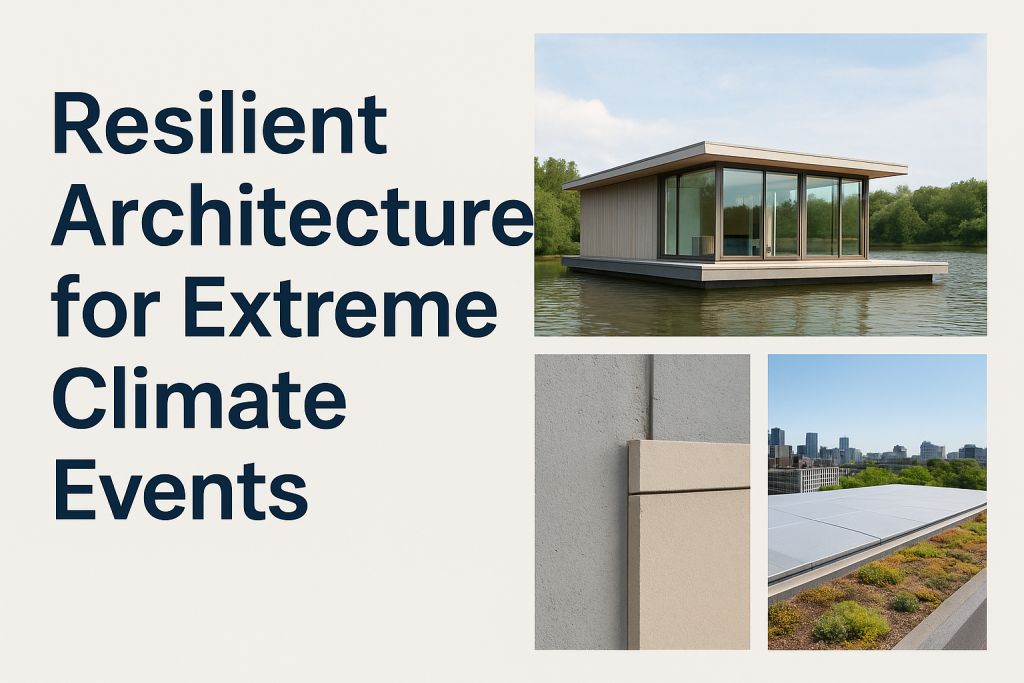
- Floating structures are built on buoyant foundations (from engineered pontoons to recycled materials) and remain on the water surface year-round or seasonally.
- Amphibious houses rest on the ground during dry periods and rise on guideposts and buoyant foundations when water levels rise—anchored for safety but free to float during floods.
Real-world examples demonstrate that these are practical solutions. Amphibious housing projects in the Netherlands (Maasbommel) and community-driven floating house designs in Bangladesh have reduced displacement and asset losses during recurrent floods. Retrofitting existing houses with floating floors or modular buoyant platforms has also been tested as an affordable solution in flood-prone communities.
Design tips
- Use resilient, water-resistant finishes at lower levels (stainless fixings, water-tolerant insulation).
- Design utilities for quick shutoff and relocation of critical systems (electrical panels, generators) above expected flood levels.
- Standardize guidepost anchors and connection details to ensure multiple units float uniformly and safely.
- Fire-resistant materials for hot, fire-prone regions
- With expanding wildfire perimeters and increasing heat stress, selecting appropriate materials and assemblies is more important than ever.
Top material choices & strategies
- Mass materials (concrete, masonry) are inherently non-combustible and offer thermal buffering. Recent studies continue to confirm concrete’s superior fire performance when detailed correctly.
- Fiber-cement, metal cladding, and treated masonry provide durable, low-combustibility exteriors.
- Fire-protective coatings & intumescent paints: used for structural steel and timber to delay heat transfer and maintain structural integrity during exposure. Research and fire tests show intumescent and cementitious coatings significantly improve fire endurance times.
- Landscape as a fire buffer: combine hardscape setbacks, ember-resistant vents, and non-combustible decking within the first 10–30 meters around buildings.
- Assembly is more critical than any single material. Proper detailing, including sealed vents, sacrificial cladding, fire-rated glazing, and setbacks, is essential to prevent ember intrusion and ignition.
- Urban cooling: reflective & porous surfaces to beat heat
- Cities retain heat, but strategic surface choices can reduce ambient temperatures and lower thermal stress for occupants.
Reflective (high-albedo) surfaces
Cool roofs and reflective coatings reduce rooftop heat gain and lower building cooling loads. New high-reflectance coatings and porous radiative materials can significantly lower roof surface temperatures and, in some prototypes, remain cooler than ambient air under certain conditions.
Porous and evaporative pavements
Porous pavements and permeable tiles allow water infiltration and support evaporative cooling, especially when combined with vegetation and managed irrigation. Studies show that cool and porous pavements can significantly reduce surface temperatures and improve stormwater management.
Integrated rooftop strategies
Combine reflective coatings, lightweight green roofs, and rooftop evaporative tiles to achieve multiple benefits, including reduced cooling demand, improved stormwater retention, and extended surface life.
Policy & scale
Municipal programs, such as cool pavement pilots and building code incentives for cool roofs, have the greatest impact. Effective strategies scale with supportive policy. The EPA and other agencies recommend cool pavement programs as part of citywide heat island mitigation.
Putting it all together: systems & community
Resilient architecture succeeds when buildings are designed with systems thinking and the community in mind:
- Pair floating units with neighborhood evacuation hubs and elevated utility corridors.
- Use fire-resistant assemblies where risk maps show repeat exposure, but pair them with defensible landscaping and community evacuation plans.
- Implement citywide cool surface programs (roofs, pavements, public plazas) prioritized for heat-vulnerable neighborhoods.
- Funding, maintenance plans, and local skill development, such as training builders on amphibious foundations or fire-safe detailing, are essential for transforming pilot projects into long-term resilience.
Practical checklist for designers (quick)
- Has the project used up-to-date hazard mapping and future climate projections?
- Are critical services (electrical, medical, communications) elevated or hardened?
- Is the envelope detailed to resist embers, water intrusion, and prolonged heat?
- Are passive cooling and heat-reflective surfaces prioritized before mechanical systems?
- Is there a community evacuation and asset-protection plan tied to the design?
Conclusion: Resilient design is designed for people
Resilient architecture is not a single product; it is a discipline that integrates research, local adaptation, and community engagement. Flood-adaptive floating structures and amphibious housing have already protected communities and preserved livelihoods in flood-prone regions. Fire-resistant materials and intumescent coatings safeguard structures and provide time for evacuation and firefighting. Reflective and porous surfaces help cool cities and reduce heat stress, particularly for vulnerable populations. Together, these strategies offer a practical toolkit for architects and cities facing increasingly extreme climates.
About the Author