Hidden hunger, or micronutrient deficiency, remains a significant global health challenge. Consuming enough calories without sufficient iron, zinc, vitamin A, or other essential micronutrients leads to stunted growth, impaired cognition, weakened immunity, and increased maternal and child morbidity. Bio-fortification, which involves breeding crops with higher micronutrient content, addresses this gap by embedding nutrition in the seed, allowing communities to improve health through their existing diets. This post reviews recent research, highlights effective field practices, and examines both the opportunities and limitations of reducing malnutrition through biofortified crops.
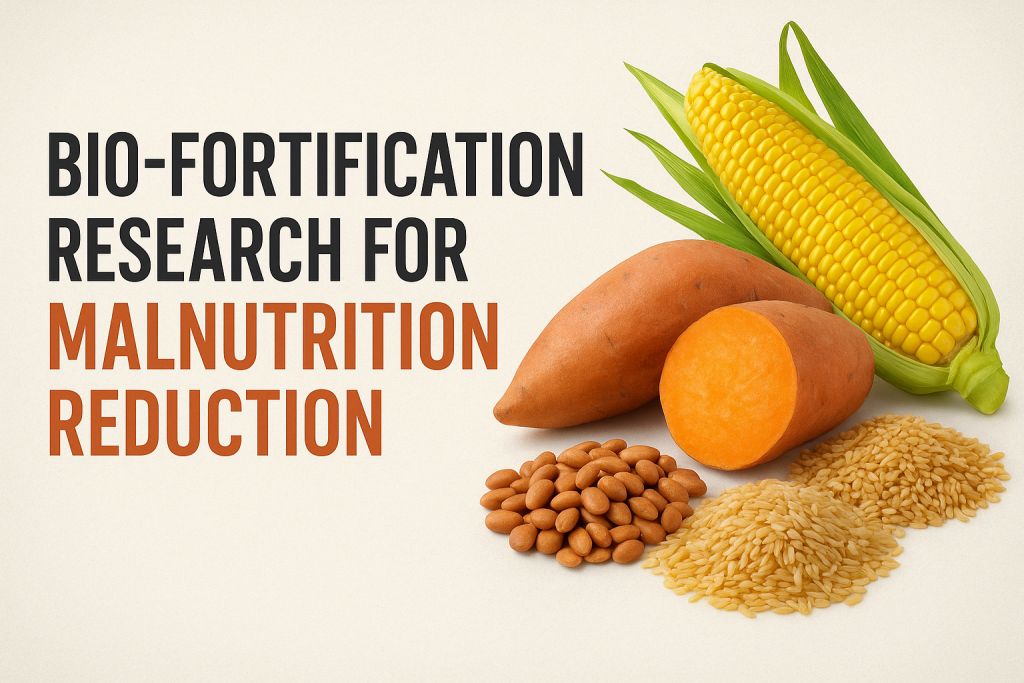
Why bio-fortification? The case for staples that heal
Traditional public health strategies—supplements, industrial fortification, and dietary diversification—are important but often insufficient. Supplements depend on reliable distribution and ongoing funding, fortification requires centralized processing and regulation, and dietary diversity is not quickly achievable in many low-income areas. Bio-fortification offers a complementary, long-term solution by providing nutrient-dense versions of staple crops that fit existing cultural diets. Studies consistently show that large-scale adoption of biofortified staples improves micronutrient status in women and children.
What’s being developed: iron, zinc, and vitamin A crops
Research over the last two decades has focused on the “big three” micronutrients most commonly deficient globally:
Iron-rich crops: High-iron beans and pearl millet varieties have been developed and tested. Trials show improved hemoglobin and iron biomarkers in populations that regularly consume these staples.
Zinc-fortified staples: Zinc-enriched wheat and rice varieties aim to reduce the severity of diarrheal disease and support growth and immune function. Zinc biofortification also improves population-level zinc intake where diverse diets are lacking.
Vitamin A (provitamin A) crops: Orange-fleshed sweet potato and provitamin A maize and cassava increase provitamin A intake, reducing vitamin A deficiency—an important driver of child blindness and infection risk.
These traits are introduced through conventional breeding, targeted agronomy such as zinc fertilization, and, where appropriate, modern biotechnologies. The objective remains to maintain yield, taste, and agronomic qualities valued by farmers while increasing nutritional content.
Real-world evidence and impact
The most compelling case for bio-fortification is its demonstrated effectiveness in real-world settings. Randomized controlled trials and implementation research show improved nutrition when households adopt biofortified crops. For example, iron-biofortified beans have improved iron status in African trials, vitamin A–rich orange sweet potato programs have reduced vitamin A deficiency in East Africa, and zinc wheat trials have increased zinc intake where wheat is a staple. Studies also confirm that farmers and consumers adopt biofortified crops when they perform well in the field and meet taste preferences.
Global initiatives have expanded rapidly. HarvestPlus and CGIAR partners estimate that hundreds of millions of servings have been delivered, with widespread adoption in smallholder systems. These programs aim to reach one billion beneficiaries by 2030 through new crop varieties, improved seed systems, and supportive policies.
A few practical success factors (lessons from the field)
Farmer-centric breeding: Adoption increases when nutrient traits are combined with high yield, pest resistance, and local taste or processing preferences.
Seed systems and supply chains: Making improved seeds available at the village level requires public–private collaboration and investment in seed multiplication and distribution. Without these efforts, improved varieties remain confined to research stations.
Behavioral and market engagement: Nutrition education, consumer testing, and market linkages accelerate adoption. Uptake increases when communities recognize health benefits and favorable cooking qualities.
Policy integration: National agricultural and nutrition policies that include bio-fortification enable faster scaling and facilitate public procurement, such as for school feeding and social safety nets.
Limits and critiques — what biofortification can’t do alone
Bio-fortification is effective but not a comprehensive solution. Critics note that:
- Bio-fortification typically increases only a few target nutrients per crop, while climate change can cause broader nutrient declines. Therefore, bio-fortification should complement efforts to enhance agro-ecological diversity and improve access to fresh fruits, vegetables, and animal-source foods.
- Regulatory, cultural, or market barriers can delay or limit access to improved seed, especially where centralized seed multiplication is weak.
- For acute clinical deficiencies, medical treatment and supplementation remain essential. Bio-fortification serves as a preventive, population-level intervention that reduces baseline risk over time.
Where research is heading: precision, retention, and climate resilience
Current research combines nutrition breeding with resilience and post-harvest nutrient retention:
Breeding for bioavailability: The focus is not only on iron content in grains, but also on how much the body can absorb. New varieties aim to reduce antinutrients such as phytate or incorporate agronomic practices that enhance bioavailability.
Post-harvest retention: Research is advancing storage and processing methods to minimize nutrient loss from field to plate.
Climate-smart biofortified varieties: Developing nutrient-dense crops that tolerate drought, heat, and flooding is essential as climate change impacts nutrient composition and yields.
Policy Brief: Bio-Fortification for Malnutrition Reduction
Strengthening National Nutrition Through Iron, Zinc & Vitamin-Enhanced Crops
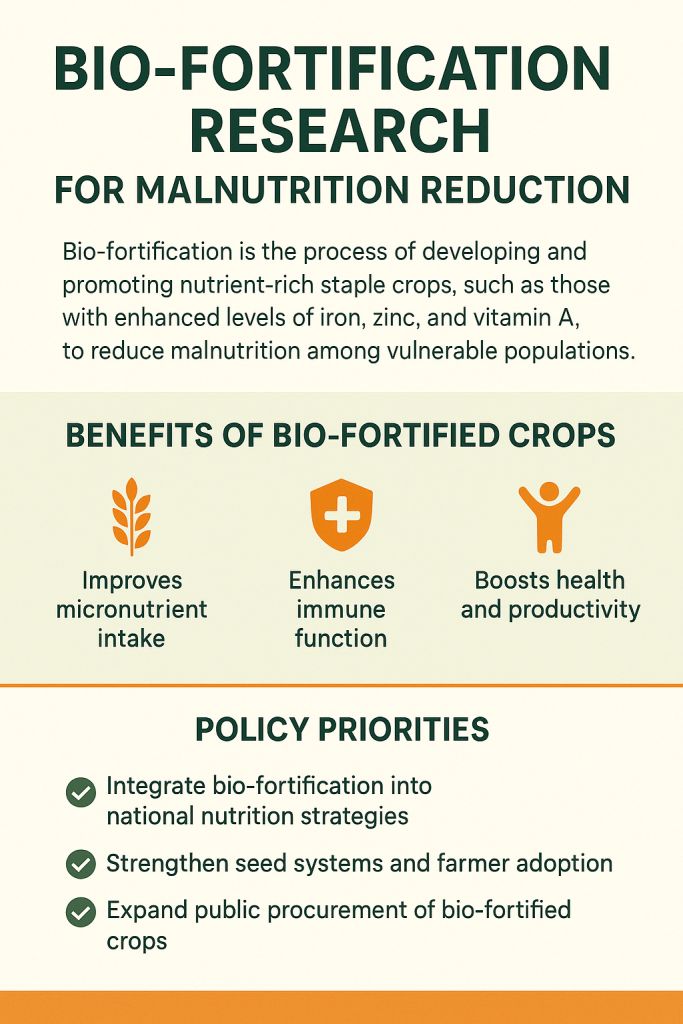
Purpose
To provide ministries and NGOs with actionable, evidence-based recommendations for integrating bio-fortified crops into national nutrition, agriculture, and food-security strategies to reduce iron, zinc, and vitamin A deficiencies.
- The Challenge: Hidden Hunger in Staple-Dependent Populations
Micronutrient deficiencies remain widespread, affecting children, women, and low-income households despite economic growth.
- Iron deficiency → anemia, reduced productivity, maternal risk.
- Zinc deficiency → weakened immunity, stunting, higher infection rates.
- Vitamin A deficiency → childhood blindness, higher infection mortality.
Traditional approaches (supplements, industrial fortification) work but face cost, logistics, and coverage limitations.
Bio-fortification complements these strategies by embedding nutrition directly into the seeds of locally consumed crops.
- Evidence: What Research Shows
Global data (HarvestPlus, CGIAR, WHO):
- Iron-rich beans & pearl millet improve hemoglobin and reduce anemia.
- Zinc-enriched wheat increases dietary zinc intake and supports child growth.
- Provitamin A crops (orange sweet potato, maize, cassava) significantly reduce vitamin A deficiency in women and children.
- Proven cost-effectiveness: ~$10–$30 per DALY averted—among the best in public nutrition.
- High farmer acceptance when crops match local yield, taste, and processing qualities.
Demonstrated scalability across Africa, South Asia, and Latin America, with hundreds of millions reached.
Policy Priorities: What Governments Should Do
- Integrate Bio-Fortification into National Food & Nutrition Strategies
- Include bio-fortified varieties in agriculture, health, and school nutrition policies.
- Align with SDG 2 (Zero Hunger), SDG 3 (Good Health), and climate-nutrition resilience plans.
2. Strengthen Seed Systems & Farmer Adoption
- Accelerate seed multiplication through public–private partnerships.
- Make certified bio-fortified seeds part of subsidized seed programs.
- Train extension officers on agronomy and nutrition messaging.
3. Expand Public Procurement
- Adopt bio-fortified staples in school meal programs, mid-day meals, and social safety nets.
- Create minimum procurement quotas that incentivize production and market stability.
4. Implement Targeted Nutrition Communication
- Educate caregivers, mothers, school communities, and farmer groups about the benefits.
- Highlight taste, cooking quality, and health improvements—not just the technical science.
5. Monitor Impact with Clear Indicators
- Track adoption at the farm level (hectares planted).
- Conduct dietary intake surveys in high-risk regions.
- Measure biomarkers in sentinel populations where possible.
Use data to refine policies and secure future investment.
- Recommended Actions for NGOs & Development Partners
- Support community-level seed distribution and demonstration farms.
- Facilitate women-led farmer groups—women are key decision-makers in nutrition.
- Integrate bio-fortified foods into maternal and child health programs.
- Produce culturally relevant recipes, cooking demos, and radio messaging.
- Collaborate with research institutions to monitor and generate evidence.
- Priority Crop Recommendations (By Nutrient)
| Nutrient | Recommended Bio-fortified Crops | Target Regions |
|---|---|---|
| Iron | High-iron beans, pearl millet, lentils | Africa, South Asia |
| Zinc | Zinc-enriched wheat, rice, maize | South Asia, Latin America |
| Vitamin A | Orange sweet potato, provitamin A maize, cassava | Africa, South Asia |
These crops should be aligned with local dietary patterns and farming systems to maximize impact.
Why Act Now?
Climate change threatens nutrient density in staple crops—bio-fortification counters this decline.
Governments can achieve large-scale health gains at low annual cost.
Investments generate multi-sector benefits: better school performance, reduced maternal morbidity, and stronger rural economies.
Executive Recommendation
Adopt a national Bio-Fortification Strategy anchored in:
- Seed system strengthening
- Farmer adoption incentives
- Public procurement
- Nutrition education
- Continuous monitoring
Bio-fortification is a scalable, affordable, and scientifically validated solution to reduce hidden hunger, beginning at the seed level.
A human moment: why this work matters
While I have not conducted fieldwork as a farmer, the accounts shared by researchers and practitioners are compelling. In one documented program, smallholder families who adopted orange-fleshed sweet potato reported improved child energy, fewer symptoms of night blindness, and increased household income from marketable surplus.
These ripple effects include healthier children, reduced healthcare burdens, and increased income that can be reinvested in education and farm improvements. Evidence-based programs that combine scientific advances with local partnerships can drive large-scale change, which is the promise of effective bio-fortification.
Practical advice for policymakers, NGOs, and funders
- Prioritize nutrition plus agronomy: support breeding programs that bundle micronutrients with climate-resilience traits.
- Invest in seed systems and farmer training so benefits reach rural households.
- Pair distribution with monitoring (biomarkers, dietary surveys) to measure impact. Evidence strengthens future investment cases.
- Use public procurement (school meals, social protection) to create demand and normalize biofortified staples.
Conclusion: an evidence-based tool in the nutrition toolbox
Bio-fortification is not a comprehensive solution, but it is an evidence-based, cost-effective, and scalable approach to reducing micronutrient deficiencies by enhancing the nutritional value of commonly consumed foods. When combined with robust seed systems, behavioral outreach, and broader food system reforms, bio-fortification can help address iron, zinc, and vitamin A deficiencies and strengthen resilience to the nutritional impacts of climate change.
For scientists, policymakers, and funders, the next steps are clear: invest in farmer-preferred varieties, ensure availability, and measure outcomes so that millions can transition from hidden hunger to healthier lives.
About the Author