Introduction: The Rise of Smart Greenhouses in 2025
Agriculture is undergoing a pivotal change. As climate challenges intensify—unpredictable weather, declining soil, and scarce water—traditional farming struggles to keep up. Smart Greenhouses with Digital Climate Control directly tackle these critical issues, redefining how we produce food.
Once just glass structures, greenhouses are now intelligent ecosystems powered by AI, sensors, IoT, automation, and predictive analytics. These next-generation greenhouses create ideal microclimates, enabling crops to grow faster, healthier, and more sustainably regardless of external conditions.
This shift from concept to implementation marks a turning point, signaling a new era in mainstream agricultural practice as smart greenhouses move beyond specialized technology.
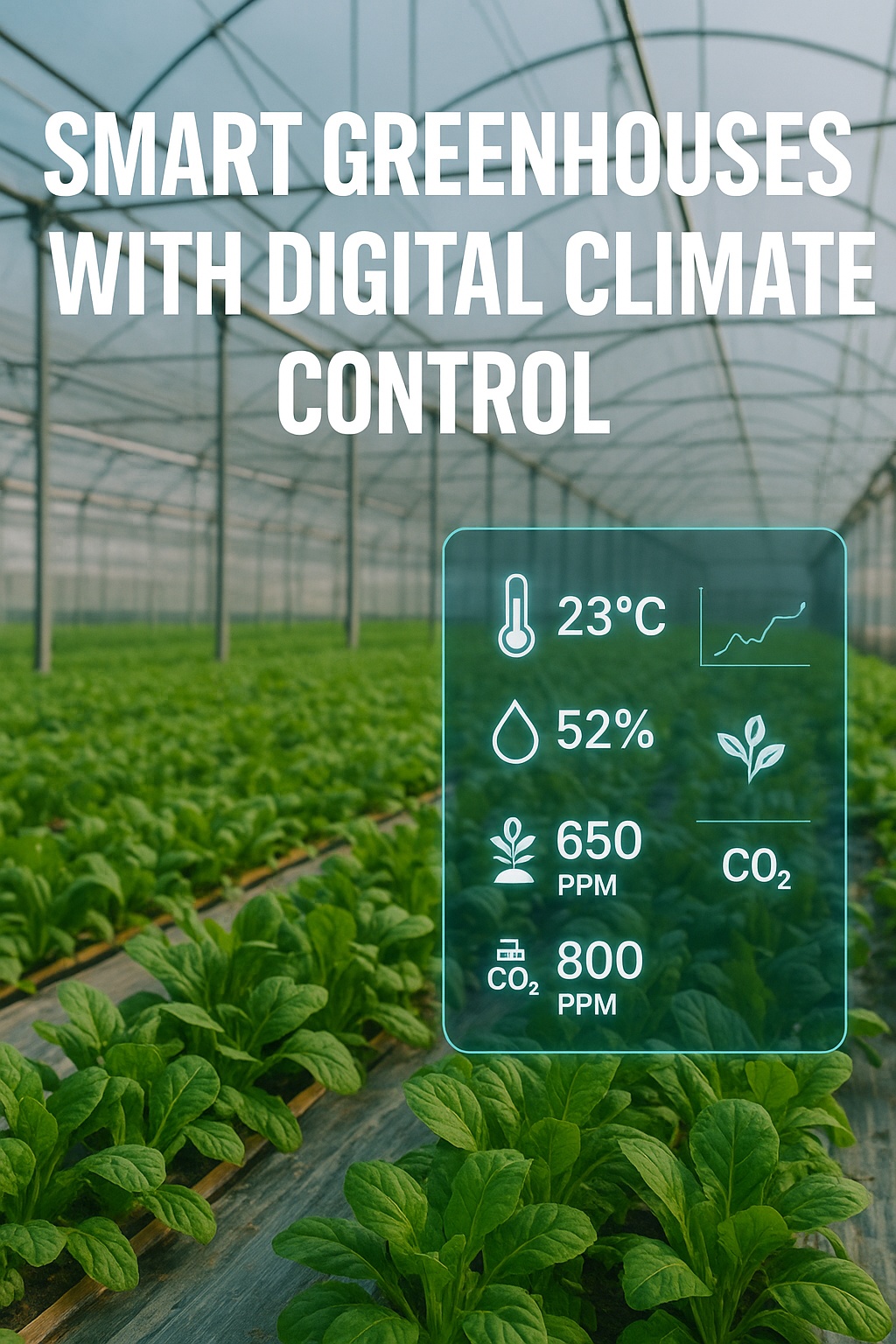
What Are Smart Greenhouses with Digital Climate Control?
A smart greenhouse uses AI to monitor and regulate:
- Temperature
- Humidity
- Artificial lighting
- Irrigation & Nutrient flow
- Soil/soilless growing medium health
- CO₂ concentration
AI-driven climate control automatically manages all of these variables.
Real-time sensors and AI adjust conditions for plant needs, reducing manual labor and guesswork.
How Digital Climate Control Works Inside Smart Greenhouses
The digital climate control ecosystem combines:
1. Temperature Control
Sensors detect heat fluctuations. AI adjusts:
- cooling systems
- heating pipes
- ventilation fans
- reflective shading
Temperature stays within the optimal range for each crop.
2. AI-Controlled Humidity
Humidity plays a major role in:
- nutrient absorption
- disease prevention
- flowering and fruiting cycles
AI systems regulate:
- fogging systems
- dehumidifiers
- ventilation
This helps prevent fungal infections and supports healthier growth.
3. AI-Optimized Nutrient Delivery
Nutrients are no longer delivered on a fixed schedule. Instead, AI analyzes:
- plant age
- root-zone moisture
- leaf color indices
- EC (electrical conductivity)
- nutrient deficiencies
It then adjusts fertilizer mix and irrigation frequency in real time, a process known as fertigation automation.
This significantly reduces nutrient waste and ensures precise feeding.
4. Intelligent CO₂ Management for Faster Growth
A key advantage of smart greenhouses is AI-controlled CO₂ enrichment.
Plants grow 20–30% faster when CO₂ levels are optimized.
AI sensors monitor CO₂ concentration and regulate:
- automated CO₂ generators
- ventilation to avoid excess buildup
- crop canopy height and spacing
This creates optimal conditions for photosynthesis, leading to faster growth and higher yields.
5. Smart LED Lighting
Lighting systems adjust based on:
- sunlight intensity
- plant growth stage
- energy consumption levels
AI optimizes light with full-spectrum LEDs to mimic natural sunlight.
6. IoT for Real-Time Monitoring
Farmers can track everything from their smartphone:
- real-time crop health
- climate readings
- alerts
- yield projections
IoT dashboards enhance predictability and enable data-driven decision-making in farming.
AI Takes Smart Greenhouses to the Next Level
Today’s smart greenhouses are not just automated—they are designed to constantly learn and improve plant growth outcomes, driven by data and intelligence.
AI learns the plant’s behavior.
By analyzing:
- transpiration rate
- leaf temperature
- chlorophyll fluorescence
- pest movement
AI adjusts environmental conditions proactively to prevent plant stress.
Predictive climate modeling
AI predicts weather changes, sunlight shortages, pest risks, and disease outbreaks, and takes action to prevent their spread.
Digital twins
Digital twins simulate crop growth under various conditions, allowing farmers to select the most effective strategy before implementation.
My Personal Experience: A Moment That Truly Moved Me
In early 2024, I visited a research-based smart greenhouse facility. Inside, an agronomist showed me how AI automatically increased CO₂ levels when cloud cover reduced photosynthesis. Moments later, the LED panels adjusted their brightness to compensate for the lack of natural sunlight.
The most notable aspect was this:
- A tomato vine was visibly struggling as its leaf temperature rose faster than normal. Before any expert intervened, the AI system increased humidity and activated micro-irrigation lines. Within minutes, the leaf temperature returned to normal.
The agronomist looked at me and said:
- “This greenhouse takes care of plants the way a mother watches her child.”
That moment left a lasting impression. It was not technology for its own sake; it was technology serving as a caretaker, nurturing life.
Later, I discovered something that amazed me even more:
- The system had predicted that the tomato vine would experience water stress 6 hours earlier, based on environmental conditions and transpiration rates. It did not simply react; it anticipated.
This experience made me realize how AI-driven agriculture could help address global food shortages.
Benefits of Smart Greenhouses with Digital Climate Control
1. Higher Yield (Up to 3x Increase)
Controlled micro-environments allow crops to grow faster and healthier.
2. 24/7 Crop Production
Weather becomes irrelevant. Production continues year-round.
3. Water Savings (Up to 80%)
Precision irrigation dramatically reduces wastage.
4. Minimal Human Labor
AI manages most environmental adjustments.
5. Pesticide Reduction
A stable climate results in fewer pest outbreaks.
6. Energy Efficiency
Smart LEDs combined with predictive heating save 25 to 40 percent in energy consumption.
7. Growth of High-Value Crops
Smart greenhouses enable the cultivation of:
- strawberries
- exotic vegetables
- herbs
- medicinal plants
- leafy greens
This is possible regardless of local climate conditions.
Sustainability Benefits: Agriculture without Environmental Damage
Smart greenhouses contribute to:
- lower carbon footprint
- soilless farming, like hydroponics and aeroponics
- Reduced groundwater pollution
- less chemical usage
- Food security for urban areas
Smart greenhouses are essential for sustainable agriculture and climate-resilient food production.
Why AI-Controlled Humidity, Nutrients & CO₂ is a Game Changer
Traditional farming relies on guesswork. Smart greenhouses rely on data.
When AI individually optimizes:
- Humidity
- Maximum nutrient uptake
- Reduced fungal attacks
- Nutrients
- Faster growth
- Balanced plant development
- Zero nutrient loss
- CO₂ Levels
- Enhanced photosynthesis
- Bigger leaves
- Faster fruiting
Together, these factors create an optimal growth environment within the greenhouse.
The Future Vision: Smart Greenhouses in Every City
Urban and rooftop greenhouses with digital climate control will soon become common. Consider the following possibilities:
- Every city produces its own vegetables
- zero-mile food transportation
- climate-independent agriculture
- decentralized food security
AI-controlled smart greenhouses can be the backbone of this transformation.
Conclusion: The Agricultural Revolution Has Already Begun
Smart Greenhouses with Digital Climate Control are more than a trend; they are rapidly becoming the core of modern agriculture.
AI-controlled humidity, nutrient automation, and CO₂ optimization have unlocked a new era of precision farming, efficiency, and sustainability.
My experience inside a smart greenhouse demonstrated that farming is evolving from a traditional occupation into a high-tech, intelligence-driven ecosystem.
As we step into the future, one thing is clear:
- Farms of the future will depend on data, intelligence, and innovation—no longer just weather.
- Smart greenhouses are not only cultivating plants; they are shaping the future of humanity.
About the Author