Tokenized securities and real-world assets (RWAs), such as real estate, bonds, funds, and collectibles, have moved beyond experimentation. They represent a structural shift by converting legal claims and cash flows from physical or traditional financial assets into digital tokens on programmable ledgers. This transformation enables fractional ownership, continuous settlement, integration with DeFi, and new distribution channels, while also introducing important questions about regulation, pricing, and systemic impact. This post outlines how tokenized securities function, assesses the economic effects of large-scale tokenization, and analyzes liquidity and pricing for tokenized real estate and bonds. It is intended to support asset managers, fintech developers, institutional investors, and advanced retail participants in making informed decisions.
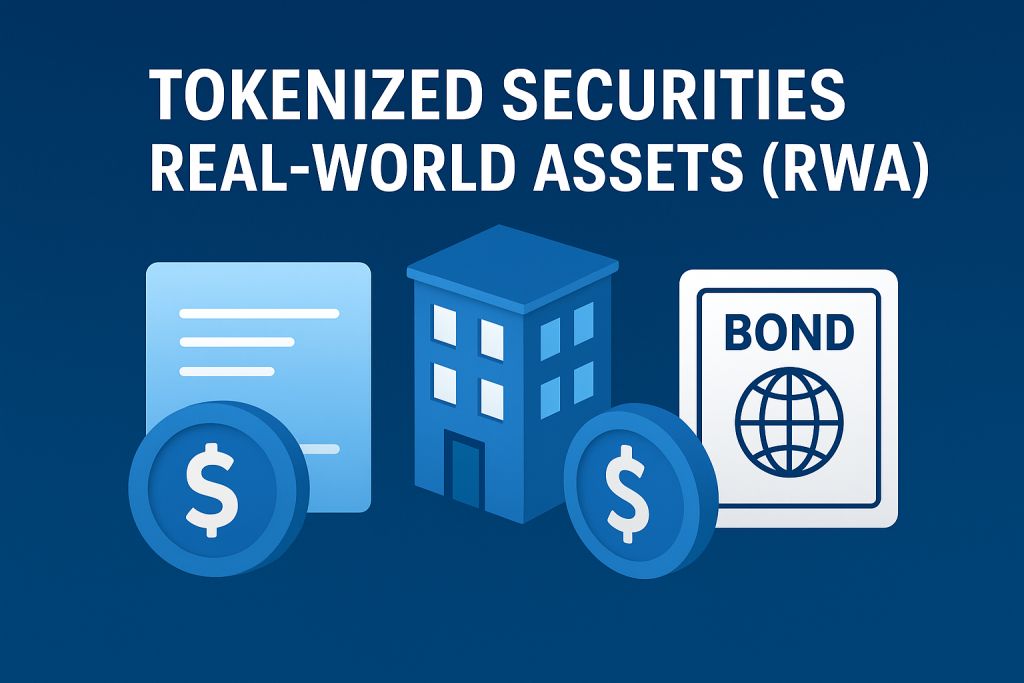
Quick primer: what are tokenized securities and RWAs?
A tokenized security is a traditional financial instrument, such as equity, bonds, fund shares, or real estate interests, represented as a digital token on a distributed ledger. The token confers legal rights, including ownership, dividends, or coupons, and is supported by a legal structure or custodian arrangement that enforces these rights off-chain. When applied to real-world assets like land, buildings, loans, art, or commodities, tokenization enables fractional, programmable, and borderless access to assets that were previously illiquid and difficult to divide.
Platforms such as Securitize and projects like RealT demonstrate how property or fund shares can be issued and managed as tokens. These platforms manage KYC/AML, recordkeeping, and compliance to ensure tokens qualify as securities under the law, rather than as anonymous crypto tokens.
Why tokenization matters: real benefits (and real caveats)
Benefits
- Fractional ownership: High-value assets become accessible to a broader range of investors, increasing participation and diversification.
- Faster settlement and fewer intermediaries: Programmable tokens can reduce reconciliation, custody, and settlement frictions.
- Continuous tradability and composability: Markets can operate around the clock and connect to DeFi infrastructure, provided legal requirements are met.
- Transparency and auditability: Ledgers provide a verifiable record of ownership and lifecycle events.
Caveats
- Legal structure is critical: A token must combine technology and legal enforceability. If legal claims are not clearly linked to tokens, owners may face enforcement risks.
- Regulatory uncertainty: Securities laws, custody requirements, and cross-border tax regulations vary and are evolving rapidly.
- Operational and cyber risks: Keys, custodians, bridges, and smart contracts introduce new potential points of failure.
These tradeoffs make tokenization a legal and operational challenge as much as a technical one. Global regulators and standard setters are actively evaluating these developments. The BIS and Financial Stability Board have published multi-stakeholder reports analyzing the market implications of tokenization.
Economic impact of large-scale asset tokenization
Estimates and models indicate that tokenization is not merely a niche fintech trend; it has the potential to reshape capital allocation and reduce costs across markets. Multiple studies and industry reports highlight significant efficiency gains:
Conservative models from academic and industry groups estimate annual savings in the trillions of dollars as tokenization reduces custody, reconciliation, and settlement costs while enabling fractional markets. One analysis projects potential gross savings of up to $2.4 trillion per year under full-scale adoption.
Consulting and market forecasts expect tokenized assets to scale to multi-trillion-dollar pools by 2030 as incumbents and large asset managers adopt tokenized funds and tokenized settlement rails. For example, major asset managers and banks are piloting tokenized funds and money-market tokens.
In practice, lower settlement and reconciliation costs may enable issuers to pursue smaller, more frequent offerings, such as micro-bonds, while retail investors gain access to diversified portions of institutional assets. This can democratize returns but may also alter market structure, shifting price discovery to new venues and fragmenting liquidity across on-chain and off-chain pools. The overall macroeconomic impact will depend on regulation, interoperability, and whether token markets attract new capital or simply reallocate existing flows.
Liquidity and pricing mechanisms of tokenized real estate
Real estate is a logical initial use case due to its high asset values and limited liquidity. Tokenization allows for fractional ownership and secondary trading, but liquidity is not guaranteed.
Primary drivers of liquidity for tokenized property
1. Fractionalization and demand: Reducing the minimum investment increases the investor base, but investors still require incentives to trade, such as income, speculative returns, or portfolio rebalancing.
2. Marketplaces & order books: liquidity requires trusted marketplaces (centralized or DEX-style), market-making, and regulatory compliance on trading venues.
3. Transparent cash flows: Reliable and auditable tokenized rental income and dividend mechanisms attract yield-seeking investors and help stabilize pricing.
4. Legal enforceability: Clearly defined legal interests, such as LLC or REIT shares, mapped to tokens increase institutional willingness to price and hold these assets.
Pricing mechanics
Pricing for tokenized property combines fundamental valuation methods, such as cap rates, net operating income, and replacement cost, with market microstructure factors like tick size, order depth, and maker or taker fees.
Because tokens allow for fractional and continuous trading, price discovery can be faster. However, in thin markets, early tokens may experience volatile spreads if market-making is lacking.
Hybrid models, in which tokens are redeemable or supported by an issuer-managed buyback facility, can reduce spreads but introduce issuer credit risk.
Platforms such as RealT demonstrate how fractional rent streams and transparent ledgers can create accessible yield products. However, the depth and stability of secondary markets still depend on active market makers and regulatory clarity.
Liquidity and pricing mechanisms of tokenized bonds
Bonds are often considered the most straightforward candidates for tokenization because their clearly defined cash flows and established legal claims simplify token mapping.
Why bonds tokenize well
Predictable coupons and principal payments make bonds inherently suitable for modeling.
Institutional counterparties are already familiar with custody and settlement processes; tokenization primarily optimizes these mechanics.
Mechanics that change
- Settlement speed: On-chain transfers can reduce settlement windows to near real time, decreasing counterparty exposure.
- Secondary trading: Tokenized bonds issued on regulated platforms can facilitate intraday trading and fractional participation.
- Pricing impact: Faster settlement reduces settlement risk premiums. Fractional bonds attract smaller investors who may offer different yields, potentially compressing yields if demand is broad.
- Historical precedent: The World Bank’s bond-i (2018), issued and managed on distributed ledgers, demonstrated the feasibility of blockchain-based bond issuance and secondary trading. Subsequent issuances and platform experiments have further refined custody and regulatory approaches.
Practical recommendations for asset owners and investors
1. Prioritize legal claims. Tokenization should begin with comprehensive legal documentation that links tokens to enforceable rights. Technology alone is insufficient without legal backing.
2. Plan liquidity strategies. If secondary markets are desired, proactively arrange for market-making, exchange listings, buyback facilities, or validator incentives. Do not assume liquidity will develop organically.
3. Use institutional infrastructure for institutional assets. Large issuers should partner with regulated tokenization platforms and custodians to reduce counterparty, AML, and custody risks.
4. Stress-test pricing models. Evaluate both fundamental valuation and market microstructure factors, such as spread, minimum tick size, and latency, to anticipate volatility in thin markets.
5. Monitor regulation and interoperability. Token standards, custody rules, and cross-chain bridges are evolving and significantly influence operational risk.
Closing: opportunity with discipline
Tokenized securities and RWAs have demonstrated success, as seen in World Bank bond experiments, emerging tokenized real estate platforms, and major banks piloting tokenized money-market tokens. The technology offers significant potential for cost reduction, improved access, and enhanced liquidity. However, it is not a universal solution; successful projects will integrate robust legal frameworks, institutional-grade operations, and proactive liquidity management. For asset managers and developers, the key question is not whether tokenization matters, but how to implement it so that legal certainty, pricing integrity, and investor protection scale alongside the technology.