Every January 26, India follows a familiar and beautiful routine.
Flags fly from balconies. Patriotic songs fill the air. Children dress in white, saffron, and green. The Republic Day parade glows on screens in homes everywhere.
Marching bands play. Fighter jets roar overhead. Yet, we often overlook something important.
The real meaning of Republic Day lies in the stories often left untold—stories that reveal the heart and purpose behind the celebration.
Not the stories from textbooks or repeated on social media, but the quiet, human stories in villages, border posts, classrooms, and homes.
These stories show what Republic Day truly means. Let’s look at moments that reveal the spirit behind the celebration.
Republic Day Means More Than Just a Holiday
Most people know that on January 26, 1950, India became a Republic when the Constitution took effect.
But not many know why January 26 was chosen.
In 1930, this date was celebrated as Purna Swaraj Day, when Indians openly declared their wish for complete independence from British rule. That choice was not just symbolic. It was brave, risky, and deeply emotional.
Choosing January 26 for Republic Day honored that first bold promise.
Freedom did not come suddenly in 1950. It had been quietly growing in people’s hearts for many years. These gradual steps are reflected in local stories still told today.
A Village Flag Made from Old Clothes
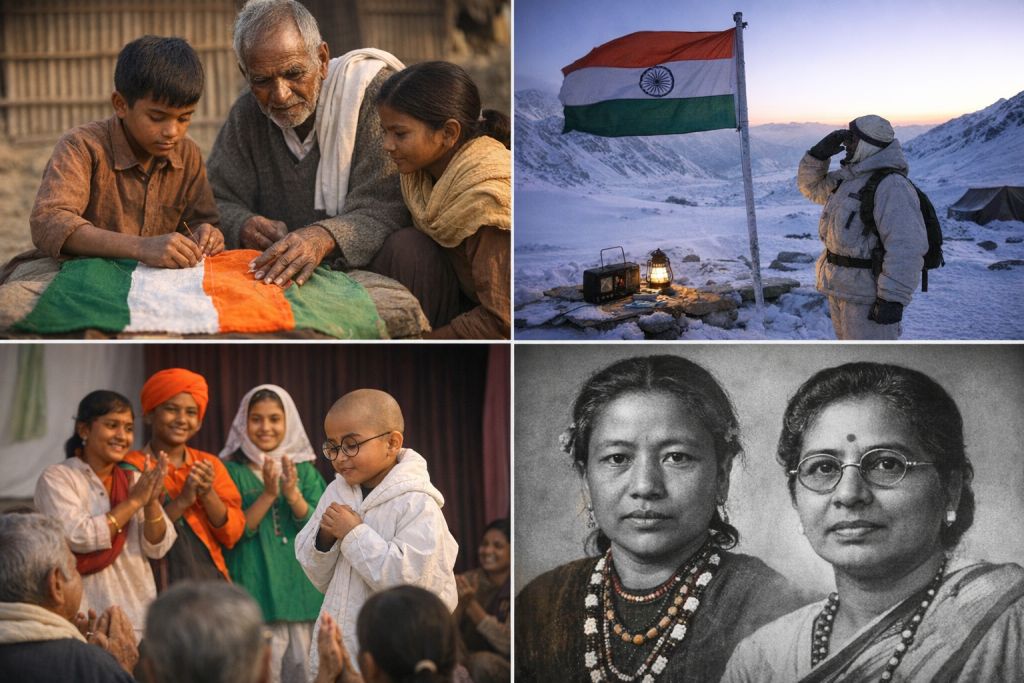
A few years ago, I visited a small village in Bihar and met an elderly schoolteacher named Raghav Sir.
He shared a story about his first Republic Day after independence.
There was no proper school building. No loudspeakers buzzed. Ready-made flags were nowhere to be found.
So the villagers came up with a simple solution.
They gathered pieces of saffron, white, and green cloth from their homes and stitched a flag by hand.
He smiled as he remembered.
“We didn’t have much. But we had pride. That flag meant everything.”
That moment stayed in my memory.
Today, flags are everywhere. Back then, even a single handmade tricolour felt powerful.
Republic Day was not about perfection. It was about belonging. That sense of belonging stretches far beyond village borders, touching the lives of those at the nation’s edge.
Republic Day Feels Different at the Border
At a local event, I once spoke with a retired Army officer who had served in Siachen.
He described what Republic Day is like at the border.
There were no parades. No crowds. Only endless snow and silence.
But at the right moment, the national anthem played on a small radio.
He said:
“We stood still in freezing wind. Some of us cried. Not because of the cold, but because we felt connected to every Indian celebrating far away.”
While people in cities celebrate with decorations, soldiers observe Republic Day by standing guard.
For them, celebration means duty.
Their fireworks are the stars shining over frozen mountains.
The Constitution Was Written with Human Dreams
We often talk about the Constitution as if it were only a legal document.
It was created after years of debate. Disagreement. Hope.
Dr. B.R. Ambedkar and other leaders were not just writing laws. They were trying to build a country where
- everyone would be equal
- voices could be heard
- dignity mattered
- Justice wasn’t optional
Jawaharlal Nehru once wrote that India is like a fabric made of many colors and cultures, held together by shared values.
That idea is still important.
Republic Day reminds us: India was meant to include everyone, not divide us.
A Child Forgot His Lines and Taught Everyone a Lesson
At a small Republic Day event in a village school, I watched children perform a skit about unity in diversity.
Halfway through, one boy stopped and froze.
He had forgotten his lines.
Instead of laughing, the crowd began to clap softly. Someone whispered words of encouragement, and another child stepped up to help.
The boy took a deep breath and continued.
Later, an elderly woman sitting next to me said quietly:
“That’s our Republic. We lift each other when someone slips.”
It was a small moment, but it captured everything Republic Day stands for.
Support, patience, and togetherness. These everyday values are the real foundation of Republic Day, reaching into every part of Indian life.
Many Indians Still Do Not Know Their Rights
Republic Day is also about being a citizen.
The Constitution gives every Indian basic rights, such as equality, freedom of expression, education, and protection from exploitation.
Yet in many rural areas, people do not even know these rights exist.
I once visited a legal awareness camp for farmers. Some did not know they could question unfair wages or land disputes.
By the end of the session, their posture changed. Shoulders lifted. Heads held high.
They were no longer just listeners.
They felt empowered.
Republic Day is not just about remembering history. It is about knowing your rights today.
Women Who Quietly Helped Shape Republic India
We often hear about famous male leaders, but many women also shaped modern India.
Rani Gaidinliu resisted British rule in the Northeast long before independence.
Dr. Muthulakshmi Reddy became India’s first woman legislator and worked tirelessly for women’s education and healthcare.
Their stories are not always found in school books.
But without women like them, Republic India would be very different. Their courage and determination remain an inspiration for what Republic Day should mean today.
What Republic Day Should Mean Today
In today’s fast-paced India, Republic Day should be more than just flag hoisting.
It should remind us to:
- respect differences
- learn our rights
- care for our communities
- support education
- treat each other with dignity
Republic Day is not about what leaders did decades ago.
It is about what we do now. Turning awareness into action keeps the Republic’s spirit alive daily.
Simple Ways to Make Republic Day Meaningful
You do not need big stages or speeches.
You can:
- donate books to a local school
- help clean your neighborhood
- teach children about the Constitution
- support small community projects
- share real stories instead of just slogans
Small actions help keep the Republic alive. These shared efforts shape the everyday stories that give true meaning to January 26.
Final Thoughts: Republic Day Lives in Everyday People
From villagers stitching a flag by hand,
To soldiers standing guard in silence,
To children helping classmates on stage,
Republic Day does not live only in Delhi parades.
It lives in everyday courage.
It lives in kindness.
It lives in people who believe India belongs to everyone.
To me, that is the most powerful Republic Day story of all.