How Seaweed Can Address Climate Change, Support Renewable Energy, and Advance the Blue Economy
Ocean farming, particularly seaweed agriculture, is becoming a leading and scalable climate solution. Seaweed contributes to carbon capture, renewable biofuel production, and coastal economic development, positioning it as a cornerstone of the future sustainable bioeconomy.
This overview explains seaweed ocean farming, its significance for carbon capture and biofuels, scientific approaches to yield and sustainability modeling, and economic considerations.
What Is Ocean Farming & Seaweed Agriculture?
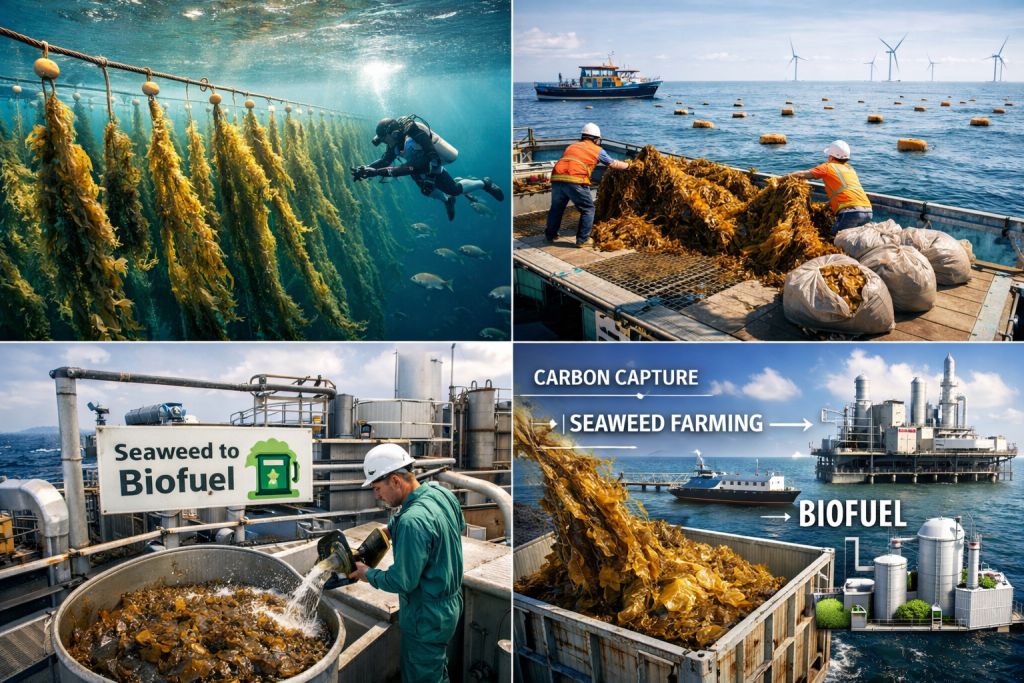
Ocean (or marine) farming refers to the cultivation of marine organisms. Seaweed agriculture is a specific type of ocean farming in which large macroalgae such as kelp, sea lettuce (Ulva), and red algae (Gracilaria) are grown on lines and arrays in coastal and open-ocean environments. Because seaweed:
- Requires no freshwater,
- Grows without fertilizer or terrestrial land,
- Consumes dissolved CO₂ in seawater,
It is uniquely positioned as a low-impact, high-benefit farming method that supports both climate goals and global food systems. Seaweeds are among the fastest-growing plants on Earth, absorbing carbon at rates that exceed most terrestrial crops relative to area.
Seaweed & Climate: Nature’s Oceanic Carbon Sponge
Unlike terrestrial forests, seaweed does not store carbon in wood, but its rapid, massive growth means it absorbs large amounts of CO₂ during photosynthesis. When seaweed biomass is buried in deep ocean sediments or exported to deep waters, carbon can remain locked away for centuries. This process is analogous to Blue Carbon ecosystems (mangroves, seagrass beds) that are already recognized for climate mitigation.
A recent study measured organic carbon buried beneath seaweed farms aged 2 to 300 years, and found that these farms bury carbon at rates similar to those of mangrove forests and seagrass meadows — about 1.87±0.73 tCO₂eq per hectare per year, with older sites storing up to 140 tC per hectare over time.
This research is significant because it demonstrates, using global farm data, that seaweed farms can function as true marine carbon sinks rather than only as carbon absorbers.
How Seaweed Captures Carbon
Seaweed converts dissolved CO₂ in seawater into organic carbon. Some of this carbon:
- Is stored in biomass that can be sunk into deep ocean layers,
- Becomes part of the sediments under the farm,
- Supports products (like biofuels) that replace fossil carbon emissions,
- Enters circular bioeconomy streams (fertilizers, food, textiles).
However, the fate of carbon depends on how the harvested biomass is managed, which highlights the importance of yield and its applications.
Analyzing Yield Models: How Much Seaweed Can We Grow?
To tap into seaweed’s full climate potential, scientists are developing biophysical and techno-economic models that estimate how much seaweed can realistically be grown, where it can be grown, and what yields look like under different conditions.
One model estimates that cultivating 1 gigaton of seaweed carbon annually, a level that would significantly impact climate goals, would require farming over 1 million square kilometers of ocean. This is a substantial but feasible area given that oceans cover 70% of Earth’s surface.
Key Yield Variables:
- Species of seaweed: Brown kelp vs. red, vs. green have different growth rates and carbon content.
- Water nutrient levels: High nitrate zones yield more productivity.
- Temperature & light availability: Affect seasonal growth and productivity.
- Farm design & density: Modular lines vs. dense arrays change yields.
Yield models are essential because they inform:
- how much biomass we can harvest,
- how much carbon biomass contains,
- what products it can become (biofuel, fertilizer, etc.),
- and how ecosystems respond to large-scale farming.
These models enable farmers, policymakers, and investors to quantify both the benefits and limitations of ocean farming.
Economics of Seaweed Farming: Costs, Markets & Profits
One of the primary challenges facing ocean farming is economic feasibility rather than biological constraints.
While seaweed grows rapidly once seeded, the costs of establishing farms, maintaining infrastructure, and harvesting in marine environments remain substantial. According to techno-economic analyses:
Under favorable conditions, sequestering 1 ton of CO₂ by sinking seaweed may cost as little as $480. This is competitive with some direct air capture technologies, but achieving viability depends on economies of scale and the development of carbon markets.
Revenue Streams from Seaweed
Seaweed provides multiple income streams in addition to its role in carbon capture:
1. Biofuels
Seaweed biomass can be processed into bioethanol, biogas, and biodiesel feedstocks due to its high carbohydrate content and low lignin content.
2. Animal Feed
Certain seaweed species can reduce methane emissions when included in cattle feed, offering a potential climate co-benefit. Research and trials are ongoing.
3. Human Food & Products
Seaweed is already a staple in many cuisines, and demand for seaweed-based foods, nutraceuticals, and cosmetics is rapidly growing.
4. Bio-products
Biochar, bioplastics, fertilizers, and biopesticides derived from seaweed expand the value chain beyond carbon storage.
The economic case is strongest when seaweed products replace more carbon-intensive alternatives, resulting in both avoided emissions and direct sequestration.
Sustainability & Real-World Impact
Environmental Benefits
Seaweed farms can:
- improve coastal water quality by absorbing excess nutrients,
- provide habitat for fish and invertebrates,
- enhance biodiversity,
- reduce ocean acidification locally,
- and stimulate oxygen production.
Unlike terrestrial agriculture, which relies on freshwater and arable land, seaweed farms produce biomass without competing for these critical land resources.
Social & Economic Benefits
In many coastal regions, including Southeast Asia, East Africa, and Latin America, seaweed farming supports local livelihoods, particularly for women and smallholder fishers. It creates jobs, builds community wealth, and helps restore shoreline ecosystems.
Challenges & Future Opportunities
Seaweed agriculture is not a comprehensive solution and faces several limitations:
1. Carbon Fate & Verification
Not all harvested seaweed carbon remains sequestered. If the biomass decomposes or is consumed, much of the carbon may return to the atmosphere. Ensuring verified long-term sequestration pathways, such as deep ocean export or biochar, is essential.
2. Scaling & Infrastructure
Large-scale ocean farming requires ships, robust moorings, and supply chains. This infrastructure must be developed carefully to avoid negative impacts on marine life and navigation.
3. Policy & Carbon Markets
Robust policies and verified carbon credit systems could facilitate financing for ocean farms and reward climate outcomes. Without these measures, up-front investment remains a significant barrier.
My Observations & Real-World Perspective
Discussions with coastal sustainability groups and aquaculture researchers highlight that seaweed farming’s potential is already being realized. Farmers in Southeast Asia have cultivated macroalgae at scale for decades, supporting food and fertilizer markets. More recently, research partnerships, including global seaweed projects across five continents, are advancing seaweed farming as both a climate mitigation tool and an economic driver.
Early adopters often face high costs and uncertain carbon value, but additional revenues from seafood, feed, and bioproducts help bridge the investment gap. As carbon pricing matures and global climate finance expands, seaweed farming is well positioned to play a leading role in the Blue Carbon sector.
Conclusion: Seaweed Farming — A Climate & Biofuel Game-Changer
Ocean farming of seaweed offers significant potential for climate mitigation, renewable energy, and sustainable economic growth. Seaweed contributes to carbon capture, provides biofuels that can replace fossil fuels, and supports products that maximize the value of each ton of biomass, making it an important climate solution.
However, achieving this potential depends on:
- smart yield models that inform where and how to farm,
- practical economic frameworks that reward climate impacts,
- durable sustainability practices,
- and policies that support innovation and equitable benefits.
If implemented thoughtfully, seaweed ocean farming could become a defining climate solution, helping to transform the vast potential of our oceans into a regenerative, low-carbon future.