The Future You Can Wear
Just picture a basic T-shirt for example which monitors heart rate, breathing, stress and hydration — all without any heavy device. We are redefining health monitoring and disease prevention by integrating micro-sensors in clothing.
First, let’s take a closer look at how smart clothing works and why this technology is revolutionizing health monitoring.
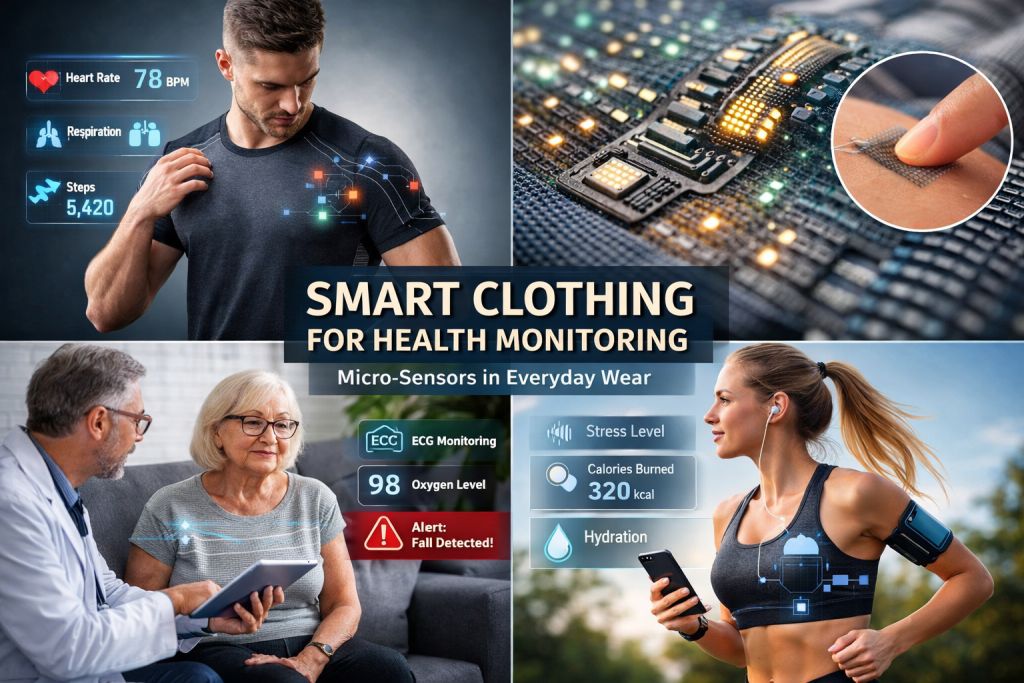
What Are Micro-Sensors in Clothing?
A micro-sensor is an electronic device embedded into the fabric of a clothing item that can sense certain physical and chemical signals produced by your body. For example, temperature sensors detect variation in skin heat, heart rate sensors measure electrical activity or blood flow, movement sensors monitor movement and position, while sweat sensors assess chemical levels like salt or glucose.
These sensors are unlike traditional wearables (for example, watches):
- Lightweight
- Flexible
- Almost invisible
They belong to the ever-expanding sector of smart wearable health technology.
Research indicates that modern sensors have small sizes and deliver continuous, real-time health information.
Now that we found out about micro-sensors, let us see how they operate within daily garments.
Smart clothing uses a combination of:
- Micro-sensors (to collect data)
- Conductive fibres (to transmit signals)
- Microprocessors (to analyse data)
- Connection (wireless, to transmit data to applications)
A smart shirt for instance can track:
- Heart rate
- Breathing patterns
- Physical activity
A real-world example would be the smart shirt Hexoskin, which in real-time tracks heart activity, breathing andmovement.
10 types of micro-sensors used in garments
✔ Motion Sensors
These identify body movement and posture using stretchy fibres.
- Useful for fitness tracking
- Aids to detect falls in elderly people
Certain fabrics utilize graphene-based sensors that monitor motion via shifts in fabric stretching.
✔ Temperature Sensors
These sensors monitor minute variations in skin temperature by detecting the body’s heat, sending alerts to the wearer or a paired app when abnormal fluctuations are identified.
- Useful for early fever detection
- Helpful in infection monitoring
✔ Pressure Sensors
These sensors are used to detect pressure changes, by sensing forces applied to certain areas of the fabric. If your foot applies too much pressure for an example, it can alert you about the potential of injuring yourself.
- Applied in intelligent socks for patients with diabetes
- Helps prevent ulcers and injuries
Micro pressure sensors with wide range applicability are normally in flexible and humanized, thus great is comfortabled and allows for real-time detection.
✔ Chemical Sensors (Sweat & Biomarkers)
These analyse sweat to detect:
- Glucose levels
- Hydration
- Electrolyte balance
At the cutting edge, it even appears that wearable sensors might be able to non-invasively detect glucose in sweat.
✔ Multi-Sensor Systems
By integrating multiple sensors into a single system, modern smart clothing can respond to environmental factors.
Recent researches have pointed out that wearable systems can combine physical and chemical sensing towards the concept of the human body as a full-body biosensor.
Real-Life Applications of Smart Clothing
✔ Healthcare Monitoring at Home
And smart clothes don’t require any hospital visits: It allows for long-term monitoring.
Example:
- Patients with heart conditions can don garments embedded with sensors that notify doctors in real time.
✔ Fitness and Sports Performance
Athletes use smart clothing to:
- Track performance
- Avoid injuries
- Optimize training
Smart garments are also used in physiological monitoring for astronauts and elite athletes.
✔ Elderly Care
Smart clothing can:
- Detect falls
- Monitor vital signs
- Send alerts to caregivers
This is particularly helpful for individuals who live by themselves.
✔ Workplace Safety
New wearable sensors to see through toxic gases were just one of several innovations developed in India that could save lives, given how fatal industrial accidents can be.
✔ Mental Health Monitoring
Sensors can track:
- Stress levels
- Sleep patterns
- Breathing irregularities
This allows for the early identification of anxiety or burnout.
A Real-Life Insight
A friend with a high-stress job bought a smart fitness shirt, opening up yet another gadget.
Over weeks, the shirt revealed his heart rate accelerated when he met with people and his breathing became more shallow when deadlines loomed.
This helped him:
- Practice breathing exercises
- Take breaks at the right time
Within a month, his stress level got better.
It’s the real power of wearable health monitoring — it makes invisible problems visible as data.
Breakthrough Innovations
The field is evolving rapidly.
✔ Smart Fibres with Built-in Computers
Researchers have created fibres that are made of:
- Sensors
- Microcontrollers
- Communication systems
These fibres can even identify human movements, with up to 95% accuracy.
✔ Electronic Skin (E-Skin)
Flexible sensors are modelled after human skin and detect:
- Pressure
- Touch
- Pulse
✔ AI Integration
Artificial intelligence helps:
- Analyse large health data
- Predict health risks
- Offer personalised insights
Key Benefits of Smart Clothing
✔ Continuous Monitoring
Instead of occasional checkups, data is collected round the clock.
✔ Non-Invasive
No needles, no discomfort.
✔ Early Detection
Detect problems before symptoms appear.
✔ Personalised Healthcare
Trained on individual data up to 2023.
Challenges and Limitations
And while it all sounds promising, smart clothing still has its challenges:
✔ Battery Life
Sensors require power, and long-lasting batteries are still a work in progress.
✔ Data Privacy
Health data is sensitive and needs to be protected.
✔ Durability
Clothes have to hold up against washing and everyday use.
✔ Cost
A few years ago, Samsung demonstrated a range of advanced smart clothing (think integrated fitness trackers or body sensors), but those things remain prohibitively priced for widespread adoption.
✔ Accuracy & Calibration
For the sensors to be accurate over time.
Signal drift and calibration are among the major problems that researchers highlight in relation to wearable sensors.
What Problems Does This Solve?
Smart clothing solve 4 important healthcare problems:
| Problem | Solution |
|---|---|
| Late disease detection | Continuous monitoring |
| Hospital dependency | Remote health tracking |
| Lack of awareness | Real-time feedback |
| High healthcare costs | Preventive care |
The Future of Smart Clothing
The future is exciting.
Soon, your clothes may:
- Proactively predicting heart attacks
- Monitor blood sugar without needles
- Detect infections early
- Connect directly with doctors
We’re headed toward this age of “invisible healthcare” — where your monitoring is something that occurs in the background and doesn’t require effort.
Final Thoughts
From a hi-tech fad to a healthcare revolution — how the day-to-day apparel will constitute electricity, power-enable micro-sensors.
Smart clothing is changing how we understand our bodies, from saving lives in industries to improving what we all experience every day.
And the best part?
You don’t have to alter your way of life.
Simply wear your clothes — and let them work for you.