If you follow digital finance, you’ve likely noticed some changes.
For years, traditional financial institutions viewed DeFi as a strange experiment that might fade away. Some bankers joked about it, others ignored it, and a few were concerned.
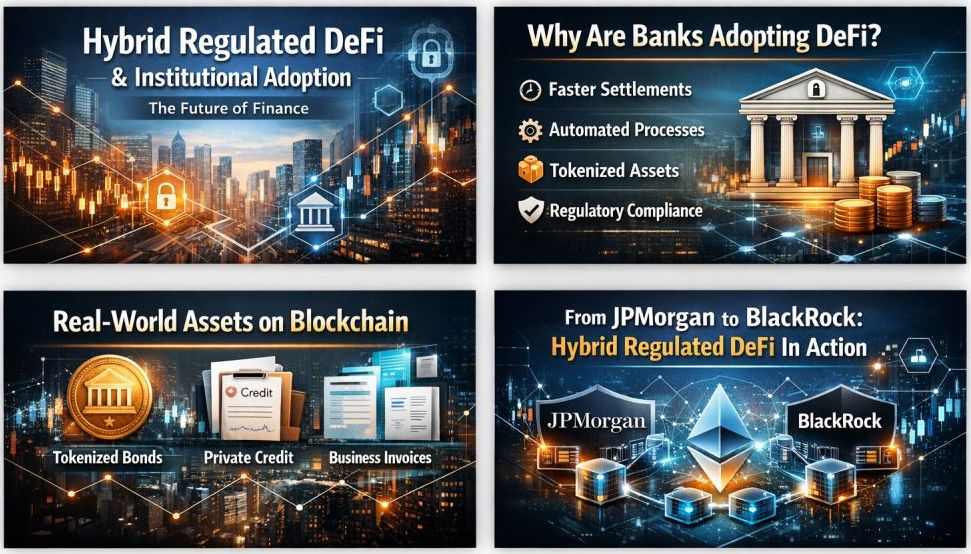
But things have changed. Many institutions are now quietly exploring a middle ground that combines the benefits of blockchain with regulatory compliance. This approach, known as hybrid regulated-DeFi, is becoming more important than many expected.
This isn’t just a buzzword or hype. It’s a real attempt to connect two fields that rarely overlapped before.
What Hybrid Regulated-DeFi Really Means
Here’s a simple way to explain it:
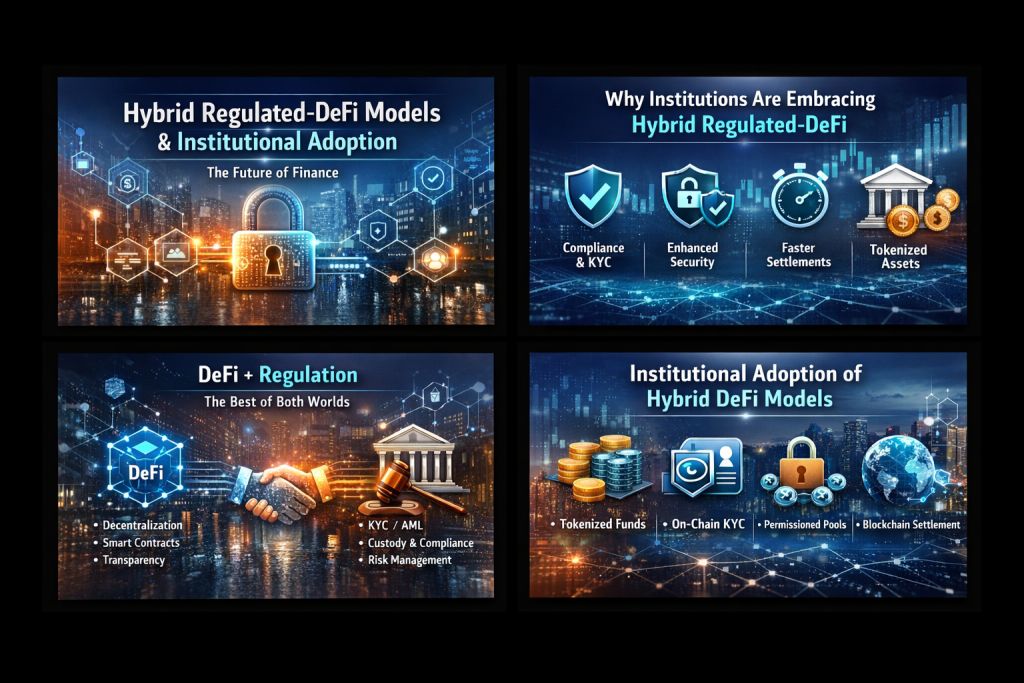
- DeFi acts as the engine, offering automation, transparency, and smart contracts.
- Regulations add seatbelts, bringing KYC and AML checks, legal clarity, and accountability.
Together, these parts create something neither side could achieve alone.
At first, it might sound complicated, but the main idea is simple:
- Use blockchain for what it does best, and rely on regulation for what it does best.
Why Institutions Stayed Away from Pure DeFi
Before the rise of hybrid systems, large institutions had good reasons to avoid DeFi. They weren’t just being cautious.
1. They couldn’t meet compliance rules.
A system that lets anyone join anonymously is the opposite of what banks need.
Banks need identity checks, reporting, and risk monitoring, but early DeFi didn’t provide these.
2. Hacks scared them.
When hundreds of millions disappeared from platforms like Poly Network or Wormhole, institutions felt their concerns were justified.
3. Regulations were unclear.
Each country had its own approach to crypto.
No major institution wants to work without clear rules.
The Turning Point
Things began to change when global regulators started taking digital assets seriously.
Some countries passed new laws. Others created frameworks for stablecoins. Banks began quietly testing tokenization behind the scenes.
Most importantly, the technology got better.
Audited smart contracts became more common. Permissioned blockchains have improved. Compliance tools moved onto the blockchain.
Even Deloitte reported that roughly three-quarters of financial institutions expect digital assets to significantly influence their businesses by 2030.
That’s more than curiosity. It’s preparation.
Hybrid DeFi models became the practical way forward.
What Hybrid DeFi Actually Fixes
1. It makes compliance automatic.
Smart contracts can enforce rules like wallet whitelisting or transaction screening without causing delays.
2. It provides a safety net.
Institutions can use blockchain features while staying within a regulated environment.
3. It reduces costs and time.
Traditional settlements can take days.
Hybrid DeFi can complete the same process in seconds.
4. It finally makes tokenization usable.
Real estate, bonds, and treasuries can’t be tokenized responsibly without regulations.
Hybrid models address this problem.
A Real Moment That Made This Click for Me
Recently, I attended a trial where a small private bank tested a hybrid DeFi system for issuing tokenized debt notes. There was clear skepticism in the room. Most people were there just to “observe,” not to be convinced.
But after the first few transactions, the mood in the room changed completely.
- Settlements that once took two days were completed in seconds.
- The compliance team could track everything in real time without having to search through spreadsheets.
- The operations team no longer had to handle paperwork.
Then a senior manager who had been openly skeptical said something that stayed with me:
- “If this is where finance is going, we’re late already.”
For the first time, I saw a genuine change in attitude, not just marketing talk.
How Institutions Are Using Hybrid DeFi Right Now
This isn’t just talk about the future. It’s already happening.
1. Tokenized money market funds
BlackRock, Franklin Templeton, and others have launched tokenized versions of traditional funds.
These funds still comply with regulations, but settlements now occur on blockchain rails.
2. Identity on-chain
Tools like Polygon ID and Civic Pass let institutions verify users without exposing private data.
3. Permissioned liquidity pools
Aave Arc allows institutions to join DeFi-style lending markets, but only after verification.
It’s DeFi, but with safeguards.
4. Blockchain settlement networks
J.P. Morgan’s Onyx platform and BIS pilot programs show that blockchain can handle tasks like:
- repo trades
- cross-border payments
- FX settlements
- custody movements
This isn’t just theory. These are real-world experiments.
Why Institutions Are Finally Comfortable
1. Smart contracts automate the boring stuff.
Compliance reporting, transaction monitoring, and settlement rules can all be programmed.
2. Transparency helps everyone.
Auditors, regulators, and institutions can see what’s happening in real time.
3. Liquidity becomes global.
Tokenized assets can move across borders with ease.
4. New products become possible.
Yield strategies, automated treasuries, and tokenized credit are all new to traditional finance.
What Still Needs Work
Even with all this progress, a few challenges remain:
- Not all blockchains work well together.
- Many teams inside institutions still don’t fully understand DeFi.
- Regulations aren’t aligned across countries.
But these issues are being addressed, and progress continues, even if slowly.
Where This Is Heading (A Realistic View)
From what I’ve seen, especially where institutions quietly test these systems, hybrid regulated-DeFi is likely to shape the next chapter of finance.
Pure DeFi isn’t going away.
But as banks, asset managers, and institutional investors move onto blockchain, they will almost certainly choose the hybrid route.
We’re moving toward a world where:
- assets move like email
- markets never close
- Compliance happens automatically
- Global liquidity pools form naturally
It’s a big change, but it’s happening gradually, not overnight.
Institutions that adapt early will be the leaders.
Final Words
Hybrid regulated-DeFi models aren’t just a compromise. They offer a practical way to support innovation while keeping the system under control.
After seeing these models tested in real settings, I believe they’re more than a passing trend. They represent a quiet shift inside institutions that once ignored DeFi.