Decentralised finance spent years on the periphery of mainstream finance, unable to break into the established system.
While developers and crypto traders embraced it, banks and asset managers largely kept their distance, viewing it as risky, unclear, and difficult to control.
This shift is underway as institutions reassess the landscape.
Recently, major financial institutions have begun to experiment with blockchain in meaningful ways. They are implementing real systems, allocating actual capital, and involving compliance teams.
Central to this shift is the emergence of hybrid regulated DeFi.
While meme coins may capture headlines, hybrid regulated DeFi quietly promises greater long-term significance.
What Hybrid Regulated DeFi Really Is
Hybrid DeFi, at its core, is a straightforward concept.
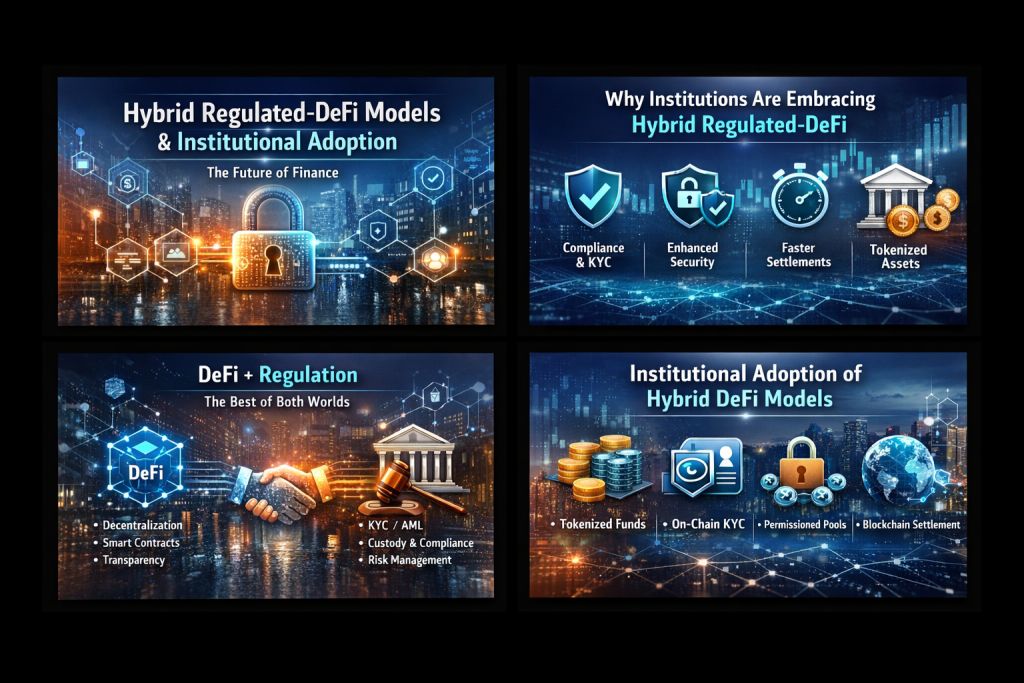
It combines the core mechanisms of decentralised finance, like smart contracts, blockchains, and automated settlements. It also adds institutional safeguards, such as identity verification, permissioned access, and regulatory oversight.
Instead of open platforms accessible to anyone, these are controlled environments where all participants are verified.
Think of it as decentralised finance under established rules.
This design closely aligns with institutional requirements.
Institutions are not aiming to disrupt; instead, their focus is on greater efficiency.
Why Banks Are Finally Paying Attention
Traditional finance still relies on outdated infrastructure. Settlements are slow. Intermediaries increase costs, reporting is delayed, and systems lack interoperability.
Hybrid DeFi offers something better:
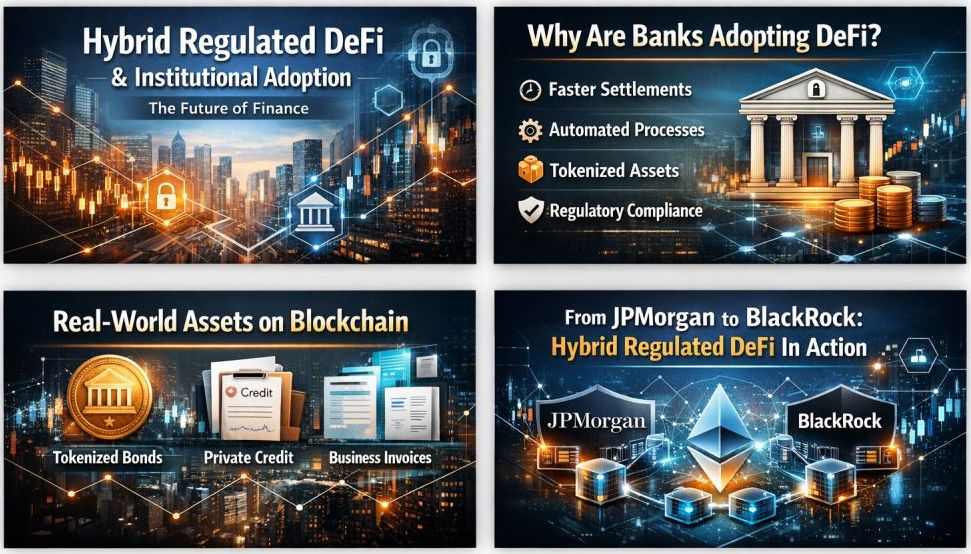
- Transactions settle almost instantly. Smart contracts automate processes that usually require manual intervention. Records are kept on shared ledgers rather than isolated databases.
- Compliance is built in, so institutions can explore blockchain while staying within legal boundaries.
For institutions, this combination holds strong appeal.
To illustrate, consider when a major bank used DeFi for liquidity—most notably, Société Générale.
Through its digital subsidiary, SG-FORGE, the bank issued bonds (debt securities) on Ethereum (a blockchain platform) and used them as collateral to borrow DAI (a crypto-backed stablecoin) from MakerDAO (a decentralised lending protocol).
This marked the first time a regulated European bank borrowed from a decentralised protocol.
Legal and compliance teams participated, ensuring the process was managed by smart contracts—hardly reckless experimentation.
The message was clear: DeFi can integrate with traditional finance rather than compete against it.
For many industry professionals, this provided the first substantial evidence that blockchain lending could operate at scale.
JPMorgan Builds Its Own Version of DeFi
JPMorgan adopted a more cautious approach.
Instead of using open DeFi platforms (public, permissionless blockchain protocols), its blockchain division partnered with Aave Arc (a permissioned version of the Aave lending protocol) to develop a system tailored for institutions.
All participants were verified. Every wallet underwent KYC, and compliance was integrated from the outset.
Within this framework, banks could lend and borrow tokenised assets through smart contracts.
This demonstrates hybrid DeFi in practice.
It offers automation with necessary safeguards.
BlackRock Brings Treasury Funds Onto Blockchain
BlackRock soon followed.
The world’s largest asset manager launched a tokenised Treasury fund on blockchain. This represented a significant turning point.
This was not a crypto-native product. It was a traditional money market fund backed by U.S. government securities and issued digitally.
Institutions could now hold regulated, yield-generating assets directly on the blockchain.
Hype and speculation were absent from this development.
Instead, the focus was on improved financial infrastructure.
Citibank Starts Putting Capital to Work
Another significant milestone occurred when Citibank reportedly allocated over $100 million to institutional DeFi lending pools.
Rather than public platforms, these were permissioned environments for regulated firms.
To earn yield while complying with AML requirements, Citibank used smart contracts.
This move provided one of the clearest signs of changing industry attitudes.
Banks were no longer merely researching DeFi.
They were actively deploying capital.
Real-World Assets Are Moving On-Chain
The trend extends beyond banks.
Protocols such as MakerDAO, Frax, Centrifuge, and Maple Finance now have billions of dollars in real-world assets. These include bonds, private credit, and business invoices.
These assets are tokenised and moved to the blockchain to generate returns.
Institutions already know these instruments. Hybrid DeFi provides faster settlement, greater transparency, and automated cash flows.
It is traditional finance operating on modern infrastructure.
Regulators Are Part of the Process
Singapore’s Project Guardian illustrates the direction of this trend.
Banks collaborated directly with regulators to test tokenised bonds and foreign exchange trading through compliant blockchain systems.
Ideology around decentralisation did not drive this initiative.
The focus was on efficiency.
Regulatory involvement from the outset is significant, indicating that hybrid finance is being developed collaboratively rather than imposed after the fact.
What All of This Adds Up To
By closely observing this sector, we reach a clear conclusion: hybrid regulated DeFi is now a practical reality.
It provides faster settlement, automated compliance, on-chain transparency, access to blockchain liquidity, and reduced operational friction.
I once heard a senior risk officer sum it up like this:
- “We’re not chasing crypto. We’re chasing efficiency.”
This mindset explains much of the current institutional interest.
Final Thoughts
Hybrid regulated DeFi does not seek to replace traditional finance.
Instead, it quietly upgrades existing systems.
By combining smart contracts with compliance, this model creates financial systems that are faster, more transparent, and globally connected, while adhering to institutional regulations.
This is driving increased adoption.
For this reason, hybrid DeFi is not simply another passing crypto trend.
It is becoming an integral part of modern financial infrastructure.