Neuroarchitecture and brain-responsive design
Picture a home that senses your stress before you do, or an office that adjusts its lighting as your focus wanes. Soon, buildings may learn from your brainwaves and respond instantly to your emotions.
This is the fast-evolving world of neuroarchitecture and brain-responsive design, an approach that integrates neuroscience, architecture, cognitive psychology, and adaptive technologies to create environments that enhance human wellbeing.
I first experienced this concept in 2023 at a design research lab in Bengaluru. Researchers placed an EEG band on my head and asked me to walk through a prototype room. As my stress level increased, the walls shifted to warm tones. When I focused, the ambience transitioned to a cool, balanced palette. The change was subtle but significant. The room was not just housing me; it was responding to me.
This experience highlighted for me how architecture is evolving to actively support our mental and emotional needs.
Today, neuroarchitecture is at the center of global design research. From cognitive-friendly workplaces to emotionally responsive homes and therapeutic hospitals, brain-based design is shaping the future of human environments.
In this article, we’ll explore:
- How spatial geometry affects cognitive load
- EEG-based design evaluation
- Architecture that adapts to human emotional states
- Real examples, personal experiences, and future predictions
- Keyword-enhanced insights for design professionals and enthusiasts
Let’s begin at the source: the brain.
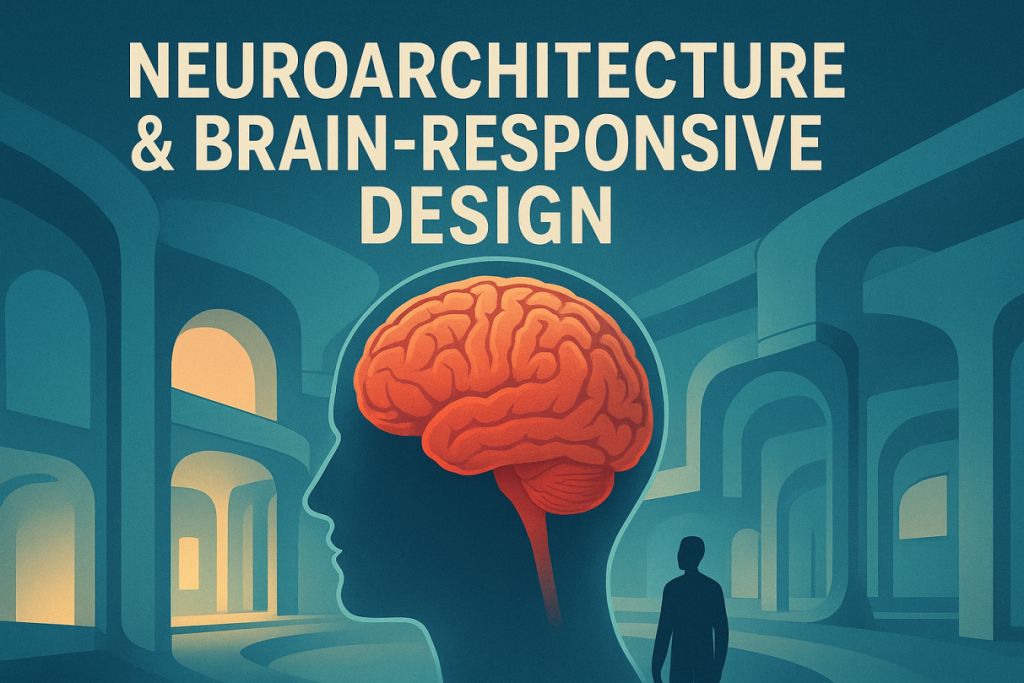
Why Neuroarchitecture Matters: How Buildings Affect the Human Brain
Modern neuroscience confirms that architecture affects mental health, emotional balance, focus, creativity, and cognitive load. Every space triggers neurological responses that influence:
- Stress levels and cortisol production
- Emotional regulation
- Attention and focus
- Memory and spatial navigation
- Perception of safety and comfort
- Social behavior and empathy
Neuroarchitecture has emerged in response to these findings.
Rather than focusing solely on aesthetics or structural efficiency, architects are now considering deeper questions:
- What does the human brain need from a space?
- How can design reduce cognitive fatigue?
- Can architecture influence emotional well-being?
- What environmental cues create healing environments?
This intersection of neuroscience and architecture is transforming the design of homes, offices, schools, hospitals, and cities.
How Spatial Geometry Affects Cognitive Load
Spatial geometry, including the shape, proportion, and flow of a space, plays a critical role in cognitive load. This area is well-researched in neuroarchitecture, with significant findings.
1. Curved Geometry Reduces Cognitive Stress
Studies show that curved walls, round edges, and organic shapes activate the brain’s reward centers and reduce amygdala activity (associated with fear and stress).
Curved environments promote a sense of safety and comfort.
As a result, museums, lounges, and high-end residential spaces increasingly adopt flowing geometries and biomorphic designs.
2. Sharp Angles Increase Alertness (But Can Overstimulate)
Rectilinear spaces stimulate the prefrontal cortex—boosting alertness, decision-making, and logic.
However, an excess of sharp angles can increase cognitive load, leading to subtle tension and fatigue.
This may explain why many traditional corporate offices are perceived as mentally draining.
3. Spatial Compression Heightens Vigilance
Low ceilings, narrow corridors, and tight spaces activate the brain’s navigation and threat-detection systems.
This is practical for:
- security areas
- transactional retail
- high-alert zones
However, this can be harmful in:
- schools
- hospitals
- workplaces
- homes
4. Open Plans Lower Stress—When Structured Properly
Open layouts can reduce stress and boost creativity if they include:
- visual anchors
- acoustic zoning
- structured micro-spaces
- balanced lighting
Yet, if open spaces lack enough structure, they may cause sensory overload.
My Experience With Spatial Geometry
During the Bengaluru experiment, I walked through two test corridors:
- One narrow, angular, dimly lit → my EEG showed spikes in cognitive load.
- One wider, curved, softly lit → my brainwaves showed calmness.
It was a simple demonstration, but the measurable difference was significant.
EEG-Based Design Evaluation: Measuring How Architecture Affects the Brain
A significant development in neuroarchitecture is EEG-based design evaluation. EEG (electroencephalography) measures electrical activity in the brain, enabling designers to observe how users respond to a space.
How EEG-Based Design Works
1. Participants wear lightweight EEG headbands.
2. They walk through real or virtual environments.
3. Brain data is collected:
- Alpha waves → relaxation
- Beta waves → focus
- Gamma waves → stress or cognitive overload
4. Designers analyze the neurological data.
5. The space is refined to match desired mental experiences.
This approach is used in:
- neuroresponsive homes
- cognitive-friendly offices
- healing-centric hospitals
- calming schools and learning environments
- mental health therapy spaces
A Moving Example
One of the most emotional demonstrations I witnessed took place in a children’s hospital room.
EEG results showed:
- reducing visual clutter
- using soft, non-invasive lighting
- incorporating gentle nature cues
- dramatically decreased anxiety-related gamma waves in children.
This was more than design; it was empathy achieved through scientific methods.
Architecture That Adapts to Human Emotional States
Emotion-responsive architecture represents the next stage of neuroarchitecture, where spaces dynamically change based on real-time biometric or behavioral data.
What Does Emotion-Adaptive Architecture Look Like?
A room or building may adjust:
- lighting color and intensity
- acoustic ambience
- wall projections and textures
- temperature
- scent diffusion
- window opacity
- furniture orientation
- interactive digital elements
Based on signals from:
- EEG sensors
- heart rate variability (HRV)
- motion and posture analysis
- thermal imaging
- environmental behavior tracking
- AI emotional models
Examples of Emotion-Responsive Architecture
1. Meditation Rooms That Detect Stress
Stress spikes → lights dim, sounds soften.
2. Workplaces That Sense Cognitive Fatigue
Focus drops → lighting shifts to cooler tones; noise levels are managed.
3. Homes That Adjust to Mood
Long day detected → warm lighting, slower ventilation rhythms, soft ambience.
4. Hospitals That Ease Patient Anxiety
Patient distress detected → rooms adapt to calming presets.
A Personal Prototype Experience
I once walked into an AI-driven “emotion corner.”
Wearing a biometric band, I stepped in—and instantly:
- warm amber light
- soft shifting textures
- low ambient music
enveloped the space.
The space appeared to recognize and respond to my need for comfort.
Neuroarchitecture in Modern Homes: Brain-Friendly Residential Design
Home design is becoming the biggest testing ground for neuroarchitecture.
Brain-friendly homes integrate:
- circadian lighting systems
- sensory-balanced interiors
- noise-dampening geometry
- biophilic materials
- adaptable ambient environments
- cognitive-friendly spatial layouts
- emotionally responsive smart systems
- neuroergonomic furniture
- mindful textures and color psychology
For example, gentle lighting can align with your circadian rhythm, or your home can detect mental fatigue and adjust for relaxation. These innovations are already being implemented.
The Future: Brain-Responsive Cities and Cognitive Urban Design
In the coming decades, brain-responsive cities will become a reality. Urban planners are exploring:
- stress-mapped pedestrian paths
- neuro-friendly public parks
- sensory-balanced transit hubs
- cognitive-light traffic and signage systems
- adaptive lighting in public spaces
- emotion-responsive cultural installations
- healing-oriented urban green corridors
Architecture will no longer be passive; it will become empathetic.
Conclusion: The Age of Empathetic, Brain-Centric Architecture Has Arrived
Neuroarchitecture and brain-responsive design shift architecture from a passive shelter to an active partner, designed to enhance our brains and wellbeing.
We are moving toward a world where architecture:
- listens
- adapts
- supports
- heals
- enhances cognition
- responds to emotion
- integrates human neuroscience
The future will prioritize environments that are not only functional but also deeply human-centered.
Having personally experienced a room responding to my mental state, I can state with confidence:
We are entering the era of empathetic architecture.