Many Americans view the United States Constitution as set out in stone, but it isn’t. The Constitution is a living document, and no amendment has transformed it more than the Fourteenth.
If you’re looking for the most transformative constitutional amendment, one that took a wrecking ball to the Constitution’s order, it is easy to point to the Fourteenth Amendment. It wasn’t just an amendment to laws; it was a redefinition of citizenship, rights and the relationship between government and the people.
Before we drill down, let’s first step back and consider why the Fourteenth Amendment matters so deeply, how it shapes your life every day and what lessons it offers us now.
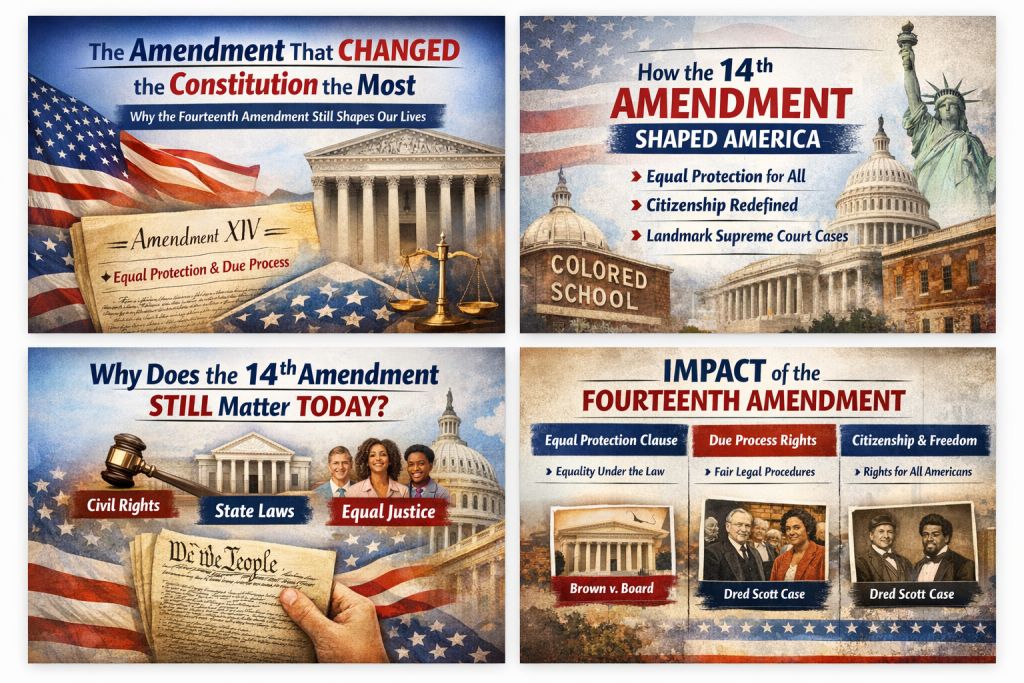
What Is the Fourteenth Amendment?
The Fourteenth Amendment — ratified in 1868, in the wake of the American Civil War — was designed to address what is arguably the most pressing question in American history: What rights would formerly enslaved people have?
At the core of it all, three unstoppable ideas became evident:
- Citizenship for anyone born or naturalised in the U.S.
- Equal protection under the law
- A win for due process rights that states must respect
These ideas might seem basic to us now, but they were revolutionary at the time.
Why This Amendment Changed Everything
It Redefined Citizenship
Citizenship had not, really, been defined in the Constitution before the Fourteenth Amendment. What we got were deeply unjust rulings like Dred Scott v. Sandford, which declared that Black Americans could not possibly be citizens of the United States.
The amendment overturned that logic.
Currently, if you are born in the U.S., you are a citizen — no exceptions. This principle lies at the heart of current discussions about immigration and identity.
It Gave Us “Equal Protection”—A Game Changer
“Equal protection of the laws” ranks among the strongest legal concepts ever deployed.
It became the foundation for:
- Civil rights movements
- Anti-discrimination laws
- Gender equality cases
A striking historic example of this is Brown v. Board of Education, in which the Fourteenth Amendment was used to outlaw racial segregation in education.
Many rights we have today was a result of this amendment.
It Extend Rights of the States
The Constitution originally limited the federal government, not individual states.
The Fourteenth Amendment changed that through the Due Process Clause. It was employed by courts over the years to apply fundamental rights in the Bill of Rights to the states.
This process is called “incorporation.”
Why it matters:
- Freedom of speech
- Freedom of religion
- Right to a fair trial
These rights are now protected from both federal and state governments under these protections.
Real-World Effects: Where We See This in Action Today
Let me make this practical.
Imagine:
- Discrimination: Example of a student who was discriminated against while at school
- A journalist challenging censorship
- A citizen protesting unfair laws
In each of these situations, the Fourteenth Amendment runs as a sort of background process.
I’ve seen conversations about online censorship and digital rights in which people blithely depend on protections that come from this amendment. This framework, the one that articulated equal protection, is often an underpinning to global conversations.
It’s not only history; it saves lives every day.
A Perspective That is Deeper Than Most Seem
Here’s something most blogs don’t even attempt to explain:
- The Fourteenth Amendment did not just enlarge rights — it redistributed power.
Before it:
- States had greater control over individual rights.
After it:
- The federal government was empowered to step in when states violated rights.
That change is what keeps the amendment at the center of legal debates today.
Challenges and Controversies
Every powerful law brings debate.
The Fourteenth Amendment has been interpreted in many different ways over the years. Courts have disagreed on:
- What “equal” really means
- How far “due process” goes
- Whether the same rights should be adapted and recognized differently
Even current issues like privacy, technology and digital free are interlaced with this amendment.
Comparing It to Other Amendments
To understand its significance, let us compare briefly:
- Only the first of ten Bill of Rights amendments to the United States Constitution
→ Guarantees speech, religion and the press
- XIII Amendment to the U. S. Constitution
→ Abolished slavery
Nineteenth Amendment, amendment (1920) to the Constitution of the United States that granted women the right to vote.
Each of these amendments matters, but the Fourteenth Amendment is a crucial bridge making many rights enforceable nationwide.
Why This Is Important to You (Even If You’re Not in the U.S.)
Some of you may be wondering: What do I care if I live overseas?
Because the Fourteenth Amendment influenced:
- Global human rights frameworks
- Democratic constitutions worldwide
- Law of fairness and equality
Countries around the globe look to its forward-thinking principles.
Lessons We Can Learn Today
Laws Must Evolve with Society
The Constitution didn’t start perfect. It improved through amendment.
Equality Requires Enforcement
Writing rights down isn’t enough; those rights need to be protected and enforced.
One Change Can Redefine Everything
The Fourteenth Amendment is an example of how one legal change can have far-reaching implications for society as a whole.
Final Thoughts
If you’re looking for the “most important constitutional amendment” or one that changed everything, here it is: the Fourteenth Amendment.
It was not just a list of new rules — it was the redefining of citizenship, what your rights are and how those rights should be protected.
And to do the latter, today, the spirit of this amendment lives on when courts adjudicate cases and people demonstrate against injustice or challenge laws.
So it’s not only historically significant but also contemporary and resonant.”