In the digital age, technological innovation is accelerating at an exponential rate. Advances such as materials that enable buildings to interact with their environment and the development of brain–cloud interfaces are transforming industries, economies, and daily life. This blog examines emerging technologies that are not only gaining attention but are also positioned to address global challenges, including climate adaptation, healthcare forecasting, immersive communication, and decentralized intelligence.
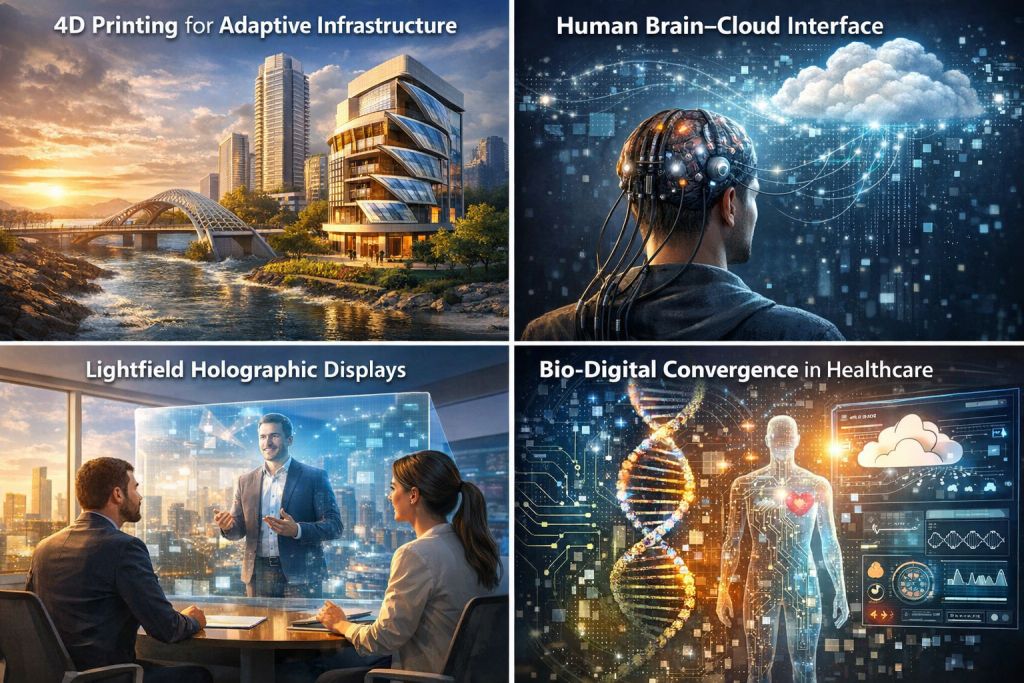
1. 4D Printing for Adaptive Infrastructure in Climate-Vulnerable Regions
4D printing offers the potential for cities to adapt automatically to climate change, rather than simply resisting its effects.
What is 4D Printing?
4D printing extends 3D printing by incorporating time as the fourth dimension, allowing structures to change shape or behavior in response to environmental triggers such as heat, humidity, or light. It uses programmable materials within smart systems, enabling objects to adapt to their surroundings.
Why It Matters for Climate-Adaptive Infrastructure
Climate change is increasing the frequency of droughts, heatwaves, floods, and unpredictable weather. Traditional infrastructure has not kept pace, but 4D-printed materials may offer solutions. For example:
- Adaptive facades in buildings that open or close based on temperature and humidity.
- Self-repairing structural elements that react to stress, reducing maintenance and extending lifespan.
- Weather-responsive shading systems that naturally cool urban spaces without AC, decreasing energy demand.
A practical example is the use of weather-responsive adaptive shading systems made from 4D-printed hygromorphic materials. These systems change shape in response to humidity and temperature, helping to reduce building emissions, improve comfort, and increase resilience.
Challenges & Road Ahead
However, widespread adoption will require:
- Scalable material production
- Updated building codes for dynamic systems
- Cost-effective manufacturing
- Interdisciplinary innovation across architects, engineers, and data scientists.
As research progresses, 4D printing is expected to advance from prototyping to resilient, city-scale solutions, particularly in climate-vulnerable regions.
2. Human Brain–Cloud Interfaces: Technical Feasibility & Ethical Implications
Human brain–cloud interfaces (BCIs) aim to directly connect human cognition with cloud storage and processing.
Scientific Progress
BCIs have traditionally referred to systems that decode brain signals to control external devices. Recent research is expanding this concept toward direct brain-to-cloud connectivity, where neural data could be processed and stored in real time by external computing systems. This development has the potential to transform education, memory augmentation, and neurological healthcare.
Scientific publications have outlined strategies using advanced nanorobotics to map or transmit neuron activity at high resolution, representing a theoretical step toward real-time connectivity between the brain and cloud computing platforms.
Ethical Reality Check
Before integrating human cognition with global networks, it is essential to address key ethical questions:
- Privacy & Cognitive Liberty: Could someone’s emotions, thoughts, or decisions be exposed or hacked?
- Consent & Agency: Who owns or controls neural data?
- Social Equity: Who benefits — and who is left behind?
International governance bodies are responding. UNESCO has recently adopted global ethical standards for neurotechnology to protect mental privacy and freedom of thought as these technologies develop.
Real-World Experience & Insight
At a neuroscience collaboration project I observed at a 2025 technology conference, participants expressed both enthusiasm and concern regarding BCIs. One neuroscientist envisioned ethical BCI systems enabling communication for locked-in syndrome patients, while another cautioned that regulatory frameworks are not keeping pace with innovation. This highlights the need for governance to advance alongside technology.
3. Lightfield Holographic Displays for Immersive Communication
Communication is advancing beyond video calls and flat screens. Lightfield holographic display technology provides true 3D visual communication without the need for glasses, enabling depth perception and dynamic interaction.
What Makes Lightfield Different
Unlike traditional 2D or VR/AR display systems, lightfield displays project multi-directional light that replicates how the eyes and brain perceive depth and perspective. This creates a sense of presence similar to a physical meeting, but in a virtual environment.
Research is improving the efficiency of holographic video transmission by using semantic communication techniques that transmit meaning rather than raw data, reducing bandwidth requirements while maintaining depth fidelity.
Applications Across Sectors
- Remote collaboration — virtual boardrooms where participants feel physically present.
- Medical training — students interacting with lifelike holographic anatomy.
- Holographic retail and advertising — products displayed in 3D before purchase.
- Entertainment — immersive concerts or storytelling experiences.
This technology bridges human presence and digital representation, indicating a future where digital and physical communication are seamlessly integrated.
4. Bio-Digital Convergence: Integrating Genetic Data with AI for Health Forecasting
Health is becoming predictive rather than solely reactive.
Bio-digital convergence is the integration of biological data, such as genetic profiles, wearable biosensors, and AI models to forecast health trends at both individual and population levels.
What This Convergence Enables
By combining AI models with genetic and biometric data, it is possible to:
- Predict susceptibility to chronic diseases years before onset.
- Personalize nutrition or treatment plans based on DNA.
- Detect infectious disease spread through integrated biosensor networks.
For example, a diabetic patient could receive a personalized forecast based on their DNA and lifestyle data, allowing for early adjustments to diet or medication before blood sugar levels rise. This represents the frontier of preventive healthcare, where AI enhances prediction and precision in medicine.
Credible Evidence
The integration of AI in life sciences is transforming diagnostics and treatment, shifting from assistive to precision-oriented models.
This convergence also raises ethical concerns regarding genetic privacy, data security, and equitable access, which must be addressed alongside technological innovation.
5. Edge AI vs. Cloud AI: Energy, Privacy & Performance Trade-offs
Cloud AI: Centralized Powerhouse
Cloud AI runs intensive computations in large data centers:
- Pros: Massive compute power, deep learning capabilities, and scalability.
- Cons: Higher latency, increased energy use from large data center operations, potential privacy vulnerabilities when personal data leaves local networks.
Edge AI: Local Intelligence at the Source
Edge AI processes data near its source, such as on smartphones, sensors, or hospital devices.
- Pros: Reduced latency (critical for real-time decisions), improved privacy since data doesn’t traverse to remote servers, and efficiency gains.
- Cons: Limited local compute power and sometimes higher upfront hardware costs.
In healthcare wearables or autonomous vehicles, edge AI can make immediate decisions, such as detecting a fall or initiating a safety maneuver, much faster than waiting for a cloud server response. Cloud AI, however, remains essential for complex analytics and global pattern recognition.
Energy & Privacy Considerations
As AI adoption increases, energy consumption rises. Cloud systems require significant power for training large models and cooling infrastructure. In contrast, edge AI distributes computational load, reducing the energy required for data transmission and central processing.
Privacy considerations are also complex. Edge computing minimizes data transmission, which is important for sensitive health or personal information, while cloud AI offers greater depth and scalability.
The Hybrid Future
The most effective systems will integrate both approaches: edge AI for rapid, private, context-aware decisions, and cloud AI for long-term learning, model training, and large-scale analytics.
Conclusion: Frontier Tech as Planetary Infrastructure
Emerging technologies are now foundational elements of 21st-century infrastructure. Adaptive buildings, neural interfaces, holographic communication, predictive health powered by AI and genetic data, and integrated edge and cloud AI are all reshaping how we live, work, and connect.
Realizing the full value of these technologies requires not only engineering excellence but also ethical governance, sustainable deployment, and equitable access.
As pioneers in this era, we must pursue innovation that enhances human strengths while protecting societal values. The future is not only about technology, but about building a better world with it.