The past presents complex challenges, and modern digital forensics has become a valuable tool for archaeologists. Techniques such as non-destructive elemental sampling, high-resolution 3D scanning, and machine-learning pattern detection are transforming how we authenticate artifacts, verify provenance, and identify forgeries. This post outlines these methods, demonstrates their practical applications, and highlights best practices for archaeologists, museum conservators, and collectors.
Why “digital forensics” matters in archaeology
Authenticity is essential for scholarship, ethics, and the art market. Misattributed artifacts can distort historical understanding, while forgeries may mislead research and support illicit activities. Traditional connoisseurship, such as visual inspection and stylistic comparison, remains valuable but is subjective and difficult to scale. Digital forensics provides objective, reproducible data, including elemental fingerprints from spectroscopy, microscopic surface signatures, and large reference datasets for algorithmic analysis. These techniques help answer three key questions quickly and non-destructively:
- What is this object made of? (material fingerprint)
- Does its surface/shape match known production methods? (micro-morphology)
- Is its documented provenance consistent with material and stylistic data? (cross-validation).
When applied carefully, machine learning accelerates these analyses and identifies anomalies that require expert review.
Core tools: what archaeologists are actually using
1. Portable XRF and spectroscopy (composition)
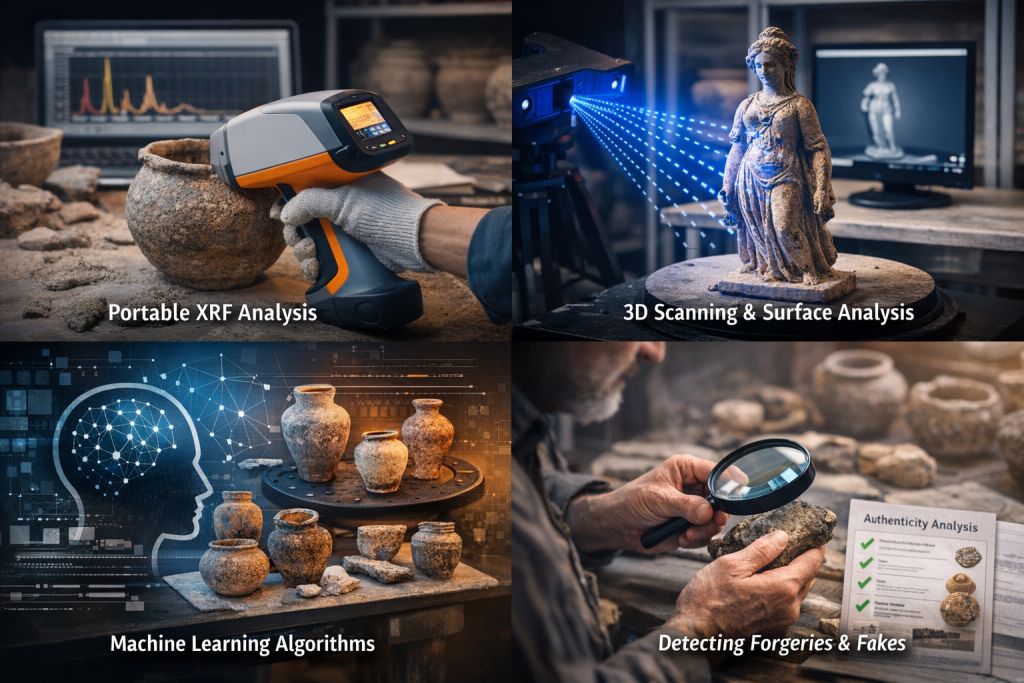
Portable X-ray fluorescence (pXRF) and Raman/IR spectroscopy allow conservators to analyze an object’s chemical signature without sampling. Elemental profiles can be grouped to suggest raw material sources, such as ceramic temper or copper alloys, and to identify modern contaminants or anachronistic elements. Handheld XRF offers advantages in speed and non-destructiveness, but calibration, matrix effects, and surface contamination require careful interpretation of results.
2. 3D scanning and micromorphology (shape + toolmarks)
High-resolution 3D laser or structured-light scanners capture surface geometry at sub-millimeter resolution. These scans can be analyzed using geometric morphometrics or pattern-matching algorithms to compare shapes, detect modern tool marks, or reconstruct missing parts. Museums and research teams increasingly use 3D models for both analysis and long-term digital curation.
3. Machine learning and pattern recognition
Supervised and unsupervised algorithms can classify pottery types, group chemical signatures, and detect outliers. For example, machine learning models trained on well-documented sherds can suggest likely origins of unknown objects or highlight stylistic anomalies that do not match the reference corpus. However, machine learning is only as reliable as its training data; biases, small sample sizes, and poor metadata can lead to false confidence if not addressed transparently.
Real cases and evidence (what the literature shows)
Recent reviews and studies document the rapid adoption of machine learning across archaeological tasks, from site detection to artifact classification, and emphasise the importance of proper methodology, including clear validation and open data. These reviews report significant, peer-reviewed improvements in accuracy when computational methods are combined with expert judgment.
XRF and compositional clustering have been used to link ceramics and metals to known production centers and, in forensic contexts, to reveal modern contaminants inconsistent with claimed antiquity. This combination has been critical for provenance and forgery investigations.
3D scanning projects, ranging from university labs to community archives, demonstrate how digital replicas enable repeated measurement and remote peer review, which is essential when physical access is limited. Initiatives such as Scan the World and museum digitization projects have made thousands of object scans publicly available for comparison.
Although forgers are increasingly sophisticated, they often fail to replicate microscopic production traces or the geochemical composition of ancient raw materials. Multi-modal digital forensics is effective in detecting these discrepancies.
A practical workflow—how to authenticate an object (step-by-step)
1. Document everything: high-res photos, acquisition history, and any paperwork. Metadata quality is critical.
2. Non-invasive scans first: 3D scan + multispectral photos to capture shape and surface pigments.
3. Elemental read: pXRF at multiple points, noting weathering and conservation layers. Use comparison databases where possible.
4. Algorithmic checks: run shape and composition through available ML classifiers or clustering tools to find statistical outliers.
5. Human expertise: conservators and specialists review flagged anomalies. If doubt remains, consider targeted laboratory analysis (e.g., petrographic analysis, radiocarbon dating).
6. Record & publish results: when appropriate, deposit scans and anonymised data to public repositories for future cross-checking.
This multi-step approach reduces false positives and negatives and establishes a defensible chain of evidence.
Pitfalls and ethical cautions
“Algorithmic certainty” is a misconception. Algorithms provide probabilities, not definitive judgments. Always combine computational results with specialist review.
Data bias and provenance gaps are significant concerns. Many training datasets under-represent non-Western collections, leading to misclassification. Invest in diverse, well-documented reference collections.
Chain of custody and legal considerations are critical. For artifacts with unclear provenance, authentication may have legal consequences, such as repatriation or seizure. Maintain thorough records.
Tools and resources (starter kit)
Hardware: handheld XRF (Bruker, Oxford), Artec/EinScan structured-light scanners for 3D capture.
Software: Artec Studio / MeshLab for 3D processing; Python libraries (scikit-learn, PyTorch) for custom ML pipelines; open platforms like Sketchfab/Scan the World for sharing.
Papers to read: Machine Learning Arrives in Archaeology(Cambridge) and Nature Scientific Reports on ML lithic sourcing for methodological examples.
Final thoughts — where this field is heading
Digital forensics in archaeology is evolving from pilot projects to robust, reproducible workflows. When interdisciplinary teams combine spectroscopy, 3D morphometrics, and machine learning, and when datasets and methods are openly shared, the community gains tools to protect cultural heritage, detect forgeries, and broaden scholarly inquiry. The future will focus less on replacing human expertise and more on enhancing it: algorithms will identify anomalies, and experts will interpret their significance.
If you are a conservator, researcher, or collector, begin building your digital footprint. Scan and sample responsibly, annotate thoroughly, and treat algorithms as investigative partners rather than definitive authorities. With high-quality data and transparent methods, digital forensics serves as a powerful tool for preserving the past.